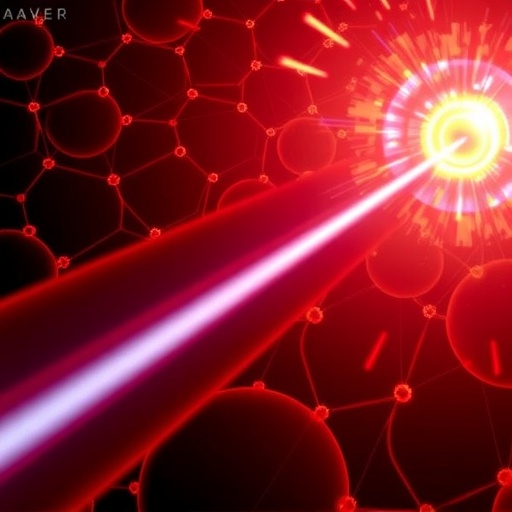
In the intricate realm of high-energy-density plasmas, a groundbreaking revelation has emerged, illuminating how rapidly expanding plasmas — quintessentially the intense, superheated states of matter crucial for fusion energy — spontaneously generate magnetic fields through mechanisms previously veiled in mystery. This discovery, the product of pioneering simulations conducted by an expert team, not only deepens our understanding of cosmic plasmas found naturally throughout the universe but also signifies a pivotal leap toward refining the direct-drive inertial fusion approach, promising a new horizon in sustainable fusion energy research.
At the core of direct-drive inertial fusion systems lies the utilization of potent laser pulses aimed directly at fuel capsules. These lasers compress and heat the capsule’s contents to such extremes that nuclear fusion reactions ignite, potentially releasing vast amounts of energy. However, unexpected magnetic fields have been repeatedly observed to arise during these processes, subtly yet profoundly altering how thermal energy diffuses through the plasma. Many current computational models, despite their sophistication, struggle to accurately predict these magnetic phenomena, posing significant challenges to reliably engineering fusion devices that deliver net positive energy output over time.
Laboratory experiments have persistently recorded the spontaneous emergence of formidable magnetic structures from plasmas vaporized by high-intensity lasers. When a laser strikes a solid target, it instantly transforms it into rapidly expanding plasma. While the presence of these magnetic fields had been empirically confirmed, their precise genesis remained an elusive puzzle. Recent simulations elucidate this enigma, demonstrating how plasma expansion alone, even under uniform laser irradiation, can instigate magnetic self-organization, thus reshaping our foundational models of plasma behavior in fusion contexts.
The phenomenon hinges on the interplay between plasma expansion dynamics and subtle temperature differentials within the expanding medium. As the laser-heated plasma rips away from the target surface, it cools unevenly — temperature drops more swiftly along the expansion trajectory compared to directions perpendicular to it. This anisotropic cooling generates a temperature imbalance, which fuels a well-known plasma instability named after Weibel. The Weibel instability acts as a catalyst to spontaneously ignite magnetic fields, provided certain conditions related to laser intensity and plasma density are met.
Delving deeper, simulations reveal a critical threshold of laser intensity beyond which this self-generation of magnetic fields becomes markedly pronounced. Above this threshold, expanding plasma self-magnetizes within a mere billionth of a second, birthing magnetic fields reaching strengths up to 40 tesla — an intensity roughly a million times stronger than Earth’s magnetic field. Below this activation point, collisional processes between plasma particles dominate, pushing the system back toward equilibrium and effectively suppressing magnetic field formation. This delicate tug-of-war underpins the threshold behavior observed in magnetization.
Kirill Lezhnin, lead author and research physicist at the U.S. Department of Energy’s Princeton Plasma Physics Laboratory (PPPL), emphasizes the uniqueness of this mechanism: “Even with uniform laser illumination, the expansion process alone suffices to generate magnetic fields within the plasma.” This finding overturns prior assumptions that irregularities or asymmetries in laser drive were prerequisites for magnetic field emergence. The implications are immense, as these magnetic fields can trap electrons in gyrations, profoundly suppressing thermal conduction away from the laser interaction region and thereby affecting plasma temperature profiles and stability.
Consequent simulations underscore the substantial influence these magnetic fields exert on plasma evolution. Not merely peripheral features, they alter core dynamics, modifying energy transport and temperature uniformity in ways that could decisively impact the success of fusion ignition campaigns. Accurately capturing this magnetic behavior in computational models is thus critical for the predictive design of future fusion experiments, offering a pathway to optimize laser parameters and target configurations for maximal energy yield.
Recognizing the practical necessity of broader utility, the research team distilled their complex findings into a simplified, predictive criterion that allows researchers to determine the likelihood of plasma magnetization given specific laser intensities and target characteristics. This threshold model demystifies the onset of magnetic field generation, enabling experimental physicists and simulation teams alike to incorporate magnetic effects into their analyses with newfound confidence and precision.
Remarkably, the derived magnetization threshold aligns closely with typical laser intensities employed in contemporary inertial fusion experiments, underscoring the high relevance of these magnetic phenomena to mainstream fusion research. This convergence signals that many current experiments, previously modeled without accounting for self-generated magnetic fields, might need reinterpretation or recalibration in light of these insights, which could help resolve longstanding discrepancies between theory and observation.
This multidisciplinary investigative effort brought together expertise from leading institutions including Princeton University, the University of Kansas, the Massachusetts Institute of Technology, and the University of Maryland, alongside PPPL’s cadre of plasma physicists. Their collaborative synergy harnessed state-of-the-art simulation techniques and substantial computational resources provided by Princeton Research Computing, highlighting the importance of computational power in unraveling plasma physics conundrums.
Funding from the U.S. Department of Energy underpins this landmark research, alongside grants from the National Science Foundation supporting key contributors. The robust financial and institutional backing enabled an intensive study blending theoretical physics, computational modeling, and practical fusion energy relevance — a model for future large-scale plasma science endeavors.
Beyond fusion energy, these insights into expansion-driven self-magnetization open new avenues in astrophysical plasma research, where large-scale plasma expansions govern phenomena such as solar flares, supernova remnants, and cosmic jet formations. Understanding the magnetic self-generation mechanism in these exotic contexts could unravel the magnetic mysteries of the cosmos and inform new astrophysical models.
In conclusion, this study reshapes our fundamental comprehension of plasma behavior under extreme conditions. By revealing how and when expanding plasmas spontaneously produce magnetic fields, it delivers a critical missing piece to the fusion puzzle, enabling more accurate simulations and experimental designs. As researchers continue refining these models, the dream of harnessing fusion energy as a clean, abundant power source inches closer to reality.
Subject of Research: Fusion Energy, Plasma Physics, Magnetic Field Generation in High-Energy-Density Plasmas
Article Title: Expansion-Driven Self-Magnetization of High-Energy-Density Plasmas
News Publication Date: 20-Mar-2026
Web References: DOI: 10.1103/stmq-c433
References: Published in Physical Review Letters
Image Credits: Kyle Palmer / PPPL Communications Department
Keywords
Fusion Energy, Plasma Magnetization, Weibel Instability, High-Energy-Density Plasma, Direct-Drive Inertial Fusion, Magnetic Fields, Plasma Simulations, Laser-Plasma Interaction, Heat Transport Suppression, Nuclear Fusion, Plasma Physics, Magnetic Self-Organization
Tags: breakthroughs in fusion science simulationschallenges in fusion energy device engineeringcomputational modeling of fusion plasma magnetizationcosmic plasma magnetic field analoguesdirect-drive inertial fusion mechanismshigh-energy-density plasma physicslaboratory experiments on laser-plasma interactionslaser pulse compression of fusion fuellaser-driven fusion plasmasmagnetic effects on thermal energy diffusionspontaneous magnetic field generation in plasmassustainable nuclear fusion energy research