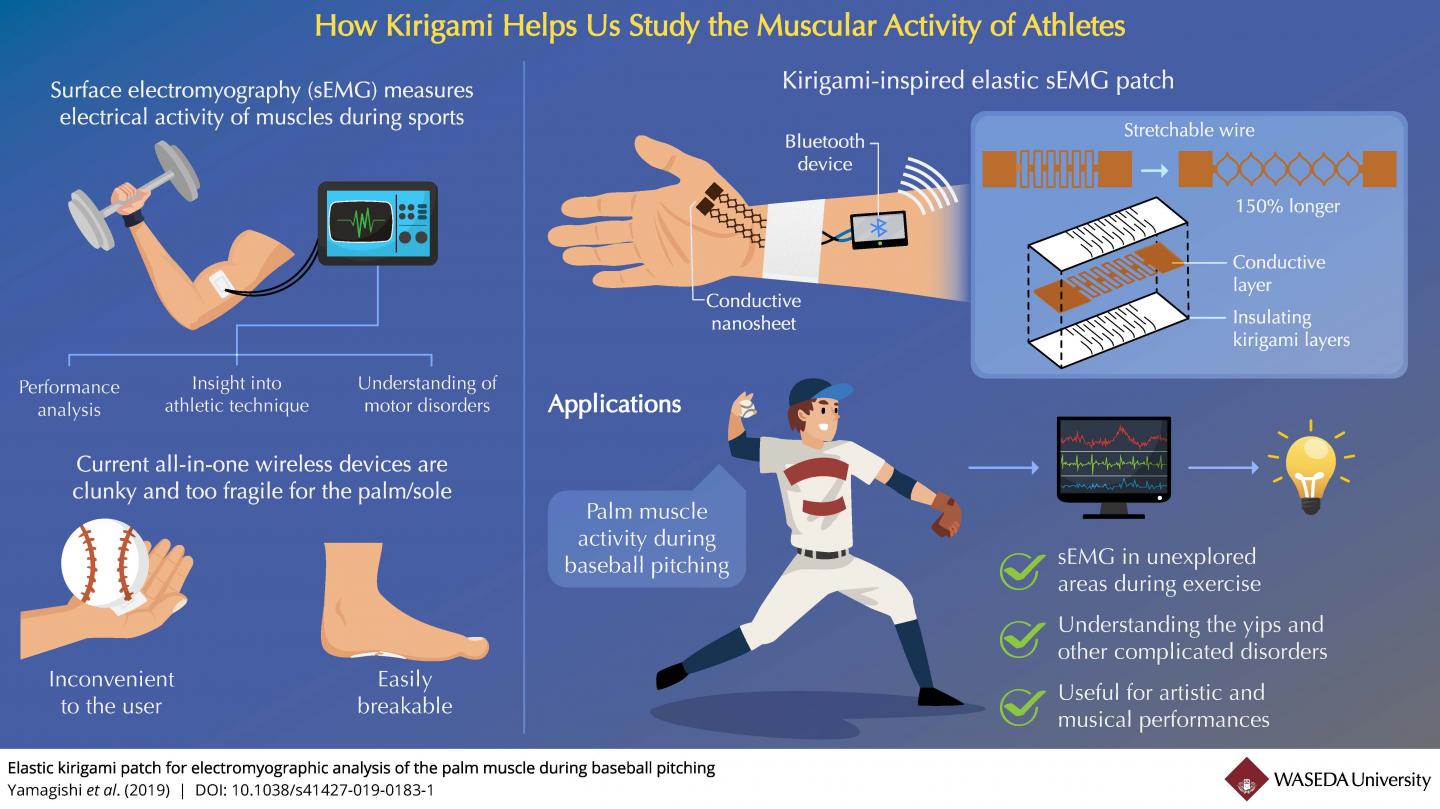
Credit: Waseda University
The upcoming Tokyo Olympic and Paralympic Games in 2020 represent a big opportunity for governments to promote a healthy lifestyle and sports, and the turn of the decade is a great opportunity to showcase how recent technological developments can be used to help us understand human motion during sports. In this regard, the combination of high-speed cameras and surface electromyographic sensors, which record the electromyographic activity of palm muscles, has been employed to obtain a better understanding on the fine control athletes and sportspeople exert on their palm muscles.
However, conventional devices for surface electromyography employ small electrodes that are attached to the skin and wires, which restrict free movement. All-in-one modules containing electrodes, amplifiers, and wireless transmitters help to solve this issue only to some extent; these modules are not suitable for certain parts of the body, like the palms or soles. During pitching in baseball, for example, the ball is in direct contact with palm muscles, and integrated modules cannot be employed without being a nuisance to the user. Even if skin-like electrodes were used, the high forces and friction involved would break them apart. This has limited electromyographic studies to other parts of the arms and legs.
To address this problem, a joint research team from Waseda University and Kitasato University, Japan drew inspiration from a traditional Japanese artform called kirigami, to prepare a durable skin-like patch for measuring the electromyographic activity of palm muscles, and have published their findings in NPG Asia Materials. Unlike the better-known origami, kirigami crafts contain both paper folds and cuts. Interestingly, it is possible to employ kirigami technique to create ultrathin insulated conductive sheets that are also largely bendable and stretchable. “By cutting a conductive sheet in a special kirigami pattern and sealing it with silicone rubber, we have managed to create elastic and insulated wirings that minimized the mechanical mismatch between skin and device during exercise,” reports Dr. Kento Yamagishi from Waseda University (Currently, Singapore University of Technology and Design), the lead author of the paper. These wires were combined with another of their previous inventions – conductive nanosheets that can be used on the palm or soles without problems.
These two devices together form an elastic kirigami patch that can capture electromyographic signals in difficult areas and carry them to a Bluetooth device placed in a less-obtrusive zone, such as the forearm. The research team tested their invention by measuring electromyographic signals from one of the palm muscles of an experienced baseball player when throwing curveballs and fastballs, finding significant differences between both types of throw. “Our elastic kirigami patch will serve as a minimally perceivable device to investigate the activity of the palm muscles of athletes without interfering with their performance,” remarks Assist. Prof. Tomoyuki Nagmi of Kitasato University. “This surface electromyographic measurement system will enable the analysis of motion in unexplored palm muscle areas, leading to a better understanding of muscular activity in a wide range of sports and even artistic or musical performances,” Assoc. Prof. Toshinori Fujie of Waseda University (Currently, Tokyo Institute of Technology), who led the research, concludes. There are also potential applications in medical research for currently unexplainable motor disorders, such as the yips. It is clear that a better understanding of our own bodies during exercise could help us perform better and lead a healthier lifestyle.
###
Reference
Title of original article: Elastic kirigami patch for electromyographic analysis of the palm muscle during baseball pitching
Authors: Kento Yamagishi, Takenori Nakanishi, Sho Mihara, Masaru Azuma, Shinji Takeoka, Kazuyuki Kanosue, Tomoyuki Nagami & Toshinori Fujie
DOI: 10.1038/s41427-019-0183-1
Journal: NPG Asia Materials
Media Contact
Jasper Lam
[email protected]
Original Source
https:/
Related Journal Article
http://dx.