These inexpensive photosensitizers could make solar power and chemical manufacturing more efficient; experiments at SLAC offer insight into how they work
Credit: Greg Stewart/SLAC National Accelerator Laboratory
Photosensitizers are molecules that absorb sunlight and pass that energy along to generate electricity or drive chemical reactions. They’re generally based on rare, expensive metals; so the discovery that iron carbenes, with plain old iron at their cores, can do this, too, triggered a wave of research over the past few years. But while ever more efficient iron carbenes are being discovered, scientists need to understand exactly how these molecules work at an atomic level in order to engineer them for top performance.
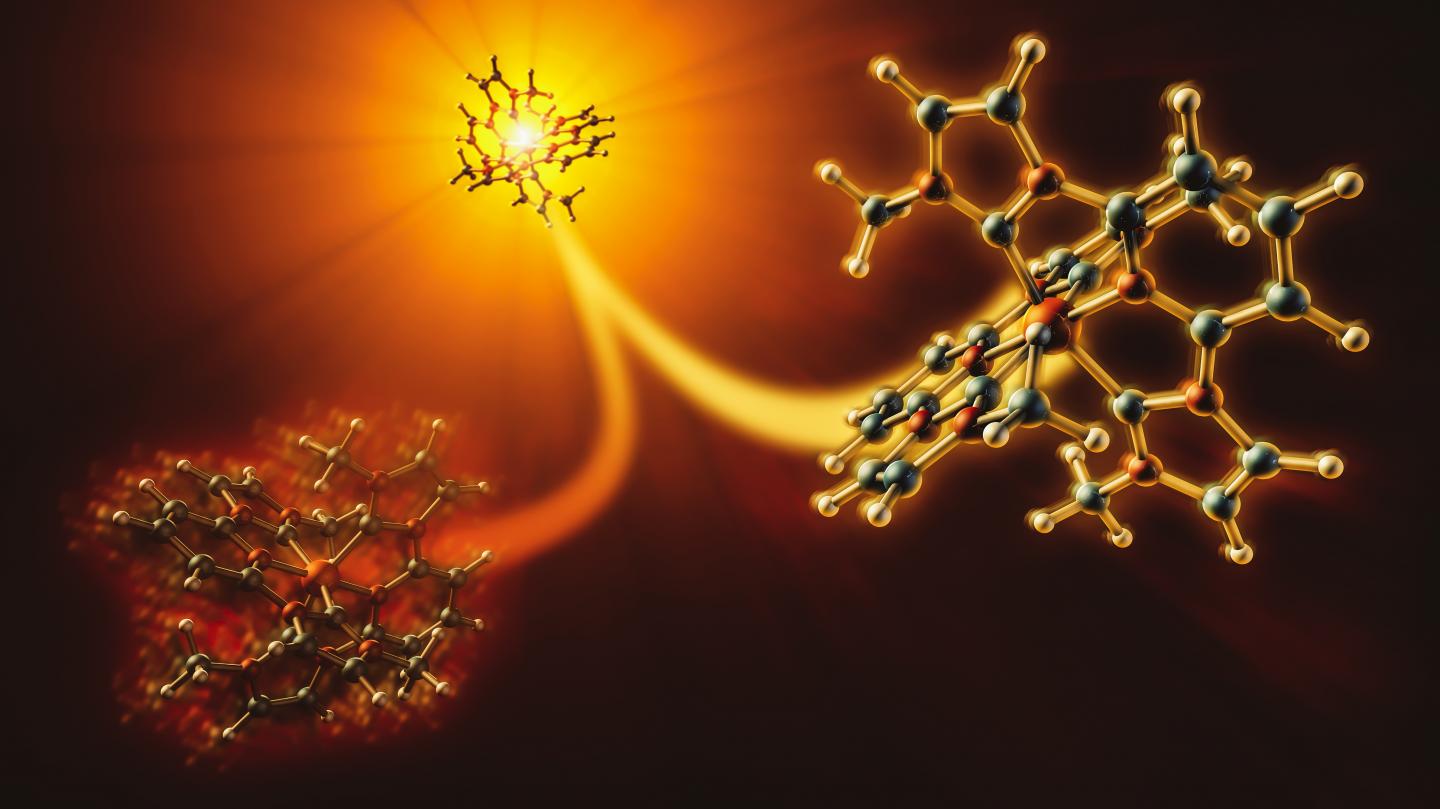
Now researchers have used an X-ray laser at the Department of Energy’s SLAC National Accelerator Laboratory to watch what happens when light hits an iron carbene. They discovered that it can respond in two competing ways, only one of which allows electrons to flow into the devices or reactions where they’re needed. In this case, the molecule took the energy-producing path about 60% of the time. The team published their results January 31 in Nature Communications.
In a solar cell, an iron carbene attaches to the semiconductor film on the surface of the cell with its iron atom sticking up. Sunlight hits the iron atom and liberates electrons, which flow into the carbene attachments. If they remain on those attachments long enough – 10 trillionths of a second or more – they can then move into the solar cell and boost its efficiency. In chemistry, the energy boost that photosensitizers provide helps drive chemical reactions, but requires even longer residence times for the electrons on the carbene attachments.
To pin down how this works, an international team led by researchers from the Stanford PULSE Institute at SLAC examined samples of iron carbene with X-ray laser pulses from the lab’s Linac Coherent Light Source (LCLS). They simultaneously measured two separate signals that reveal how the molecule’s atomic nuclei move and how its electrons travel in and out of the iron-carbene bonds.
The results showed that electrons were stored in the carbene attachments long enough to do useful work about 60% of the time; the rest of the time they returned to the iron atom too soon, accomplishing nothing.
PULSE’s Kelly Gaffney said the long-term goal of this research is to get close to 100 percent of the electrons to stay on carbenes much longer, so the energy from light can be used to drive chemical reactions. To do that, scientists need to find design principles for tailoring iron carbene molecules to carry out particular jobs with maximum efficiency.
###
PULSE postdoctoral researcher Kristjan Kunnus led the analysis for this study, which was carried out at LCLS and at SLAC’s Stanford Synchrotron Radiation Lightsource (SSRL), both DOE Office of Science user facilities. Researchers from Lund University in Sweden prepared the samples for analysis, and scientists from Uppsala University in Sweden, Technical University of Denmark, Copenhagen University, Wigner Research Centre for Physics and ELI-ALPS, ELI-HU Non-Profit Ltd. in Hungary, and Deutsches Elektronen-Synchrotron (DESY) in Germany also contributed to the research. Major funding came from the DOE Office of Science.
Citation: Kristjan Kunnus et al., Nature Communications, 31 January 2020 (10.1038/s41467-020-14468-w)
SLAC is a vibrant multiprogram laboratory that explores how the universe works at the biggest, smallest and fastest scales and invents powerful tools used by scientists around the globe. With research spanning particle physics, astrophysics and cosmology, materials, chemistry, bio- and energy sciences and scientific computing, we help solve real-world problems and advance the interests of the nation.
SLAC is operated by Stanford University for the U.S. Department of Energy’s Office of Science. The Office of Science is the single largest supporter of basic research in the physical sciences in the United States and is working to address some of the most pressing challenges of our time.
Media Contact
Glennda Chui
[email protected]
510-507-2766
Original Source
https:/
Related Journal Article
http://dx.