• HOME
  • NEWS
  • EXPLORE
    • CAREER
      • Companies
      • Jobs
    • EVENTS
    • iGEM
      • News
      • Team
    • PHOTOS
    • VIDEO
    • WIKI
  • BLOG
  • COMMUNITY
    • FACEBOOK
    • INSTAGRAM
    • TWITTER
Sunday, February 8, 2026
BIOENGINEER.ORG
No Result
View All Result
  • Login
  • HOME
  • NEWS
  • EXPLORE
    • CAREER
      • Companies
      • Jobs
        • Lecturer
        • PhD Studentship
        • Postdoc
        • Research Assistant
    • EVENTS
    • iGEM
      • News
      • Team
    • PHOTOS
    • VIDEO
    • WIKI
  • BLOG
  • COMMUNITY
    • FACEBOOK
    • INSTAGRAM
    • TWITTER
  • HOME
  • NEWS
  • EXPLORE
    • CAREER
      • Companies
      • Jobs
        • Lecturer
        • PhD Studentship
        • Postdoc
        • Research Assistant
    • EVENTS
    • iGEM
      • News
      • Team
    • PHOTOS
    • VIDEO
    • WIKI
  • BLOG
  • COMMUNITY
    • FACEBOOK
    • INSTAGRAM
    • TWITTER
No Result
View All Result
Bioengineer.org
No Result
View All Result
Home NEWS Science News

How insects activate muscles to adapt to limbs removed

Bioengineer by Bioengineer
January 14, 2021
in Science News
Reading Time: 2 mins read
0
IMAGE
Share on FacebookShare on TwitterShare on LinkedinShare on RedditShare on Telegram

IMAGE

Credit: Dai Owaki and Hitoshi Aonuma

Adaptability explains why insects spread so widely and why they are the most abundant animal group on earth. Insects exhibit resilient and flexible locomotion, even with drastic changes in their body structure such as losing a limb.

A research group now understands more about adaptive locomotion in insects and the mechanisms underpinning it. This knowledge not only reveals intriguing information about the biology of the insects, but it can also help to design more robust and resilient multi-legged robots that are able to adapt to similar physical damage.

The insect nervous system is comprised of approximately 105 to 106 neurons. Understanding the process behind this requires researchers to consider the role of the intrinsic neural circuits that influence the adaptions of insects under unfavorable circumstances and the sensory feedback mechanisms reflected in their body characteristics and physical interactions with the environment.

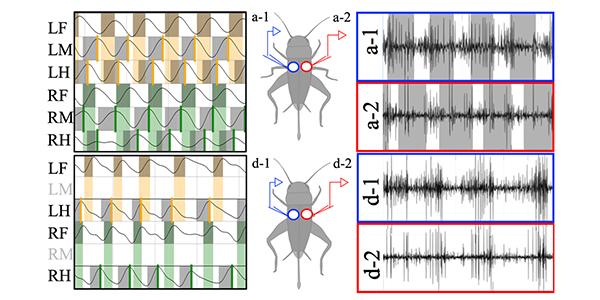
A research group comprising associate professor Dai Owaki from Tohoku University’s Department of Robotics at the Graduate School of Engineering and associate professor Hitoshi Aonuma from the research institute of electronic science at Hokkaido University simultaneously recorded the leg movements and muscle activation of crickets, both before and after middle leg amputation.

Their findings showed that the walking manner of crickets shifted from a tetrapod/tripod gait to a four-legged trot after the middle leg had been removed.

Electromyogram (EMG) analysis of the muscles at the base of the middle leg revealed that the muscles were active in opposite phases when walking. Activation timing of the middle leg muscles synchronized in phase when both legs had been removed, whereas the activation timing showed anti-phase synchronization for crickets with all of their legs.

The findings demonstrated two things. First, an intrinsic contralateral connection exists within the mesothoracic ganglion, which generates in-phase synchronization of muscle activation. Second, mechanoreceptive informational feedback from the campaniform seensilla of the legs overrides the centrally generated patterns, resulting in the anti-phase leg movements of a normal gait.

“Our results will pave the way for the further understand of the leg coordination mechanism in insect locomotion,” said professor Dai Owaki. “It may also aid design principles for a decentralized controller that enables flexible and adaptive walking in an insect-like-six-legged robot.”

###

Media Contact
Dai Owaki
[email protected]

Related Journal Article

http://dx.doi.org/10.1038/s41598-020-79319-6

Tags: BiologyTechnology/Engineering/Computer Science
Share12Tweet8Share2ShareShareShare2

Related Posts

Group Therapy Boosts Recovery in Elderly Depression

February 8, 2026

Evaluating Biosimilar Trastuzumab for Breast Cancer in Thailand

February 8, 2026

Decoding Phantom Limb Movements via Intraneural Signals

February 8, 2026

Attitudes Toward Aging Impact Early Nursing Home Quality

February 8, 2026
Please login to join discussion

POPULAR NEWS

  • Robotic Ureteral Reconstruction: A Novel Approach

    Robotic Ureteral Reconstruction: A Novel Approach

    82 shares
    Share 33 Tweet 21
  • Digital Privacy: Health Data Control in Incarceration

    63 shares
    Share 25 Tweet 16
  • Breakthrough in RNA Research Accelerates Medical Innovations Timeline

    53 shares
    Share 21 Tweet 13
  • Mapping Tertiary Lymphoid Structures for Kidney Cancer Biomarkers

    50 shares
    Share 20 Tweet 13

About

We bring you the latest biotechnology news from best research centers and universities around the world. Check our website.

Follow us

Recent News

Group Therapy Boosts Recovery in Elderly Depression

Evaluating Biosimilar Trastuzumab for Breast Cancer in Thailand

Decoding Phantom Limb Movements via Intraneural Signals

Subscribe to Blog via Email

Success! An email was just sent to confirm your subscription. Please find the email now and click 'Confirm' to start subscribing.

Join 74 other subscribers
  • Contact Us

Bioengineer.org © Copyright 2023 All Rights Reserved.

Welcome Back!

Login to your account below

Forgotten Password?

Retrieve your password

Please enter your username or email address to reset your password.

Log In
No Result
View All Result
  • Homepages
    • Home Page 1
    • Home Page 2
  • News
  • National
  • Business
  • Health
  • Lifestyle
  • Science

Bioengineer.org © Copyright 2023 All Rights Reserved.