• HOME
  • NEWS
  • EXPLORE
    • CAREER
      • Companies
      • Jobs
    • EVENTS
    • iGEM
      • News
      • Team
    • PHOTOS
    • VIDEO
    • WIKI
  • BLOG
  • COMMUNITY
    • FACEBOOK
    • INSTAGRAM
    • TWITTER
Sunday, June 28, 2026
BIOENGINEER.ORG
No Result
View All Result
  • Login
  • HOME
  • NEWS
  • EXPLORE
    • CAREER
      • Companies
      • Jobs
        • Lecturer
        • PhD Studentship
        • Postdoc
        • Research Assistant
    • EVENTS
    • iGEM
      • News
      • Team
    • PHOTOS
    • VIDEO
    • WIKI
  • BLOG
  • COMMUNITY
    • FACEBOOK
    • INSTAGRAM
    • TWITTER
  • HOME
  • NEWS
  • EXPLORE
    • CAREER
      • Companies
      • Jobs
        • Lecturer
        • PhD Studentship
        • Postdoc
        • Research Assistant
    • EVENTS
    • iGEM
      • News
      • Team
    • PHOTOS
    • VIDEO
    • WIKI
  • BLOG
  • COMMUNITY
    • FACEBOOK
    • INSTAGRAM
    • TWITTER
No Result
View All Result
Bioengineer.org
No Result
View All Result
Home NEWS Science News Biology

How high-fat diets allow cancer cells to go unnoticed

Bioengineer by Bioengineer
September 28, 2021
in Biology
Reading Time: 2 mins read
0
Mouse Small Intestine
Share on FacebookShare on TwitterShare on LinkedinShare on RedditShare on Telegram

A high-fat diet increases the incidence of colorectal cancer. Cold Spring Harbor Laboratory Fellow Semir Beyaz and collaborators from Harvard Medical School and Massachusetts Institute of Technology have discovered that in mice, fat disrupts the relationship between intestinal cells and the immune cells that patrol them looking for emerging tumors. Reconfiguring the gut microbiome may be a way to heal the relationship.
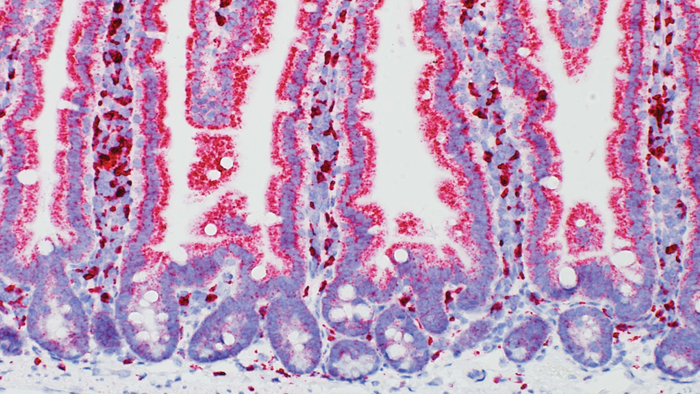
Mouse Small Intestine

Credit: Beyaz lab/CSHL, 2021

A high-fat diet increases the incidence of colorectal cancer. Cold Spring Harbor Laboratory Fellow Semir Beyaz and collaborators from Harvard Medical School and Massachusetts Institute of Technology have discovered that in mice, fat disrupts the relationship between intestinal cells and the immune cells that patrol them looking for emerging tumors. Reconfiguring the gut microbiome may be a way to heal the relationship.


The immune system patrols tissues looking for and eliminating threats. Certain immune cells look for tags that distinguish between normal and abnormal cells. One tag, called MHC-II, helps target cells for destruction. Cell-surface MHC-II activates the immune system to destroy that cell, whether it is just worn out or about to become cancerous. Beyaz and his colleagues found that when mice ate diets high in fat, MHC-II levels were suppressed in intestinal cells. Cells with reduced levels of these tags were not recognized as abnormal and thus could grow into tumors. Charlie Chung, a Stony Brook University graduate student-in-residence in Beyaz’s lab, says, “If we alter the level of these immune recognition molecules in a positive way, then the tumor will more likely be recognized by the immune cell. We hope this can be coupled with the existing strategies, such as immunotherapy, to eradicate tumors.”

The researchers found that a high-fat diet changed the mouse’s intestinal microbiome (the mixture of microbes in the gut). Several bacteria, including ones called Helicobacter, increase MHC-II, which may help immune cells locate abnormal cells. The team did a “dirty roommate” experiment where mice without these bacteria were housed with ones that had it. The “clean” mice became infected with the Helicobacter bacteria and produced more of the MHC-II tag.

The scientists’ findings suggest a new way to boost current immunotherapy treatments against cancer. Increasing the production of this MHC-II tag, either by diet, drugs, or changing the microbes in the body, can help the immune system recognize and eliminate cancer cells. Beyaz says:

“This interaction between diet, microbes, and immune recognition has the potential to help us explain how lifestyle factors can contribute to tumor initiation, progression, or response to therapy.”

Cancer cells use many tricks to avoid being recognized as abnormal by the immune system, but Beyaz hopes he’s found several ways to outwit them.


Journal

Cell Stem Cell

DOI

10.1016/j.stem.2021.08.007

Article Title

Dietary suppression of MHC class II expression in intestinal epithelial cells enhances intestinal tumorigenesis

Article Publication Date

15-Sep-2021

Share12Tweet8Share2ShareShareShare2

Related Posts

Natural Hallucinogens: Evolution’s Ecological Tools, Not Mere Chemical Byproducts

June 25, 2026

This Famous Butterfly Revealed: Three Distinct Species Hidden in One

June 25, 2026

Scientists Attack Soybean Cyst Nematode by Starving Its Food Source

June 25, 2026

Decoding the Secret Code of a Crucial Immune Sensor

June 24, 2026

POPULAR NEWS

  • Saying Goodbye to PGY-6: Pediatric Fellowship Realities

    103 shares
    Share 41 Tweet 26
  • Multi-Hospital Study Reveals Long Covid Burden Is Twice as High as Current Estimates

    92 shares
    Share 36 Tweet 23
  • Detection of EDCs in Breast Milk and Infant Urine Up to Six Months Highlights Early Exposure Risks

    77 shares
    Share 31 Tweet 19
  • New Drug Candidate Developed at McMaster Shows Potential for Treating Brain Cancer

    58 shares
    Share 23 Tweet 15

About

We bring you the latest biotechnology news from best research centers and universities around the world. Check our website.

Follow us

Recent News

Tracking Lanthanide-Labeled Microplastics in Plants

POSTECH Researchers Slash Cost of Reconstituted Cell-Free Systems by 95%

AI and Physics Collaborate to Design Advanced Hydrogen Storage Materials

Subscribe to Blog via Email

Success! An email was just sent to confirm your subscription. Please find the email now and click 'Confirm' to start subscribing.

Join 82 other subscribers
  • Contact Us

Bioengineer.org © Copyright 2023 All Rights Reserved.

Welcome Back!

Login to your account below

Forgotten Password?

Retrieve your password

Please enter your username or email address to reset your password.

Log In
No Result
View All Result
  • Homepages
    • Home Page 1
    • Home Page 2
  • News
  • National
  • Business
  • Health
  • Lifestyle
  • Science

Bioengineer.org © Copyright 2023 All Rights Reserved.