The study “Understanding atmospheric intercontinental dispersal of harmful microorganisms”* compiles the scope of the problem of the global dispersal of harmful microorganisms through the upper layers of the atmosphere.
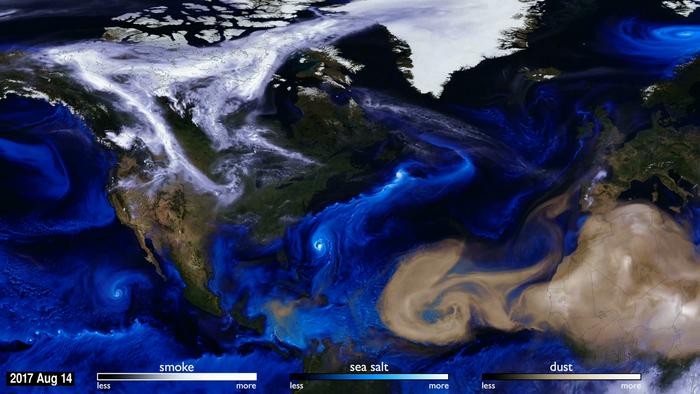
Credit: NASA
The study “Understanding atmospheric intercontinental dispersal of harmful microorganisms”* compiles the scope of the problem of the global dispersal of harmful microorganisms through the upper layers of the atmosphere.
It confirms that the atmosphere -specifically the free troposphere- acts as a highway for many microbes and emphasizes the mechanisms that facilitate it.
The work combines microbiology and the dynamics of the Earth system and emphasizes the importance of the intertropical convergence zone in the phenomenon. In this area, above and below the equator, there are strong updrafts of warm air and the winds from the northern and southern hemispheres meet. It is the key area for this massive dispersal of microorganisms through the atmosphere.
The process happens as follows: the strong ascending wind that occurs in this strip of the Earth sucks in large masses of aerosolized particles – mainly marine, fire and desert dust. Many microorganisms adhere to them and ascend to the free troposphere (their characteristics and adaptation mechanisms allow it). Once there, they can travel thousands of kilometers and disperse throughout the world. They can do it thanks to the constant and long-range air currents that converge in the upper layers of upper air and the massive injection that occurs in the intertropical zone.
The article also underlines that this natural phenomenon is being exacerbated by climate change and by other consequences of human intervention such as deforestation and the drying up of large wetlands. The increase in arid areas and deserts leads to a greater inhalation of dust and, therefore, also of microorganisms, including some pathogens. Likewise, climate change is altering the dynamics of global air currents (so decisive in this process); it can make them go where they didn’t go, changing the dynamics of ecosystems on a global scale.
In addition to clarifying the mechanisms of atmospheric dispersion, the study provides insight into the types of microorganisms that manage to travel in this way. They must be able to stick and lift, as well as withstand the extreme conditions of the upper atmosphere. And some have developed adaptive strategies that allow it. DNA analysis of these microscopic life forms has concluded that most of them are innocuous, and some are even beneficial for the natural dynamics of ecosystems. Others, however, are harmful. Among the most detected potentially harmful microorganisms are those that harm plants. Secondly, those that affect fish, amphibians and other animals. And, finally, those that can directly make humans sick. Among others, a significant presence of allergens has been detected, as well as antibiotic-resistant microbes that can travel long distances. For all these reasons, it is concluded that the phenomenon has important implications for global health and it is urged to address it from a global and systemic perspective to minimize the spread of diseases and preserve the health of ecosystems.
The main author of the article, the researcher from Blanes Centre for Advanced Studies (CEAB-CSIC) Emilio O. Casamayor, explains that the work includes scientific arguments so that managers act from a global vision: “Situations that are occurring in remote places have effects in any corner of the planet. Especially these areas in the south of the Sahara, which are judged to be of little floristic and faunal interest, should be taken care of, for the common good, because they are areas of high aerosol emission that have effects on different ecosystems that are far away”.
The expert highlights that often what is being dispersed are potentially harmful elements “from countries where there are fewer legal restrictions for the massive use of harmful products or where they dump. These products are aerosolized in global aspiration zones and deposited thousands of kilometres away in places where protection regulations may be very strict, but do not contemplate the atmospheric inputs of remote pollutants.“
These areas of the intertropical convergence zone that should be taken special care of are northern Brazil, the Caribbean and the Amazon, the sub-Saharan zone, northern Madagascar, the Gobi desert (between China and Mongolia) and northern from ‘Australia, among others.
A cross-sectional study
This study is part of the AEROSMIC project, financed by the State Research Agency (AEI) and by the long-term ecological monitoring network (LTER) and has a strong cross-sectional component. It connects the study of microscopic life forms with that of the global dynamics of planet Earth. It unites disciplines such as microbiology, physics or meteorology to deepen the knowledge of the long-range dispersal mechanisms of microorganisms.
To carry it out, samples of microorganisms present in the upper layers of the atmosphere for seven years have been collected, the DNA of these microorganisms has been analysed, and the data provided by NASA satellites regarding the movement of large air masses and aerosols. All the data obtained have been processed by biocomputation. This methodology has allowed extracting patterns and reaching the conclusions presented in the work.
The knowledge obtained from this research will have a prominent role in the next Congress of the Spanish Society of Microbiology, which will be held in Burgos between June 25 and 28.
Journal
Current Opinion in Biotechnology
DOI
10.1016/j.copbio.2023.102945
Article Title
Understanding atmospheric intercontinental dispersal of harmful microorganisms
Article Publication Date
21-Jun-2023