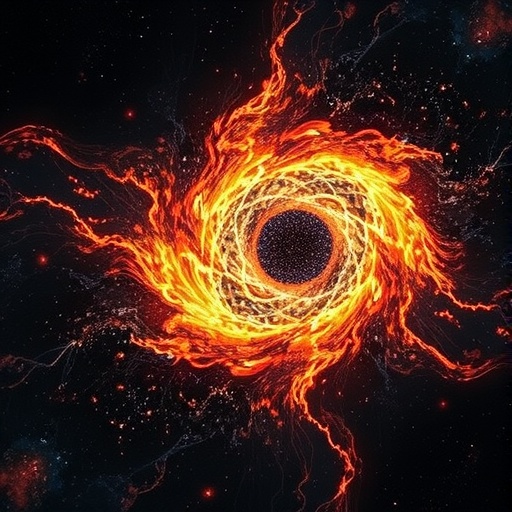
In the vast expanse of the cosmos, one of the most perplexing mysteries captivating astronomers and physicists alike is the existence of supermassive black holes that defy conventional theories of cosmic evolution. These gargantuan black holes, some tipping the scales at over a billion times the mass of our Sun, have been detected less than a billion years following the Big Bang, an epoch when such monumental structures, according to standard cosmological models, should have been impossible. This profound conundrum challenges our understanding of the universe’s earliest epochs and the processes governing the formation of cosmic structures.
A transformative study spearheaded by Yash Aggarwal, a graduate student at the University of California, Riverside, throws a new light on this enigma, revealing that the decay of dark matter—a mysterious and elusive form of matter constituting approximately 85% of the total matter in the universe—may be the crucial mechanism catalyzing the rapid birth of these early supermassive black holes. Published in the prestigious Journal of Cosmology and Astroparticle Physics, the research elucidates how subtle injections of energy from dark matter decay could manipulate the primordial chemistry within early galaxies, fostering conditions ripe for the direct collapse of gas clouds into black holes, effectively bypassing the conventional stellar formation pathway.
The timing of this breakthrough is particularly significant in the era of the James Webb Space Telescope, which has been unveiling a surprising abundance of massive black holes dating back to the universe’s infancy. Historically, the direct collapse pathway was thought to require a rare and delicate interaction—where ultraviolet light from nearby stars inhibits star formation in gas clouds, causing them to collapse directly into black holes. Aggarwal’s work advances beyond this model by incorporating the role of decaying dark matter, which can uniformly and intrinsically energize the gas clouds, significantly raising the probability of direct collapses without relying on such specific environmental coincidences.
Delving into the mechanics, the researchers modeled the thermo-chemical dynamics of primordial hydrogen gas subjected to energy inputs from hypothetical decaying axions—an intriguing dark matter candidate particle. Their results indicate a narrow window of dark matter masses, specifically between 24 and 27 electronvolts, wherein decay-induced energy release can augment the ionization and heating of gas clouds. This process disrupts standard cooling channels that typically lead to star formation and instead stabilizes massive gas clouds that collapse directly into black holes. Notably, the energy required for this mechanism is astoundingly minute—comparable to an infinitesimal fraction of a single AA battery’s energy—yet profound in its cosmic implications.
Flip Tanedo, an associate professor of physics and astronomy at UC Riverside and co-advisor to Aggarwal, emphasizes the incredible sensitivity of early galactic environments to minute energy injections. The primordial galaxies, comprising predominantly pristine hydrogen gas, effectively function as natural detectors for these subtle dark matter interactions. The observed presence of supermassive black holes in the very early universe could therefore be interpreted as indirect evidence of dark matter decay, furnishing a compelling intersection between particle physics and cosmology.
This research underscores a broader sentiment within contemporary astrophysics—the awakening to the indispensable role of dark matter’s microphysical properties in shaping macroscopic cosmic structures. The interdisciplinary approach taken by Tanedo and Aggarwal’s team, combining aspects of particle physics, cosmology, and astrophysics, epitomizes the modern scientific paradigm where complex cosmic puzzles demand integrative solutions spanning multiple fields.
The study also serves to recalibrate our theoretical frameworks regarding the timeline for black hole growth. Conventional theories have wrestled with the tight constraints imposed by Eddington-limited accretion, which governs the rate at which black holes can grow through matter consumption. By positing that black holes could originate directly via gas cloud collapse facilitated by dark matter decay, this pathway circumvents slow accumulation processes, neatly explaining how these titanic black holes emerged so swiftly in cosmic history.
Additional authors contributing to this research include James Dent from Sam Houston State University and Tao Xu from the University of Oklahoma, whose collaborative efforts bolstered the robustness of the computational simulations and models. Their collective work synthesizes inputs from myriad astrophysical processes, accommodating complex chemical reactions, cooling mechanisms, and energy transfer phenomena occurring during the universe’s formative epochs.
Furthermore, this dark matter-driven direct collapse model introduces a testable prediction for future astronomical observations. If decaying dark matter particles are indeed the architects behind early supermassive black holes, then signatures of their mass and decay properties could be inferred indirectly through detailed population statistics of black holes and their distribution in the early universe, as well as precise measurements of the chemical composition and ionization states of early gas clouds.
The research’s foundation was significantly galvanized by a series of workshops and intellectual exchanges that bridged traditionally siloed disciplines, fostering a fertile environment for novel ideas to germinate. This collaborative spirit mirrors the cosmic scales of the phenomena under study—vast, interconnected, and driven by both chance and underlying fundamental principles.
Supported by the National Science Foundation and the UCR Hellman Fellowship, this pioneering investigation exemplifies how fundamental physics concepts can illuminate astronomical mysteries. As the James Webb Space Telescope continues to probe deeper into cosmic history, the intersection of dark matter physics and black hole cosmology stands poised to reveal further surprises, potentially reshaping our comprehension of the universe’s earliest chapters and its enigmatic dark constituents.
The implications of this research reach beyond academia, touching on humanity’s enduring quest to understand our cosmic origins. Dark matter decay, once a speculative hypothesis in the shadows of particle physics, now emerges as a potent force capable of sculpting the universe’s most awe-inspiring phenomena—supermassive black holes that anchor galaxies and possibly influence the very fabric of cosmic evolution.
Subject of Research:
Astrophysical modeling of early universe black hole formation influenced by hypothesized dark matter decay processes.
Article Title:
Direct collapse black hole candidates from decaying dark matter
News Publication Date:
14-Apr-2026
Web References:
https://iopscience.iop.org/article/10.1088/1475-7516/2026/04/034
https://science.nasa.gov/mission/webb/
References:
Tanedo, F., Aggarwal, Y., Dent, J., Xu, T. (2026). Direct collapse black hole candidates from decaying dark matter. Journal of Cosmology and Astroparticle Physics. DOI: 10.1088/1475-7516/2026/04/034.
Image Credits:
Flip Tanedo, University of California, Riverside.
Keywords
Supermassive black holes, dark matter decay, direct collapse black holes, early universe, cosmology, axion dark matter, James Webb Space Telescope, primordial galaxies, computational astrophysics, black hole formation, cosmic structure, particle astrophysics
Tags: cosmology and astroparticle physics researchdark matter and galaxy formationdark matter decay and supermassive black hole formationdark matter influence on cosmic structuredirect collapse black hole theoryearly universe black hole conundrumearly universe cosmic evolution challengesenergy injection from dark matter decayformation of billion-solar-mass black holesorigins of early supermassive black holesprimordial chemistry in early galaxiesrapid black hole growth mechanisms