• HOME
  • NEWS
  • EXPLORE
    • CAREER
      • Companies
      • Jobs
    • EVENTS
    • iGEM
      • News
      • Team
    • PHOTOS
    • VIDEO
    • WIKI
  • BLOG
  • COMMUNITY
    • FACEBOOK
    • INSTAGRAM
    • TWITTER
Tuesday, July 7, 2026
BIOENGINEER.ORG
No Result
View All Result
  • Login
  • HOME
  • NEWS
  • EXPLORE
    • CAREER
      • Companies
      • Jobs
        • Lecturer
        • PhD Studentship
        • Postdoc
        • Research Assistant
    • EVENTS
    • iGEM
      • News
      • Team
    • PHOTOS
    • VIDEO
    • WIKI
  • BLOG
  • COMMUNITY
    • FACEBOOK
    • INSTAGRAM
    • TWITTER
  • HOME
  • NEWS
  • EXPLORE
    • CAREER
      • Companies
      • Jobs
        • Lecturer
        • PhD Studentship
        • Postdoc
        • Research Assistant
    • EVENTS
    • iGEM
      • News
      • Team
    • PHOTOS
    • VIDEO
    • WIKI
  • BLOG
  • COMMUNITY
    • FACEBOOK
    • INSTAGRAM
    • TWITTER
No Result
View All Result
Bioengineer.org
No Result
View All Result
Home NEWS Science News Biology

How cells get moving

Bioengineer by Bioengineer
December 17, 2019
in Biology
Reading Time: 3 mins read
0
IMAGE
Share on FacebookShare on TwitterShare on LinkedinShare on RedditShare on Telegram

IMAGE

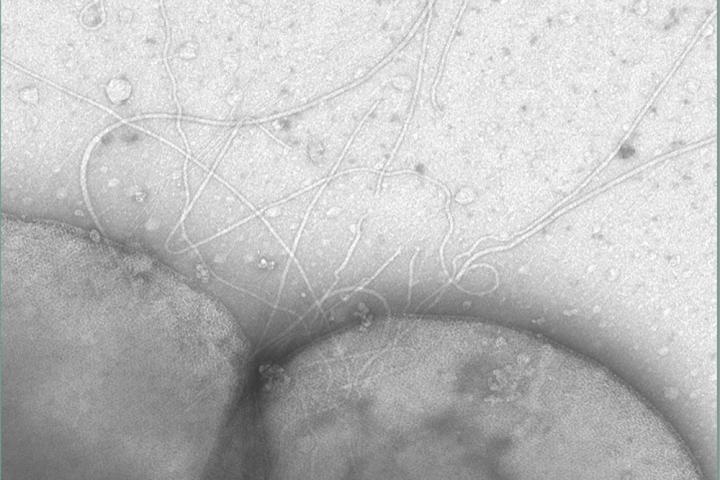
Credit: Source: Sonja-Verena Albers


Archaea, bacteria and eukaryotes are what biologists call the three domains of life. Of these three, archaea form an important link within the evolutionary theory. They are the direct ancestors of eukaryotes, but resemble bacteria in structure and organization. Archaea can colonize hot sulphur springs or extremely saline lakes, but can also be found in the ocean or in the human intestine and on the skin. Unlike bacteria, archaea have been relatively little researched – because no pathogenic forms have been identified so far. A research team led by Professor Sonja-Verena Albers from the Professorship of Microbiology at the University of Freiburg and Professor John Tainer from the University of Texas in Austin, USA, has now succeeded in identifying proteins that are essential for the assembly of the motility structure, i.e. for the ability of archaea to move actively – and hence also for the locomotion of cells. The team has presented its findings in the latest Nature Microbiology.

It is important for microorganisms to be able to move actively – so that if their environment deteriorates they can seek better living conditions. Bacteria use what is known as the flagellum, a complex structure requiring up to 50 proteins that assemble according to a strict timetable. Scientists assumed that archaea used the same structure as bacteria to “swim” from one place to another. But after sequencing the first archaeal genomes, the researchers discovered that archaea did not possess flagella operons. Instead, archaea swim using a structure called an archaellum. It consists of only seven subunits in the model organism Sulfolobus acidocaldarius used by Albers, which lives in highly acidic hydrothermal springs. “Nevertheless, this relatively simple structure can perform the same functions as the bacterial flagellum,” she explains.

She and her team have already discovered the structure of the protein FlaI required for this and have shown that it forms the motor complex of the archaellum in combination with the proteins FlaX and FlaH. The Freiburg scientists also described the protein FlaF, which bonds with the model organism’s only cell wall protein and anchors it there. “This enables archaea to interact with the environment – and thus with human cells,” explains Albers. In the current study, the researchers show that the protein FlaG is able to form a filament which is like a fiber. Together with FlaF, FlaG then forms a protein complex that is essential for the assembly of the archaellum. This complex is probably located at the tip of the FlaG filament, which enables FlaG and FlaF to interact with the cell wall.

In addition, the scientists proved that cells without a cell wall can form an archaellum but cannot swim. Albers says that this suggests that the interaction between FlaG and FlaF and the cell wall contributes to the function of the archaellum. “We showed that FlaG and FlaF are essential for the rotation of the archaellum and hence for the locomotion of the cell,” she says.

###

The study was funded via an FET-OPEN-Project, a European Union MARA project.

Publication:

Tsai, C.-L., Tripp, P., Sivabalasarma, S., Zhang, C., Rodriguez-Franco, M., Wipfler, R.L., Chaudhury, P., Banerjee, A., Beeby, M., Whitaker, R.J., Tainer, J.A., Albers, S.-V. (2019): The structure of the periplasmic FlaG-FlaF complex and its essential role for archaellar swimming motility. In: Nature Microbiology. DOI: 10.1038/s41564-019-0622-3

Contact:

Institute of Biology II – Microbiology

University of Freiburg

Media Contact
Dr. Sonja-Verena Albers
[email protected]
49-761-203-2630

Related Journal Article

http://dx.doi.org/10.1038/s41564-019-0622-3

Tags: BiologyCell BiologyMicrobiology
Share12Tweet8Share2ShareShareShare2

Related Posts

Here are a few rewritten headlines for a science magazine post, each with a slightly different tone: Intriguing & poetic: How do organs sculpt themselves? Sea stars hold the secret Direct & research-focused: Sea stars reveal the hidden rules of organ formation Metaphorical & inviting: Tiny architects beneath the waves: What sea stars teach us about building organs Short & punchy: Star-shaped clues to how our organs take shape Question-led: Could a sea star show us how organs form? Elegant & feature-style: The body’s blueprint, glimpsed in a sea star’s arm

July 6, 2026
Bacteria evolve faster with unconventional gene copies — Biology

Bacteria evolve faster with unconventional gene copies

July 6, 2026

Neighbours rewire soil feedback via root microbiome shifts

July 6, 2026

Evolution-Inspired Biosensors Revolutionize Lipid Tracking in Real Time

July 2, 2026
Please login to join discussion

POPULAR NEWS

  • Detection of EDCs in Breast Milk and Infant Urine Up to Six Months Highlights Early Exposure Risks

    77 shares
    Share 31 Tweet 19
  • New Drug Candidate Developed at McMaster Shows Potential for Treating Brain Cancer

    58 shares
    Share 23 Tweet 15
  • Saying Goodbye to PGY-6: Pediatric Fellowship Realities

    103 shares
    Share 41 Tweet 26
  • KTU Researchers Explore Ultrasound’s Role in Enhancing Blood Flow Beyond Diagnostics

    53 shares
    Share 21 Tweet 13

About

We bring you the latest biotechnology news from best research centers and universities around the world. Check our website.

Follow us

Recent News

Flame retardant BDE-209 targets molecularly linked to ulcerative colitis

Ultra-high frequency particle impacts mimic rockbursts to shatter hard rock

Kidney transplant outcomes in older adults studied by German researchers

Subscribe to Blog via Email

Enter your email address to subscribe to this blog and receive notifications of new posts by email.

Join 83 other subscribers
  • Contact Us

Bioengineer.org © Copyright 2023 All Rights Reserved.

Welcome Back!

Login to your account below

Forgotten Password?

Retrieve your password

Please enter your username or email address to reset your password.

Log In
No Result
View All Result
  • Homepages
    • Home Page 1
    • Home Page 2
  • News
  • National
  • Business
  • Health
  • Lifestyle
  • Science

Bioengineer.org © Copyright 2023 All Rights Reserved.