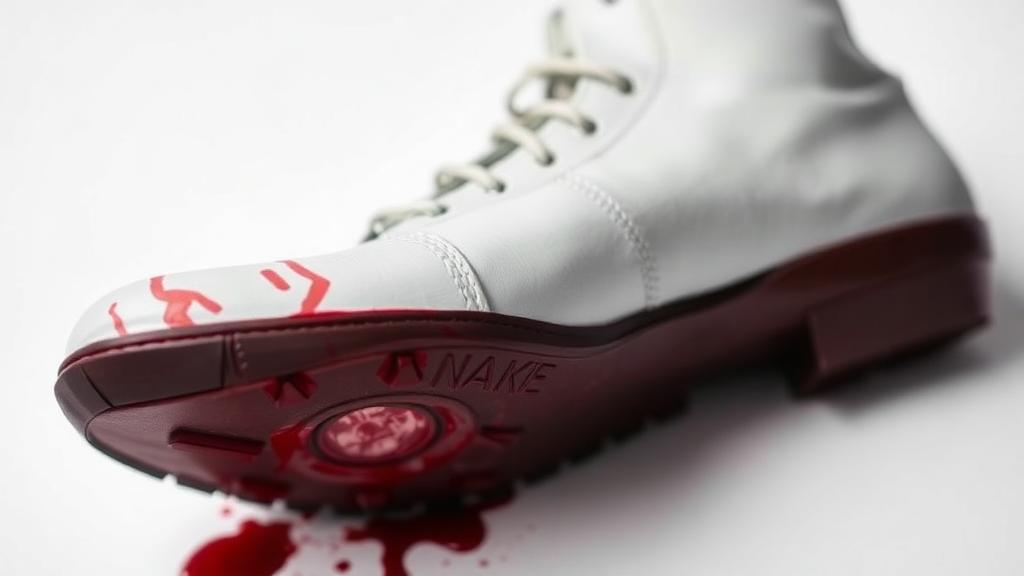
When a killer walks through a pool of blood, every subsequent step leaves behind a fading record of the shoe that made it. Forensic investigators have long relied on these bloody footwear impressions to reconstruct movement through a crime scene, but a new study reveals that the way those impressions decay is far stranger and more informative than anyone had systematically measured. A team of forensic scientists at Magna Graecia University in Catanzaro, Italy, has now tracked, step by step, how blood drains from a shoe sole, and their findings upend a common intuition about what a degraded footprint can still tell investigators.
The research, published as a proof-of-concept pilot study in the International Journal of Legal Medicine, compared two walking scenarios. In the first, a volunteer stepped into a standardized 20-milliliter pool of fresh human blood and then walked ten consecutive steps at a sustained pace, mimicking someone moving steadily away from a blood source. In the second, the walker paused for two to three minutes after the first step, allowing the blood film on the outsole to partially dry before resuming at a slower pace, simulating a person who lingers near a blood pool before leaving. Each condition was run twice, producing four complete depletion sequences, with every single footprint photographed under fixed, calibrated conditions.
The numbers tell a dramatic story of rapid loss. In the continuous walking sequence, the initial blood pool covered roughly 160 square centimeters, but the very first footprint already carried only 60 to 70 square centimeters of blood. By the second step, that figure had collapsed to 20 to 30 square centimeters, and by the third it fell to 10 to 20 square centimeters. More than 80 percent of the transferable blood vanished within the first three contacts, a pattern the authors describe as consistent with a negative exponential decay model, in which the bulk of available blood is shed almost immediately and subsequent steps leave progressively smaller residues.
Yet quantity is not the whole story. Despite this steep quantitative collapse, the overall geometry of the shoe, its tread pattern and outline, remained recognizable for a surprisingly large number of consecutive steps in the continuous sequence. The researchers analyzed each image using custom Python and OpenCV algorithms, converting photographs into HSV color space to isolate blood pixels, then computing a battery of indices: a Fragmentation Density Index tracking how broken up the pattern became, a Spatial Dispersion Index measuring how far residual deposits spread from the footprint’s core, and a Transfer Ratio comparing each step’s blood area to the first. As blood area shrank, fragmentation relentlessly increased, with the highest values appearing in the terminal stages when only isolated microdeposits remained.
The interrupted partial-drying sequence produced an unexpected twist. Counterintuitively, letting the blood partially dry did not preserve the footprint longer. Instead, interpretability declined sharply around the fourth step, the point at which the overall tread geometry could no longer be reliably reconstructed. What partial drying changed was not longevity but geography: residual deposits became more localized and concentrated rather than diffusely scattered. The authors caution that this Step 4 transition is specific to their experiment, not a universal forensic threshold, and that their design cannot separate the individual effects of the pause, the drying itself, and the slower walking pace that followed.
Perhaps the most striking discovery concerns the mismatch between what can be seen and what can be detected chemically. Using Combur Test strips, a tetramethylbenzidine-based reagent that responds to the pseudoperoxidase activity of hemoglobin, the team tested traces at each stage. Fresh deposits reacted strongly, but after roughly 24 hours of drying, direct testing of the traces was predominantly negative, even where blood was still visible to the eye. The crucial move came next: rehydrating the dried traces with physiological saline restored positive reactions, even in advanced stages of depletion and even on the shoe’s outsole itself after a full day.
This dissociation between morphological persistence and biochemical persistence carries real weight for criminal investigations. A footprint that has degraded beyond recognition, reduced to scattered punctiform flecks with no reconstructable tread pattern, may still harbor biologically reactive blood material. The study suggests that apparently worthless, fragmented impressions could retain forensically relevant evidence, including material potentially suitable for confirmatory testing, long after their value for pattern comparison has evaporated. Investigators who dismiss heavily depleted traces as uninformative may be discarding evidence that a combined morphological and biochemical approach could recover.
The authors are careful to frame their conclusions as hypothesis-generating rather than definitive. The study involved a single 59-kilogram subject, one worn athletic shoe in EU size 43, one blood source collected in EDTA tubes, and one smooth non-porous surface resembling linoleum. Blood viscosity, water loss, film thickness, and plantar pressure were not directly measured, and the image segmentation retained an analyst-dependent component without formal inter-rater validation. Combur itself is only a presumptive test, indicating heme reactivity but not confirming that a stain is human blood. Real crime scenes introduce countless variables, from carpet and concrete to rain and scrubbing, that this controlled pilot could not address.
Even so, the work opens a productive line of inquiry at the intersection of fluid physics, biomechanics, and forensic science. Blood is a complex non-Newtonian fluid whose wetting, spreading, and drying behavior on surfaces has only recently attracted systematic study, and previous research has shown that DNA can survive on shoe soles for hundreds of steps. The Italian team’s integrated approach, fusing digital morphometry with presumptive chemistry, offers a template for future studies incorporating multiple subjects, diverse footwear, varied substrates, and gait analysis. The broader message is already clear: the footprint you can see and the blood you can detect follow two different clocks, and forensic science needs to read both.
Subject of Research: Depletion dynamics of blood-bearing footwear impressions in forensic bloodstain pattern analysis
Article Title: Blood footwear impression depletion: comparative morphological and biochemical analysis of continuous and interrupted partial-drying transfer sequences
Article References: Aquila, I., Gualtieri, S., Grimaldi, G., & Sacco, M. A. (2026). Blood footwear impression depletion: comparative morphological and biochemical analysis of continuous and interrupted partial-drying transfer sequences. International Journal of Legal Medicine. https://doi.org/10.1007/s00414-026-04035-1
Image Credits: AI Generated
DOI: 10.1007/s00414-026-04035-1
Keywords: forensic science, bloodstain pattern analysis, footwear impressions, blood transfer, hemoglobin detection, Combur Test, morphometric analysis, crime scene reconstruction, partial drying, exponential decay, legal medicine, trace evidence
News Source: Ophelia Keating. (October 10, 2026). How Blood Dries on a Shoe Sole: Forensic Footprints Fade Before the Evidence Does. Scienmag.