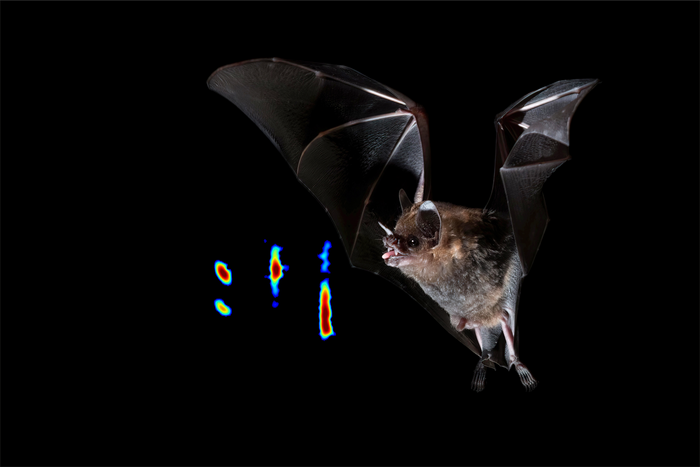
Bats famously have an ultrasonic navigation system: they use their extremely sensitive hearing to orient themselves by emitting ultrasonic sounds and using the echoes that result to build up a picture of their environment. For example, Seba’s short-tailed bat (Carollia perspicillata) finds the fruits that are its preferred food using this echolocation system. At the same time, bats also use their vocalisations to communicate with other bats. They use a somewhat lower range of frequencies for this purpose.
Credit: Dr. Julio C. Hechavarría
Bats famously have an ultrasonic navigation system: they use their extremely sensitive hearing to orient themselves by emitting ultrasonic sounds and using the echoes that result to build up a picture of their environment. For example, Seba’s short-tailed bat (Carollia perspicillata) finds the fruits that are its preferred food using this echolocation system. At the same time, bats also use their vocalisations to communicate with other bats. They use a somewhat lower range of frequencies for this purpose.
Neuroscientist Julio C. Hechavarría [SS1] from the Institute of Cell Biology and Neuroscience at Goethe University and his team are investigating the brain activities associated with vocalisations in Seba’s short-tailed bat. Their most recent study investigates how the auditory cortex and the frontal lobe work together in echolocation. The auditory cortex processes auditory information and the frontal lobe is a region in the forebrain that is associated, in humans, with tasks that include planning actions. To discover more about this, the researchers inserted tiny electrodes into the bats’ brains to record neural activity in the frontal lobe and the auditory cortex.
The researchers succeeded in identifying a feedback loop that had previously been entirely unknown in the frontal lobe-auditory cortex network of bats emitting echolocation calls. Information normally flows from the frontal lobe, where call production is planned, to the auditory cortex to ready it to expect an acoustic signal. But it was observed that the flow of information from the frontal lobe to the auditory cortex diminished after the emission of an echolocation pulse until the direction of information transfer switched completely and information flowed from the auditory cortex back to the frontal lobe. Hechavarría hypothesises that this feedback loop readies the auditory cortex to better receive the sounds reflected back from the echolocation call.
The neurobiologists simulated signals originating from the auditory cortex by electrically stimulating the frontal lobe. The activity this generated in the frontal lobe had the expected effect of prompting the auditory cortex to respond more strongly to acoustic reflections. “This shows that the feedback loop we found is functional”, neurobiologist Hechavarría sums up. He takes up the metaphor of a highway to illustrate the significance of these findings: “Up to now, it was generally believed that the flow of data on this information superhighway mainly runs in one direction and that feedback loops are exceptions. Our data show that this view is most likely incorrect and that feedback loops in the brain are probably considerably more significant than has previously been hypothesised.”
Surprisingly, no pronounced reversal of information flow was observed for bat vocalisations used for communication purposes. “This may be because the bats were alone in a sound-proofed and electrically isolated chamber and therefore did not expect a response to their calls”, Hechavarría speculates before going on to note: “One of the aspects that makes our study so interesting is that it opens up new ways to study the social interactions of bats. We want to continue work in this area in the future.”
Publication: Francisco García-Rosales, Luciana López-Jury, Eugenia Gonzalez-Palomares, Johannes Wetekam, Yuranny Cabral-Calderín, Ava Kiai, Manfred Kössl, Julio C. Hechavarría: Echolocation-related reversal of information flow in a cortical vocalisation network. Nature Communications 13, 3642 (2022) https://doi.org/10.1038/s41467-022-31230-6
An image to download: [Link]
Caption: Bats “see” with their ears. Researchers at Goethe University have discovered how the auditory cortex is readied for incoming acoustic signals. (Photo: Dr. Julio C. Hechavarría)
Further information
Dr. Julio C. Hechavarría (Ph.D.)
Auditory Computations Group (Group Leader)
Institute for Cell Biology and Neuroscience
Tel. +49 (0)69 798-42050
[email protected]
https://www.julio-hechavarria.com/
[SS1]Ich habe die Version des Namens mit dem Akzent auf dem “I” benutzt, weil es in der Veröffentlichung so erscheint:
https://www.nature.com/articles/s41467-022-31230-6
Journal
Nature Communications
DOI
10.1038/s41467-022-31230-6
Method of Research
Experimental study
Subject of Research
Animals
Article Title
Echolocation-related reversal of information flow in a cortical vocalisation network