• HOME
  • NEWS
  • EXPLORE
    • CAREER
      • Companies
      • Jobs
    • EVENTS
    • iGEM
      • News
      • Team
    • PHOTOS
    • VIDEO
    • WIKI
  • BLOG
  • COMMUNITY
    • FACEBOOK
    • INSTAGRAM
    • TWITTER
Tuesday, July 7, 2026
BIOENGINEER.ORG
No Result
View All Result
  • Login
  • HOME
  • NEWS
  • EXPLORE
    • CAREER
      • Companies
      • Jobs
        • Lecturer
        • PhD Studentship
        • Postdoc
        • Research Assistant
    • EVENTS
    • iGEM
      • News
      • Team
    • PHOTOS
    • VIDEO
    • WIKI
  • BLOG
  • COMMUNITY
    • FACEBOOK
    • INSTAGRAM
    • TWITTER
  • HOME
  • NEWS
  • EXPLORE
    • CAREER
      • Companies
      • Jobs
        • Lecturer
        • PhD Studentship
        • Postdoc
        • Research Assistant
    • EVENTS
    • iGEM
      • News
      • Team
    • PHOTOS
    • VIDEO
    • WIKI
  • BLOG
  • COMMUNITY
    • FACEBOOK
    • INSTAGRAM
    • TWITTER
No Result
View All Result
Bioengineer.org
No Result
View All Result
Home NEWS Science News Health

How axons change chemical cues to mechanical force

Bioengineer by Bioengineer
August 7, 2018
in Health
Reading Time: 2 mins read
0
Share on FacebookShare on TwitterShare on LinkedinShare on RedditShare on Telegram
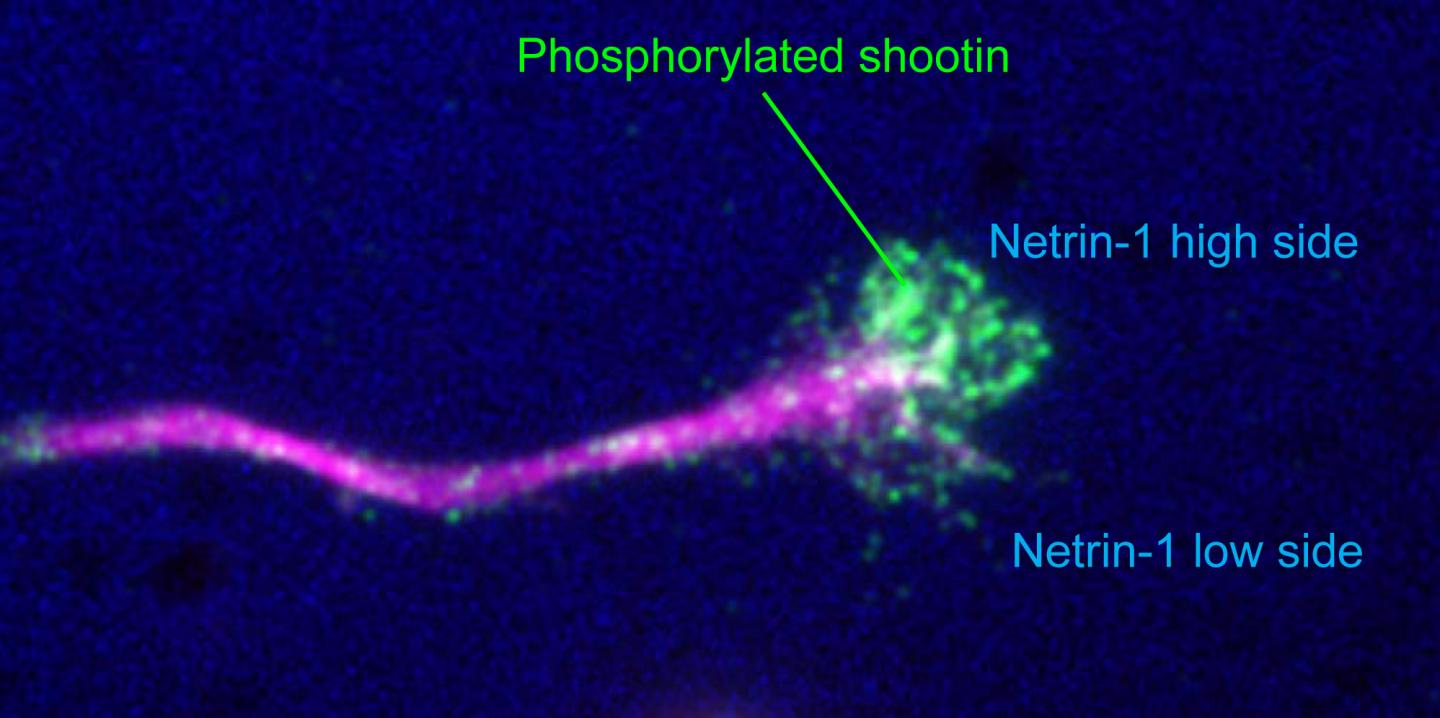
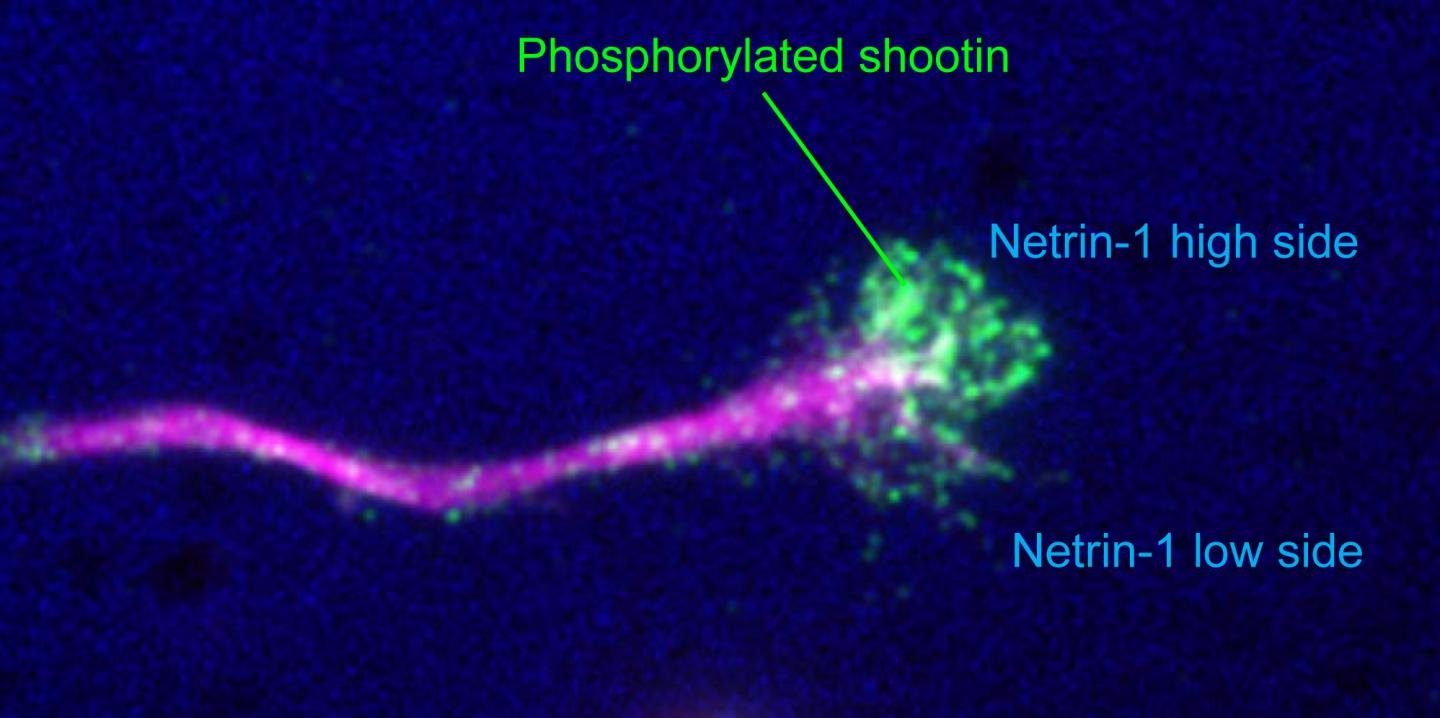
IMAGE

Credit: Naoyuki Inagaki

While today's technology is growing increasingly wireless, nature's greatest technology, the human brain, still depends on neurons being directly connected to one another. Two neurons are connected when one extends its axon to the other. This extension is activated by chemical cues that causes the axon to exert a directional force towards the proper direction. While scientists have long known of different molecules that can act as cues, the molecules that initiate the force have remained a mystery. In a new study published in eLIFE, a team of Japanese and American scientists report that shootin1 is one such molecule and is essential for guiding the axon to its final destination.

Naoyuki Inagaki, Professor at the Nara Institute of Science and Technology (NAIST) and leader of the study, explains that there are two molecules that have vital roles in axon guidance.

"Nectin-1 is a well characterized axon guidance molecule. Shootin1 is a brain-specific protein involved in axon outgrowth."

Concentration changes in nectin-1 cause an axon to change its direction of growth with such abruptness that under a microscope it almost seems like someone is controlling the axon with a steering wheel. However, just how big an effect shocked even the scientists.

"We found that a slight concentration gradient in netrin-1 of only 0.4% induces a 71% difference in shootin1a phosphorylation within growth cones," says Dr. Kentarou Baba, who first-authored the study. "That is remarkable sensitivity."

That means even if the difference between the amount of nectin-1 on the two sides of the growth cone was less than 1%, more than two-thirds of phosphorylated shootin1 would accumulate on the side with more nectin-1, and thus steer the axon to its proper direction.

Further, the phosphorylation significantly enhanced the binding of shootin1 to L1-CAM, a molecule which Inagaki says "are the wheels of the axon." The axons could still grow if the interaction between shootin1 and L1-CAM was disrupted, albeit at a slower velocity, but not in the direction signaled by the nectin-1 gradient.

"The direct interaction between shootin1 and L1-CAM generated the traction force for growth cone motility," says Baba.

The findings suggest that shootin1 is a natural chemo-mechanical transducer, converting chemical information into mechanical output.

"Our findings suggest that the polarized phosphorylation of shootin1 within growth cones is required for the directional axon guidance induced by netrin-1 gradients," says Inagaki.

###

Resource

Title: Gradient-reading and mechano-effector machinery for netrin-1-induced axon guidance

Authors: Kentarou Baba, Wataru Yoshida, Michinori Toriyama, Tadayuki Shimada, Colleen F Manning, Michiko Saito, Kenji Kohno, James S Trimmer, Rikiya Watanabe & Naoyuki Inagaki

Publication: eLife, 7, e34593

DOI: 10.7554/eLife.34593

Information about Prof. Inagaki lab can be found at the following website: http://bsw3.naist.jp/inagaki/english/index.html

Media Contact

Takahito Shikano
[email protected]
81-743-725-644
@NAIST_MAIN_EN

http://www.naist.jp/en/

Related Journal Article

http://dx.doi.org/10.7554/eLife.34593

Share14Tweet8Share2ShareShareShare2

Related Posts

Flame retardant BDE-209 targets molecularly linked to ulcerative colitis

July 6, 2026

Kidney transplant outcomes in older adults studied by German researchers

July 6, 2026

Salmonella protein SopB curbs early inflammation to slow disease progression

July 6, 2026

Multi-metal cooperation drives lung cancer chemoresistance, reversed by MiADMSA

July 6, 2026
Please login to join discussion

POPULAR NEWS

  • Detection of EDCs in Breast Milk and Infant Urine Up to Six Months Highlights Early Exposure Risks

    77 shares
    Share 31 Tweet 19
  • New Drug Candidate Developed at McMaster Shows Potential for Treating Brain Cancer

    58 shares
    Share 23 Tweet 15
  • Saying Goodbye to PGY-6: Pediatric Fellowship Realities

    103 shares
    Share 41 Tweet 26
  • KTU Researchers Explore Ultrasound’s Role in Enhancing Blood Flow Beyond Diagnostics

    53 shares
    Share 21 Tweet 13

About

We bring you the latest biotechnology news from best research centers and universities around the world. Check our website.

Follow us

Recent News

Flame retardant BDE-209 targets molecularly linked to ulcerative colitis

Ultra-high frequency particle impacts mimic rockbursts to shatter hard rock

Kidney transplant outcomes in older adults studied by German researchers

Subscribe to Blog via Email

Enter your email address to subscribe to this blog and receive notifications of new posts by email.

Join 83 other subscribers
  • Contact Us

Bioengineer.org © Copyright 2023 All Rights Reserved.

Welcome Back!

Login to your account below

Forgotten Password?

Retrieve your password

Please enter your username or email address to reset your password.

Log In
No Result
View All Result
  • Homepages
    • Home Page 1
    • Home Page 2
  • News
  • National
  • Business
  • Health
  • Lifestyle
  • Science

Bioengineer.org © Copyright 2023 All Rights Reserved.