• HOME
  • NEWS
  • EXPLORE
    • CAREER
      • Companies
      • Jobs
    • EVENTS
    • iGEM
      • News
      • Team
    • PHOTOS
    • VIDEO
    • WIKI
  • BLOG
  • COMMUNITY
    • FACEBOOK
    • INSTAGRAM
    • TWITTER
Sunday, August 30, 2026
BIOENGINEER.ORG
No Result
View All Result
  • Login
  • HOME
  • NEWS
  • EXPLORE
    • CAREER
      • Companies
      • Jobs
        • Lecturer
        • PhD Studentship
        • Postdoc
        • Research Assistant
    • EVENTS
    • iGEM
      • News
      • Team
    • PHOTOS
    • VIDEO
    • WIKI
  • BLOG
  • COMMUNITY
    • FACEBOOK
    • INSTAGRAM
    • TWITTER
  • HOME
  • NEWS
  • EXPLORE
    • CAREER
      • Companies
      • Jobs
        • Lecturer
        • PhD Studentship
        • Postdoc
        • Research Assistant
    • EVENTS
    • iGEM
      • News
      • Team
    • PHOTOS
    • VIDEO
    • WIKI
  • BLOG
  • COMMUNITY
    • FACEBOOK
    • INSTAGRAM
    • TWITTER
No Result
View All Result
Bioengineer.org
No Result
View All Result
Home NEWS Science News Biology

How a mouse’s brain bends time

Bioengineer by Bioengineer
January 30, 2024
in Biology
Reading Time: 2 mins read
0
Alston's singing mouse
Share on FacebookShare on TwitterShare on LinkedinShare on RedditShare on Telegram

Life has a challenging tempo. Sometimes, it moves faster or slower than we’d like. Nevertheless, we adapt. We pick up the rhythm of conversations. We keep pace with the crowd walking a city sidewalk. 
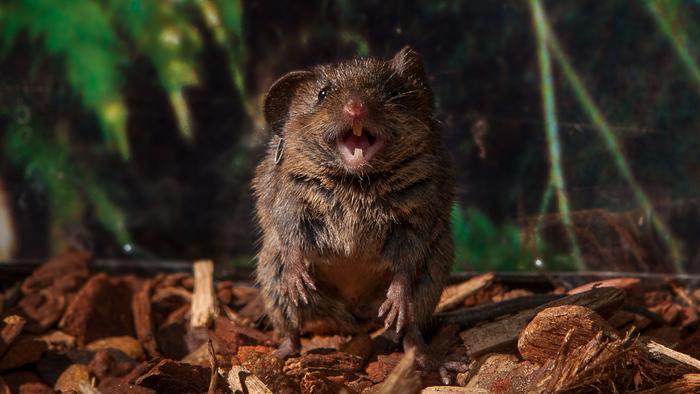
Alston's singing mouse

Credit: Banerjee lab/Cold Spring Harbor Laboratory

Life has a challenging tempo. Sometimes, it moves faster or slower than we’d like. Nevertheless, we adapt. We pick up the rhythm of conversations. We keep pace with the crowd walking a city sidewalk. 

“There are many instances where we have to do the same action but at different tempos. So the question is, how does the brain do it,” says Cold Spring Harbor Laboratory Assistant Professor Arkarup Banerjee. 

Now, Banerjee and collaborators have uncovered a new clue that suggests the brain bends our processing of time to suit our needs. And it’s partly thanks to a noisy critter from Costa Rica named Alston’s singing mouse.

This special breed is known for its human-audible vocalizations, which last several seconds. One mouse will sing out a longing cry, and another will respond with a tune of its own. Notably, the song varies in length and speed. Banerjee and his team looked to determine how neural circuits in the mice’s brains govern their song’s tempo.

The researchers pretended to engage in duets with the mice while analyzing a region of their brains called the orofacial motor cortex (OMC). They recorded neurons’ activity over many weeks. They then looked for differences among songs with distinct durations and tempos.

They found that OMC neurons engage in a process called temporal scaling. “Instead of encoding absolute time like a clock, the neurons track something like relative time,” Banerjee explains. “They actually slow down or speed up the interval. So, it’s not like one or two seconds, but 10%, 20%.”

The discovery offers new insight into how the brain generates vocal communication. But Banerjee suspects its implications go beyond language or music. It might help explain how time is computed in other parts of the brain, allowing us to adjust various behaviors accordingly. And that might tell us more about how our beautifully complex brains work. 

“It’s this three-pound block of flesh that allows you to do everything from reading a book to sending people to the moon,” says Banerjee. “It provides us with flexibility. We can change on the fly. We adapt. We learn. If everything was a stimulus-response, with no opportunity for learning, nothing that changes, no long-term goals, we wouldn’t need a brain. We believe the cortex exists to add flexibility to behavior.”

In other words, it helps make us who we are. Banerjee’s discovery may bring science closer to understanding how our brains enable us to interact with the world. The possible implications for technology, education, and therapy are as unlimited as our imagination.


Journal

Nature Neuroscience

DOI

10.1038/s41593-023-01556-5

Article Publication Date

30-Jan-2024

Share12Tweet8Share2ShareShareShare2

Related Posts

How SHH-Wnt crosstalk, DNA methylation, and miRNAs drive uterine fibroids

How SHH-Wnt crosstalk, DNA methylation, and miRNAs drive uterine fibroids

August 30, 2026
Two Cuckoo Lineages Parasitize the Same Daurian Redstart Nest

Two Cuckoo Lineages Parasitize the Same Daurian Redstart Nest

August 30, 2026

Genome-Wide Scan Reveals Type VI Secretion Systems Across Morganella Species

August 30, 2026

GWAS-informed ensembles boost genomic prediction of vitamin A carotenoids in cassava

August 30, 2026

POPULAR NEWS

  • Breast cancer survivors face fertility challenges, review finds

    29 shares
    Share 12 Tweet 7
  • Unequal colonoscopy follow-up and precancer detection after positive stool blood test

    29 shares
    Share 12 Tweet 7
  • Injury-Site Monitoring After Spinal Cord Injury: 109 Patients Across Five ICUs

    29 shares
    Share 12 Tweet 7
  • Cross-Species AI Predicts Human Interneuron Genes from Mouse Electrical Signatures

    29 shares
    Share 12 Tweet 7

About

We bring you the latest biotechnology news from best research centers and universities around the world. Check our website.

Follow us

Recent News

Breast cancer survivors face fertility challenges, review finds

Unequal colonoscopy follow-up and precancer detection after positive stool blood test

Injury-Site Monitoring After Spinal Cord Injury: 109 Patients Across Five ICUs

Subscribe to Blog via Email

Enter your email address to subscribe to this blog and receive notifications of new posts by email.

Join 85 other subscribers
  • Contact Us

Bioengineer.org © Copyright 2023 All Rights Reserved.

Welcome Back!

Login to your account below

Forgotten Password?

Retrieve your password

Please enter your username or email address to reset your password.

Log In
No Result
View All Result
  • Homepages
    • Home Page 1
    • Home Page 2
  • News
  • National
  • Business
  • Health
  • Lifestyle
  • Science

Bioengineer.org © Copyright 2023 All Rights Reserved.