• HOME
  • NEWS
  • EXPLORE
    • CAREER
      • Companies
      • Jobs
    • EVENTS
    • iGEM
      • News
      • Team
    • PHOTOS
    • VIDEO
    • WIKI
  • BLOG
  • COMMUNITY
    • FACEBOOK
    • INSTAGRAM
    • TWITTER
Tuesday, May 19, 2026
BIOENGINEER.ORG
No Result
View All Result
  • Login
  • HOME
  • NEWS
  • EXPLORE
    • CAREER
      • Companies
      • Jobs
        • Lecturer
        • PhD Studentship
        • Postdoc
        • Research Assistant
    • EVENTS
    • iGEM
      • News
      • Team
    • PHOTOS
    • VIDEO
    • WIKI
  • BLOG
  • COMMUNITY
    • FACEBOOK
    • INSTAGRAM
    • TWITTER
  • HOME
  • NEWS
  • EXPLORE
    • CAREER
      • Companies
      • Jobs
        • Lecturer
        • PhD Studentship
        • Postdoc
        • Research Assistant
    • EVENTS
    • iGEM
      • News
      • Team
    • PHOTOS
    • VIDEO
    • WIKI
  • BLOG
  • COMMUNITY
    • FACEBOOK
    • INSTAGRAM
    • TWITTER
No Result
View All Result
Bioengineer.org
No Result
View All Result
Home NEWS Science News Biology

Hot summer frequents Europe-west Asia and northeast Asia after the mid-1990s

Bioengineer by Bioengineer
June 21, 2017
in Biology
Reading Time: 2 mins read
0
Share on FacebookShare on TwitterShare on LinkedinShare on RedditShare on Telegram
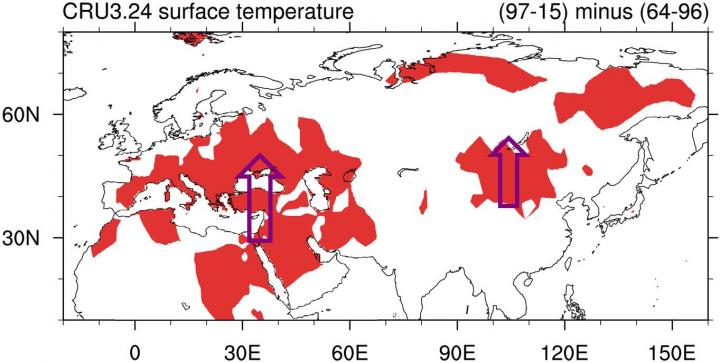
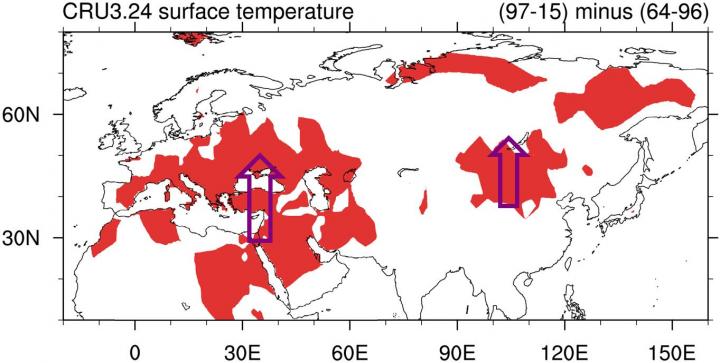
IMAGE

Credit: Xiaowei Hong

After the mid-1990s, the global surface temperature presents a significant warming trend. According to the World Meteorological Organization, the global mean surface temperature of the period 2011-2015 has increased by 0.57? than that of 1961-1990. This warming trend provides favorable background for occurrence of hot summers, and inflames the hot extreme events. Based on statistics, the casualties caused by hot events during 2001-2010 have increased by twenty-three times relative to those during 1991-2000.

This warming trend is particularly prominent in the boreal mid- and high- latitudes. Europe's 2003 heat wave, for instance, has brought about more than 30, 000 deaths. In 2010, the maximum temperature of several cities in Russia exceeded 40?, being about twice of the climatological value (23?). This heat attack led to at least 15, 000 deaths and more than $15 billion economic loss. In the same year, the Mohe country, which located in the northern most of China, also made a high historical record, with its daily maximum temperature being 39.3?. Actually, the northeast region of China is a key base for commercial food production. During the past decade, the cultivated land over this domain has extended by more than 30 percent. This somewhat relates to the warming climate and longer duration of summer season in this region.

Against the background of global warming, amplitudes of the warmth differ much between different regions. This is an issue to be addressed in the climate change investigation.

A recent research by Institute of Atmospheric Physics, Chinese Academy of Sciences identified a nonuniform warming pattern in summer after the mid-1990s over the Eurasian continent, with a predominant amplified warming over Europe-West Asia and Northeast Asia but much weaker warming over Central Asia. They suggest that the Atlantic Multidecadal Oscillation may induce this asymmetry in temperature changes through the decadal change of the Silk Road Pattern. The so-called Silk Road Pattern, is a wave-like pattern along the upper-tropospheric westerly jet in midlatitudes. Their results show that the Silk Road Pattern has a strong decadal variability, which can explain about 30% of its total variance.

Considering that the AMO has a cycle of about 65-80 years and has entered into a positive phase since the mid-1990s, it implies that there will still be a strong warming over Europe-West Asia and Northeast Asia in the coming decade. And this would exert great influence on the ecological condition, the agriculture, and the human life.

###

Media Contact

Zheng Lin
[email protected]
86-108-299-5053
@aasjournal

http://english.iap.cas.cn/

Original Source

http://iopscience.iop.org/article/10.1088/1748-9326/aa7909 http://dx.doi.org/10.1088/1748-9326/aa7909

############

Story Source: Materials provided by Scienmag

Share12Tweet8Share2ShareShareShare2

Related Posts

New Study Uncovers “Bet-Hedging” Strategy Enabling Gut Bacteria to Survive and Thrive — Biology

New Study Uncovers “Bet-Hedging” Strategy Enabling Gut Bacteria to Survive and Thrive

May 19, 2026
Transcription Attenuation Boosts Rifampicin-Resistant TB Weaknesses — Biology

Transcription Attenuation Boosts Rifampicin-Resistant TB Weaknesses

May 19, 2026

Decoding Darkness: Photoreceptor Functions With and Without Light

May 19, 2026

Advanced Models Pave the Way for Improved Therapies Targeting Primary Sclerosing Cholangitis

May 19, 2026
Please login to join discussion

POPULAR NEWS

  • Research Indicates Potential Connection Between Prenatal Medication Exposure and Elevated Autism Risk

    845 shares
    Share 338 Tweet 211
  • New Study Reveals Plants Can Detect the Sound of Rain

    731 shares
    Share 292 Tweet 182
  • Salmonella Haem Blocks Macrophages, Boosts Infection

    62 shares
    Share 25 Tweet 16
  • Breastmilk Balances E. coli and Beneficial Bacteria in Infant Gut Microbiomes

    58 shares
    Share 23 Tweet 15

About

We bring you the latest biotechnology news from best research centers and universities around the world. Check our website.

Follow us

Recent News

Unveiling Human Betaine/GABA Transporter 1 Mechanisms

Ice-forming proteins spark innovative ‘cool’ technologies

Enhancing Efficiency and Sustainability in Chemical Reaction Control

Subscribe to Blog via Email

Enter your email address to subscribe to this blog and receive notifications of new posts by email.

Join 82 other subscribers
  • Contact Us

Bioengineer.org © Copyright 2023 All Rights Reserved.

Welcome Back!

Login to your account below

Forgotten Password?

Retrieve your password

Please enter your username or email address to reset your password.

Log In
No Result
View All Result
  • Homepages
    • Home Page 1
    • Home Page 2
  • News
  • National
  • Business
  • Health
  • Lifestyle
  • Science

Bioengineer.org © Copyright 2023 All Rights Reserved.