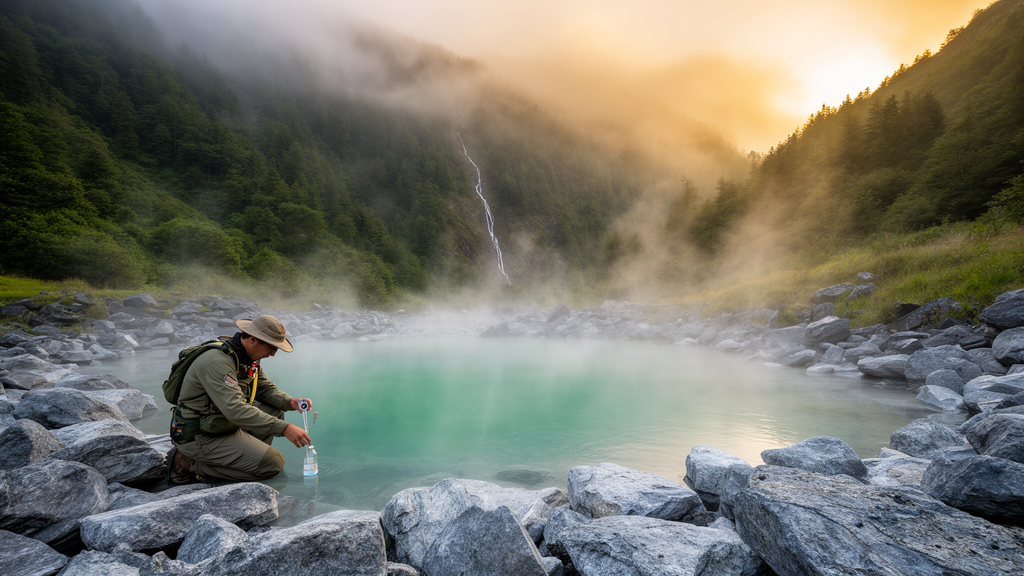
Deep beneath Qingyuan, a city in northern Guangdong Province, China, hot water rises toward the surface along faults, carrying a chemical fingerprint that scientists have now decoded in detail. A new study published in Frontiers in Energy Research analyzed 16 representative geothermal water samples from the region, supplemented by hydrogen and oxygen stable isotope measurements on five of them, to establish where the thermal fluids come from, how they evolve underground, and how hot the reservoir feeding them really is. The work fills a conspicuous gap: despite Qingyuan's reputation for abundant geothermal resources, systematic investigations of the hydrogeochemical characteristics and genesis of its thermal waters had remained scarce, a shortfall the authors say has hindered scientific development and efficient utilization of the resource.
As rainwater percolates downward and warms, it dissolves the rocks it passes through. In Qingyuan, those reactions manifest as the dissolution of carbonate and silicate minerals working in conjunction with cation exchange, the process by which dissolved ions swap with ions adsorbed on mineral surfaces. The isotopic evidence points to an equally clear origin.
The stable isotope compositions of hydrogen and oxygen, reported as δD and δ¹⁸O values, corroborate a meteoric source, meaning the water now emerging hot from the ground began its journey as ordinary rainfall. The isotope data also allowed the researchers to estimate where that rainfall enters the ground. Calculated recharge elevations range from 193 to 635 meters above sea level, placing the recharge area in the low-mountain and hilly terrain of the study region.
How hot does that engine get? The team applied the quartz geothermometer, a chemical thermometer that infers reservoir temperature from the concentration of dissolved silica equilibrated with quartz under the assumption of no steam loss, and obtained estimates ranging from 46 to 146 degrees Celsius. Temperature translates into depth.
Using the estimated reservoir temperatures together with plausible geothermal gradients, the authors calculated corresponding circulation depths of roughly 1,113 to 5,442 meters. These numbers converge on a coherent conceptual model for the region. Meteoric water infiltrates in the low-mountain and hilly recharge zone and circulates downward to depths of one to several kilometers.
At depth, the water is heated by the local geothermal gradient and reacts chemically with the surrounding rocks, dissolving carbonate and silicate minerals and exchanging cations along the way. The buoyant, heated fluid then ascends along faults, which act as high-permeability conduits, and discharges at the surface as the hot springs that have long marked the Qingyuan landscape. The authors frame their results as a hydrogeochemical basis for future geothermal exploration and resource assessment in Qingyuan.
Scientifically, the study refines the conceptual understanding of how geothermal waters in this part of northern Guangdong originate and evolve. The study, conducted by Wei Zhang and Fangfang Guo of the Shanxi Institute of Technology together with Wenjing Lin of the Chinese Academy of Geological Sciences Institute of Hydrogeology and Environmental Geology, was received in September 2026 and accepted the following month.
Subject of Research: Hydrogeochemical characteristics and genesis of geothermal waters in Qingyuan, northern Guangdong, China
Article Title: Hydrogeochemical characteristics and genesis of geothermal waters in Qingyuan, northern Guangdong, China
Article References: Zhang, W., Guo, F., & Lin, W. (2026). Hydrogeochemical characteristics and genesis of geothermal waters in Qingyuan, northern Guangdong, China. Frontiers in Energy Research, 14, 2001308. https://doi.org/10.3389/fenrg.2026.2001308
Image Credits: AI Generated
DOI: 10.3389/fenrg.2026.2001308
Keywords: geothermal water, hydrogeochemistry, water-rock interaction, stable isotopes, geothermometry, Qingyuan, Guangdong, circulation depth, meteoric recharge, fault-controlled discharge, low-to-moderate temperature geothermal system, resource assessment
News Source: Denise Maddox. (October 27, 2026). Hot Springs of Qingyuan Trace Their Origins to Rain and Deep Faults. Scienmag.