• HOME
  • NEWS
  • EXPLORE
    • CAREER
      • Companies
      • Jobs
    • EVENTS
    • iGEM
      • News
      • Team
    • PHOTOS
    • VIDEO
    • WIKI
  • BLOG
  • COMMUNITY
    • FACEBOOK
    • INSTAGRAM
    • TWITTER
Sunday, July 5, 2026
BIOENGINEER.ORG
No Result
View All Result
  • Login
  • HOME
  • NEWS
  • EXPLORE
    • CAREER
      • Companies
      • Jobs
        • Lecturer
        • PhD Studentship
        • Postdoc
        • Research Assistant
    • EVENTS
    • iGEM
      • News
      • Team
    • PHOTOS
    • VIDEO
    • WIKI
  • BLOG
  • COMMUNITY
    • FACEBOOK
    • INSTAGRAM
    • TWITTER
  • HOME
  • NEWS
  • EXPLORE
    • CAREER
      • Companies
      • Jobs
        • Lecturer
        • PhD Studentship
        • Postdoc
        • Research Assistant
    • EVENTS
    • iGEM
      • News
      • Team
    • PHOTOS
    • VIDEO
    • WIKI
  • BLOG
  • COMMUNITY
    • FACEBOOK
    • INSTAGRAM
    • TWITTER
No Result
View All Result
Bioengineer.org
No Result
View All Result
Home NEWS Science News Health

Host cell proteases can process viral capsid proteins

Bioengineer by Bioengineer
December 4, 2019
in Health
Reading Time: 2 mins read
0
IMAGE
Share on FacebookShare on TwitterShare on LinkedinShare on RedditShare on Telegram

IMAGE

Credit: Varpu Marjomäki/University of Jyväskylä


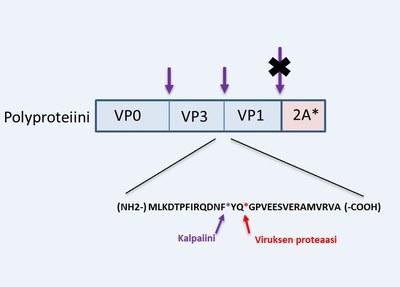
It has long been suggested that a cell protease could take part in enterovirus infection. However, the identity of such proteases have remained unknown. The work performed in the University of Jyväskylä shows, for the first time, that host cell calpain proteases can process enterovirus polyprotein in vitro. The research was published in Viruses scientific journal in November 2019.

Enteroviruses are the most common viruses infecting humans. Although most of the diseases that enteroviruses cause are symptomless or mild, enteroviruses can also cause more severe diseases.

Calpains are common host cell proteases, ubiquitous in the cell cytoplasm. The group of Docent Varpu Marjomäki has shown earlier that inhibition of calpain proteases very efficiently stops enterovirus infection. The work done now sheds light to the mechanism of the inhibitory effect. The work suggests that enteroviruses have learnt through evolution to take advantage of the cellular resources for their own benefit.

“We showed that calpain proteases can cut out viral capsid proteins from the larger polyprotein, and thus have the potential to contribute to the assembly of new viruses”, says Docent Varpu Marjomäki.

The work done is very interesting as suggested by the eminent virologist Dr. Marco Vignuzzi from Pasteur-Institute, Paris.

“I consider this an outstanding observation and very significant first demonstration that will lead to significant advances in the field. It may very likely be that this mechanism of cleavage is also used by viruses in other viral families”, Vignuzzi says.

According to Vignuzzi the work is to be considered to be one of the most interesting things that will be published this year in picornavirus research. This work was part of Mira Laajala´s dissertation at 22.11.2019 in Marjomäki´s group. Laajala showed further that calpain proteases have cross-reactivity against viral proteases as well. Inhibition of calpain proteases thus offers a future possibility to develop anti-viral therapies based on calpains.

###

The new research was done in collaboration with the researchers Minna Hankaniemi, Juha Määttä, Vesa Hytönen and Olli Laitinen in the University of Tampere. The work has been supported by Jane and Aatos Erkko foundation in the University of Jyväskylä.

Link to the article in Viruses-journal: https://www.mdpi.com/1999-4915/11/12/1106

For further information:

Docent Varpu Marjomäki [email protected], tel. 040 563 4422

Communications officer Tanja Heikkinen, [email protected], tel. 050 581 8351
https://www.jyu.fi/science/en

Facebook: jyuscience Twitter: jyscience Instagram: jyscience

Media Contact
Docent Varpu Marjomaki
[email protected]
358-405-634-422

Original Source

https://www.mdpi.com/1999-4915/11/12/1106

Related Journal Article

http://dx.doi.org/10.3390/v11121106

Tags: BiologyCell BiologyInfectious/Emerging DiseasesMicrobiologyMolecular BiologyVirology
Share13Tweet8Share2ShareShareShare2

Related Posts

Lysine Pyruvylation Links Glycolysis to Epigenetics

July 4, 2026

Personalized Neoantigen Dendritic Cell Vaccine in Glioblastoma

July 4, 2026

Decoding Neural Timescales: A Computational Viewpoint

July 4, 2026

Uncovering C5aR2: Unique Signaling and Agonists

July 4, 2026
Please login to join discussion

POPULAR NEWS

  • Detection of EDCs in Breast Milk and Infant Urine Up to Six Months Highlights Early Exposure Risks

    77 shares
    Share 31 Tweet 19
  • Saying Goodbye to PGY-6: Pediatric Fellowship Realities

    103 shares
    Share 41 Tweet 26
  • New Drug Candidate Developed at McMaster Shows Potential for Treating Brain Cancer

    58 shares
    Share 23 Tweet 15
  • KTU Researchers Explore Ultrasound’s Role in Enhancing Blood Flow Beyond Diagnostics

    53 shares
    Share 21 Tweet 13

About

We bring you the latest biotechnology news from best research centers and universities around the world. Check our website.

Follow us

Recent News

Quasi-Bound States Boost Quantum Well Photoresponse

Lysine Pyruvylation Links Glycolysis to Epigenetics

Multiphysics Coupling: Single vs. Multiple DeepONet Branches

Subscribe to Blog via Email

Success! An email was just sent to confirm your subscription. Please find the email now and click 'Confirm' to start subscribing.

Join 83 other subscribers
  • Contact Us

Bioengineer.org © Copyright 2023 All Rights Reserved.

Welcome Back!

Login to your account below

Forgotten Password?

Retrieve your password

Please enter your username or email address to reset your password.

Log In
No Result
View All Result
  • Homepages
    • Home Page 1
    • Home Page 2
  • News
  • National
  • Business
  • Health
  • Lifestyle
  • Science

Bioengineer.org © Copyright 2023 All Rights Reserved.