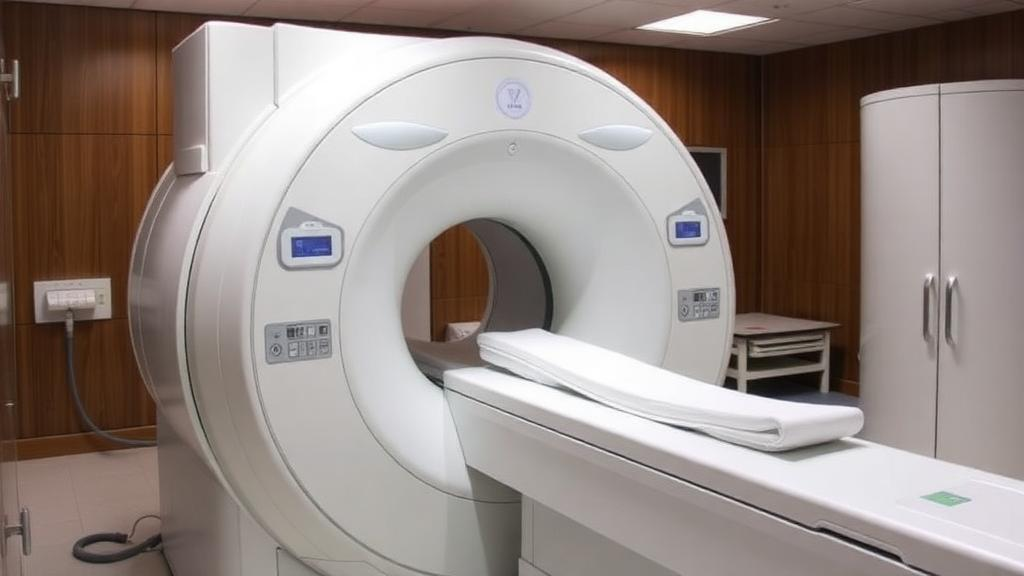
Magnetic resonance imaging has become one of the most indispensable diagnostic tools in modern medicine, capable of resolving exquisite detail in soft tissue without ionizing radiation. Yet the machines themselves are extraordinarily expensive to buy, house, and maintain, with superconducting magnets demanding continuous cooling and specialized technical support. For hospitals in low- and middle-income countries, where health budgets are stretched thin, the question of whether to run MRI units internally or hand them over to private contractors has long been debated without firm numbers behind it. A new economic evaluation from Iran now offers some of the most concrete evidence to date, and the verdict is striking: outsourcing delivered dramatically shorter waits for patients and turned a persistent financial loss into a meaningful surplus.
The study, conducted by researchers at Shahid Sadoughi University of Medical Sciences in Yazd and published in BMC Health Services Research, compared two public hospitals during 2021 and 2022. One operated its MRI service in-house through the hospital’s own staff and budget. The other had outsourced the entire unit to a private provider under a contractual arrangement. Rather than relying on impressions or anecdote, the team built a full economic accounting of both models, drawing on hospital financial records, administrative databases, and survey responses from 441 patients who had experienced one system or the other.
The technical backbone of the analysis rested on three established economic metrics. The researchers calculated the Average Cost-Effectiveness Ratio, which expresses total cost per unit of output; the Benefit-Cost Ratio, which divides measured benefits by total costs so that a value above one indicates the service pays for itself; and the Net Financial Result, the straightforward difference between income and expenditure. Because the comparison covered a single period, no discounting of future costs was applied, simplifying the arithmetic without distorting the comparison. All direct and indirect costs, from salaries and equipment depreciation to shared hospital overheads, were fully allocated to the MRI departments so that neither model received a hidden subsidy.
The headline finding concerns waiting times, the interval between a physician’s imaging request and the delivery of the final radiology report. In the in-house hospital, patients waited an average of 11.62 days, with relatively tight variation around that mean. In the outsourced facility, the wait collapsed to just 2.74 days, a difference the authors report as highly statistically significant with a p-value below 0.001. For patients awaiting a diagnosis of a tumor, a demyelinating lesion, or a spinal cord compression, a difference of nearly nine days is not a bookkeeping curiosity; it can alter the trajectory of treatment and, in the gravest cases, the prognosis itself.
Quality of care, the dimension skeptics of outsourcing worry about most, told a more nuanced story. The researchers used the SERVQUAL questionnaire, a validated instrument with a high internal consistency in this sample, Cronbach’s alpha of 0.87, that probes five dimensions of perceived service quality: tangibility, reliability, responsiveness, assurance, and empathy. Overall scores did not differ significantly between the two hospitals, registering 58.16 for the outsourced service against 57.32 for the in-house unit, a gap easily within the range of chance. But when the individual dimensions were unpacked, two of them clearly favored the contracted provider. Tangibility, covering the physical environment and equipment, and empathy, reflecting the human warmth of the interaction, both scored significantly higher under outsourcing, with p-values of 0.02 and 0.01 respectively.
The financial ledger revealed the sharpest contrast. The outsourced unit cost far more to run each month, at 148,182 dollars against 54,815 dollars for the in-house service, but it also generated substantially more revenue, bringing in 173,784 dollars compared with just 42,260 dollars. The result was a positive Net Financial Result of 25,602 dollars per month from the provider’s perspective for the outsourced service, and even from the broader societal perspective, which folds in indirect costs borne by patients and society, it remained in the black at 9,135 dollars. The in-house model, by contrast, lost money on both counts, with a deficit of 12,555 dollars per month under each accounting frame.
The Benefit-Cost Ratios crystallized the asymmetry. Outsourcing scored 1.17 from the provider’s perspective and an eye-catching 8.73 from the societal perspective, meaning every dollar of cost returned more than eight dollars of measured societal benefit once the shorter waits and reduced patient burden were valued. The in-house model returned only 0.77, indicating that for every dollar spent, roughly 23 cents of value evaporated. Independent statistical tests, including t-tests and Mann-Whitney U comparisons, confirmed that the differences in waiting times and in the two favorable quality dimensions were unlikely to have arisen by chance.
What explains the outsourced unit’s performance? The authors do not claim a single mechanism, but the economics of contracting plausibly matter. A private operator with an incentive tied to throughput has strong reasons to optimize scheduling, minimize machine downtime, keep coils and cryogens in supply, and move reports off radiologists’ desks quickly. The higher revenue also suggests the outsourced machine was scanning more patients per month, spreading fixed costs across a larger volume, a textbook example of economies of utilization. Meanwhile, the improved tangibility and empathy scores hint that the contractor invested in the patient-facing environment and in front-desk service in ways the public hospital’s strained budget could not easily match.
For policymakers in Iran and across similarly constrained health systems, the practical message is that outsourcing is not a concession to austerity but a strategy that can simultaneously shorten queues and restore fiscal balance. The researchers are careful to temper enthusiasm: because overall perceived quality did not improve, and because the study did not measure clinical outcomes such as diagnostic accuracy or appropriateness of referrals, contracting governments must keep quality monitoring mechanisms firmly in place. The authors also flag unanswered questions for future work, including whether outsourcing erodes the teaching mission of academic medical centers and how patient complexity differs between the two models.
The study arrives at a moment when many national health services, from the Middle East to South Asia to stretched systems in Europe, are rethinking how to finance high-capital diagnostic technology. Its contribution is methodological as much as substantive: a transparent, dual-perspective cost accounting applied to a real-world contractual arrangement, complete with validated patient-reported quality data. If the Yazd findings replicate elsewhere, the humble purchase order, the contract that hands an MRI scanner to a private operator, may prove to be as consequential for patient outcomes as any advance in magnet technology itself.
Subject of Research: Economic evaluation of outsourced versus in-house MRI services in Iranian hospitals
Article Title: Economic evaluation of outsourcing versus in-house MRI services: evidence from Iranian hospitals
Article References: Pakdaman, M., Sadooghian, M., Askari, R., Rahimi, M. K., Zarezadeh, M., & Madadizade, F. (2026). Economic evaluation of outsourcing versus in-house MRI services: evidence from Iranian hospitals. BMC Health Services Research. https://doi.org/10.1186/s12913-026-15758-7
Image Credits: AI Generated
DOI: 10.1186/s12913-026-15758-7
Keywords: MRI, outsourcing, health economics, cost-effectiveness, waiting time, SERVQUAL, Iran, hospital management, benefit-cost ratio, health services research, medical imaging, public hospitals
News Source: Ophelia Keating. (October 12, 2026). Hospitals That Outsource MRI Scans Cut Waiting Times and Turn a Profit. Scienmag.