German physicists generate exotic quantum state in an atomically thin crystal
Credit: Johannes Michl
At extremely low temperatures, matter often behaves differently than in normal conditions. At temperatures only a few degrees above absolute zero (-273 degrees Celsius), physical particles may give up their independence and merge for a short time into a single object in which all the particles share the same properties. Such structures are known as Bose-Einstein Condensates, and they represent a special aggregate state of matter.
An international team of researchers led by physicists Dr Carlos Anton-Solanas and Professor Christian Schneider from the UNiversity of Oldenburg has now succeeded for the first time in generating this unusual quantum state in charge carrier complexes that are closely linked to light particles and located in ultrathin semiconductor sheets consisting of a single layer of atoms. As the team reports in the scientific journal Nature Materials, this process produces light similar to that generated by a laser. This means that the phenomenon could be used to create the smallest possible solid-state lasers.
The work is the result of a collaboration between the Oldenburg researchers and the research groups of Professor Sven Höfling and Professor Sebastian Klembt from the University of Würzburg (Germany), Professor Sefaattin Tongay from Arizona State University (USA), Professor Alexey Kavokin from Westlake University (China), and Professor Takashi Taniguchi and Professor Kenji Watanabe from the National Institute of Materials Science in Tsukuba (Japan).
The study focuses on quasi particles that consist of both matter and light, known as exciton-polaritons – the product of strong couplings between excited electrons in solids and light particles (photons). They form when electrons are stimulated by laser light into a higher energy state. After a short time in the order of one trillionth of a second, the electrons return to their ground state by re-emitting light particles.
When these particles are trapped between two mirrors, they can in turn excite new electrons – a cycle that repeats until the light particle escapes the trap. The light-matter hybrid particles that are created in this process are called exciton-polaritons. They combine interesting properties of electrons and photons and behave in a similar way to certain physical particles called bosons. “Devices that can control these novel light-matter states hold the promise of a technological leap in comparison with current electronic circuits,” said lead author Anton-Solanas, a postdoctoral researcher in the Quantum Materials Group at the University of Oldenburg’s Institute of Physics. Such optoelectronic circuits, which operate using light instead of electric current, could be better and faster at processing information than today’s processors.
In the new study, the team led by Anton-Solanas and Schneider looked at exciton-polaritons in ultrathin crystals consisting of a single layer of atoms. These two-dimensional crystals often have unusual physical properties. For example, the semiconductor material used here, molybdenum diselenide, is highly reactive to light.
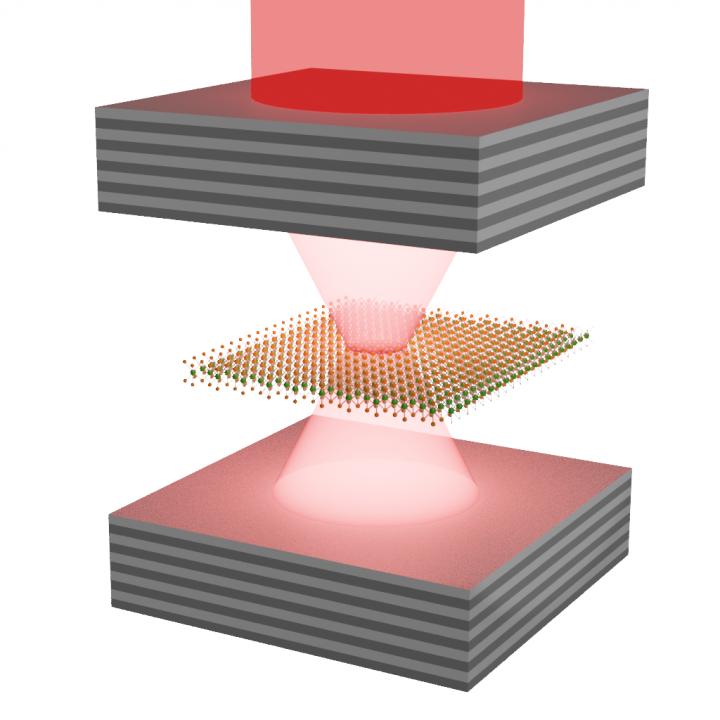
The researchers constructed sheets of molybdenum diselenide less than one nanometre (a billionth of a metre) thick and sandwiched the two-dimensional crystal between two layers of other materials that reflect light particles like mirrors do. “This structure acts like a cage for light,” Anton-Solanas explained. Physicists call it a “microcavity”.
Anton-Solanas and his colleagues cooled their setup to a few degrees above absolute zero and stimulated the formation of exciton-polaritons using short pulses of laser light. Above a certain intensity they observed a sudden increase in the light emissions from their sample. This, together with other evidence, allowed them to conclude that they had succeeded in creating a Bose-Einstein Condensate out of exciton-polaritons.
“In theory, this phenomenon could be used to construct coherent light sources based on just a single layer of atoms,” said Anton-Solanas. “This would mean we had created the smallest possible solid-state laser.” The researchers are confident that with other materials the effect could also be produced at room temperature, so that in the long term it would also be suitable for practical applications. The team’s first experiments heading in this direction have already been successful.
The study is a result of the “unlimit2D” project led by Christian Schneider, which is funded by a Starting Grant from the European Research Council (ERC). The experiments were conducted at the University of Würzburg.
###
Media Contact
Dr. Carlos Anton-Solanas
[email protected]
Related Journal Article
http://dx.