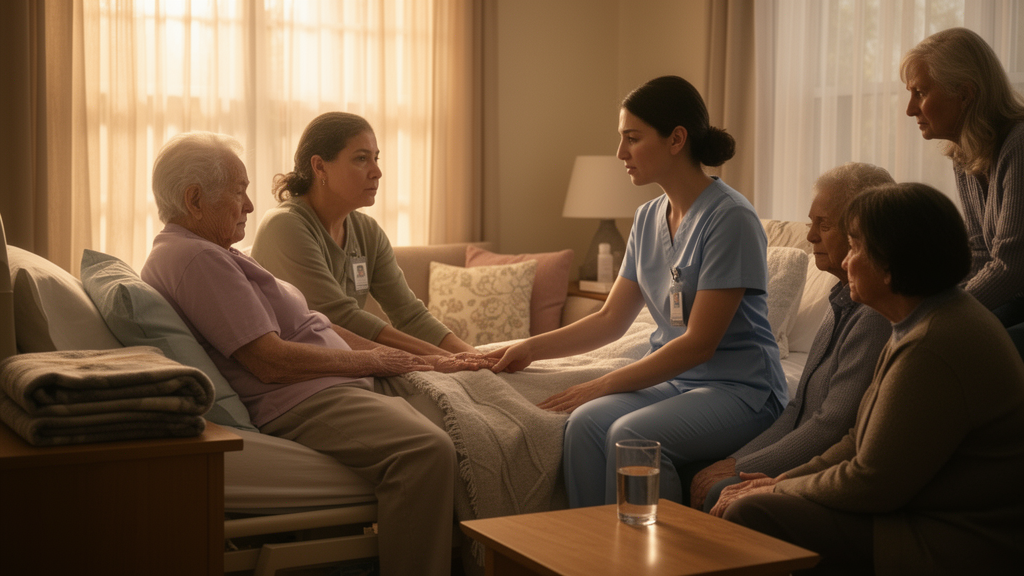
Home-based hospice nurses in Taiwan gradually come to see themselves not just as clinicians but as trusted figures within dying patients’ families, according to a qualitative narrative inquiry published in BMC Palliative Care. The study, which drew on in-depth interviews with ten certified home-based hospice nurses, traced how these professionals formed their identities and sustained their commitment to end-of-life care across their careers. Among the most striking images to emerge was that of the nurse as the family’s “last piece of driftwood” — something to cling to when a loved one is dying at home.
The research team, led by Ning-Hsuan Chang with colleagues including Yvonne Hsiung, Su-Fen Cheng and Chien-Lin Kuo, conducted the interviews between November 2021 and March 2022. Participants were recruited through purposive and snowball sampling, and each interview lasted between 50 and 195 minutes. The researchers adopted a life-course perspective and analyzed the accounts using Polkinghorne’s narrative analysis, supported by Kelly and Howie’s procedures for organizing narratives and interpreting them across cases. This design captures how nurses make sense of their working lives as unfolding stories rather than isolated events, though as a small qualitative study of ten nurses in one country, its findings are descriptive rather than generalizable.
Home-based hospice care extends palliative care into patients’ own homes, requiring nurses to provide clinical, emotional, practical and existential support within family contexts. Although these nurses occupy a central role in the model, the authors note that little was previously known about how they develop professional identity and sustain commitment while managing the emotional and relational demands of caring for people at the end of life.
The participants’ career stories revealed a developmental journey: nurses entered the profession searching for direction, then gradually became trusted relational caregivers within patients’ homes and families. Four themes organized this journey — searching for a place in nursing; finding meaning beyond clinical tasks; walking through the valley with patients and families; and sustaining self while caring for others. Relationships with patients and families were central to both identity formation and long-term commitment.
The driftwood metaphor came from two participants, one of whom described being the family’s “last piece of driftwood.” The authors present this imagery as reflecting a broader pattern across the narratives: a strong sense of emotional responsibility, the trust families placed in nurses, and the ongoing negotiation of professional boundaries.
The study’s conclusions emphasize that professional identity in home-based hospice nursing is shaped through relational caregiving, repeated encounters with suffering and death, reflective practice, team support and lifelong learning. The authors argue that these findings point to the importance of educational and workforce support strategies that strengthen emotional boundary-setting, communication, relational ethics and interprofessional collaboration — supports they suggest are needed to sustain the home-based hospice nursing workforce.
Subject of Research: Professional identity formation among home-based hospice nurses in Taiwan
Article Title: Becoming the family’s last piece of driftwood: a narrative inquiry into professional identity formation among home-based hospice nurses
Article References: Chang, N.-H., Hsiung, Y., Cheng, S.-F., & Kuo, C.-L. (2026). Becoming the family’s last piece of driftwood: a narrative inquiry into professional identity formation among home-based hospice nurses. BMC Palliative Care. https://doi.org/10.1186/s12904-026-02367-8
Image Credits: AI Generated
DOI: 10.1186/s12904-026-02367-8
Keywords: hospice care, palliative care, home-based nursing, professional identity, narrative inquiry, qualitative research, end-of-life care, Taiwan, nursing workforce, emotional boundaries, Becoming, family
News Source: Ophelia Keating. (October 28, 2026). Home hospice nurses describe becoming the family’s last piece of driftwood. Scienmag.