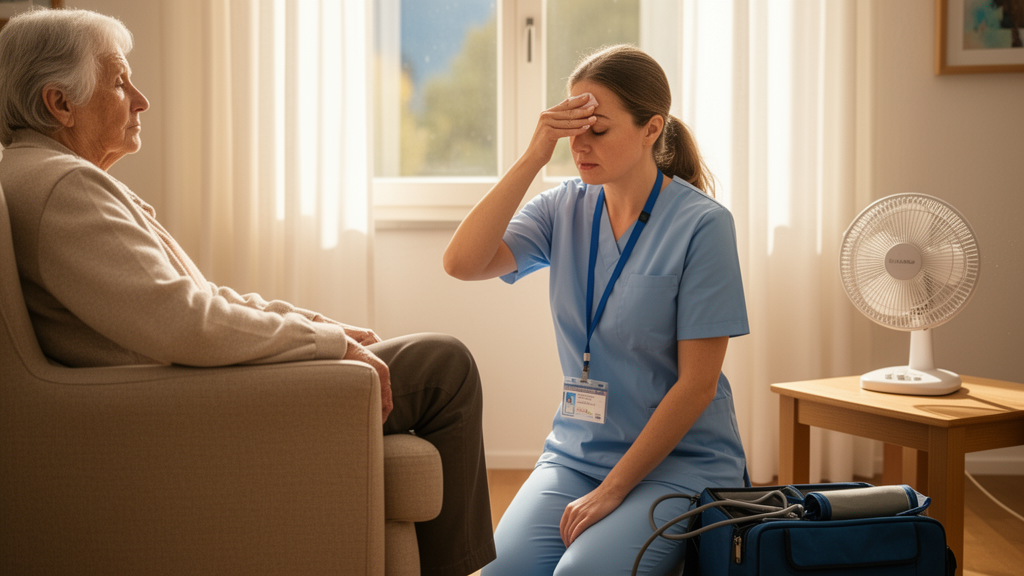
In a cross-sectional survey of 359 home health care workers published in BMC Public Health, 86 percent of participants said that working on hot days above 30 degrees Celsius felt rather or very strenuous, and 90 percent reported at least one symptom they attributed to heat exposure. The study, led by Remo Fortunato and colleagues, is the first to examine perceived heat strain specifically among home health care workers, a mobile and largely overlooked segment of the health care workforce that delivers nursing and ambulatory care inside patients' private residences. The survey ran from late August until late September 2024 and covered two climatically distinct regions of Switzerland: north-eastern Switzerland, comprising the cantons of Zürich and Thurgau with a temperate climate, and southern Switzerland, the canton of Ticino, which has a Mediterranean climate and is the warmest region in the country.
In the weeks before and during data collection, temperatures repeatedly climbed above 30 degrees Celsius; Zurich alone recorded ten days above that threshold in August 2024. Mean August temperatures were 20.4 degrees Celsius in the north-east and 24.8 degrees Celsius in the south, providing a natural contrast for studying how regional climate shapes occupational heat exposure. Participants were recruited through two large home health care organizations in the north-east and, in the south, through a public list of freelance workers, associations, and private and public organizations, using snowball sampling.
The questionnaire, administered online via Redcap, drew on validated instruments from prior occupational heat stress studies. The central outcome, perceived heat strain, was measured with a single item asking how strenuous the heat is at work on hot days above 30 degrees Celsius, with response options ranging from not at all to very strenuous. Because only three respondents reported no heat strain at all, those answers were merged with the lowest category for analysis.
The researchers note that while subjective perception does not directly equal physiological strain, prior work by O'Connor and colleagues has shown that self-reported heat strain maintains a significant linear relationship with objectively measured physiological indices across moderate occupational workloads. The symptom profile reported by participants was striking. Weakness, fatigue, or exhaustion was the most common complaint, affecting 68 percent of respondents, followed closely by excessive sweating at 65 percent.
Headaches affected 36 percent, irritability 28 percent, and dizziness or light-headedness 25 percent. Workers in southern Switzerland reported higher frequencies of symptoms than their northern counterparts, and these regional differences were statistically significant. The pattern is consistent with earlier research: a systematic review by Rossi and colleagues, along with studies by Venugopal and colleagues in India and Suter and colleagues in Indonesia, found similarly high prevalence of fatigue and sweating among heat-exposed workers, though those studies were conducted in tropical climates.
The Swiss data extend this evidence to a temperate setting. Workload emerged as a central theme. Thirty-four percent of respondents said their workload increased a lot on hot days, and another 34 percent said it increased somewhat.
This is not incidental: many of the clients served by home care organizations are elderly or otherwise vulnerable to heat-related health effects, so heatwaves simultaneously raise the demand for care and the physical burden on those delivering it. In 2024, Swiss home care organizations supported 476,413 clients with a workforce of 68,707 workers, who provided more than 25.6 million hours of health care, underscoring the scale of the sector that stands to be affected as summers warm. Working conditions in home care differ fundamentally from those in hospitals or offices.
These workers commute between clients' residences, often under time pressure, and perform physically strenuous tasks such as lifting people. Their transportation choices differ sharply by region: 96 percent of workers in southern Switzerland reported traveling by car between clients, while in the north-east 56 percent used an e-Bike and 15 percent a bicycle, a statistically significant difference. Crucially, neither the workers nor their employers can regulate the temperature of the rooms in which they work, since those rooms are private homes.
Hydration emerged as a surprisingly common problem. Forty-three percent of respondents reported frequently constraining their water intake on hot days, citing lack of time, restroom availability, and similar constraints. Previous research has shown that sufficient hydration positively affects heat tolerance, making constrained hydration a plausible contributor to the heat strain these workers experience.
The statistical core of the study is an ordinal logistic regression model identifying factors associated with higher perceived heat strain. Experiencing any heat-related symptoms was associated with 5.27 times higher odds (95 percent CI 2.20 to 12.88). Working in southern Switzerland carried 3.98 times higher odds (95 percent CI 2.11 to 7.61), seeking cool environments to rest carried 3.78 times higher odds (95 percent CI 1.55 to 9.60), and constrained hydration carried 2.59 times higher odds (95 percent CI 1.35 to 5.02).
The researchers also tested whether region moderated the effects of workload, cool-environment breaks, and hydration; these interactions were not significant and did not improve model fit, so they were dropped from the final model. The finding that seeking cool environments was associated with higher perceived heat strain is worth reading carefully. It does not suggest that cooling off is harmful; rather, it indicates that workers who perceive heat as more strenuous respond by seeking cool places to rest, a behavioral adaptation that tracks their perceived burden.
The association between heat strain and heat-related symptoms likewise reflects the co-occurrence of subjective strain and symptomatic distress, and the authors are careful to frame these as associations from a cross-sectional design rather than causal effects. Because both the outcome and the independent variables were self-reported, the estimates are susceptible to recall and reporting bias, an inherent limitation of survey studies of this kind. Several further caveats shape how the results should be interpreted.
Participants were recruited through convenience and snowball sampling, which the authors acknowledge likely overrepresented workers experiencing significant heat strain, since those with milder symptoms or higher thermal tolerance may have been less inclined to participate; the reported prevalence rates may therefore overestimate the true population burden. The study did not collect data on some potential covariates such as body mass index or menopausal status, and it is bound to the Swiss home care system, limiting transferability to other climates or regulatory frameworks. The sample was 88 percent female and had a mean age of 44.8 years, mirroring the sex distribution of the workforce, which means the data are robust for women but cannot probe gender differences or heat strain features specific to men.
No objective measurements of environmental heat exposure or physiological indicators were collected concurrently with the survey responses. Despite these limitations, the study fills a genuine gap. Most research on occupational heat stress has focused on outdoor workers such as construction and agricultural laborers, and the limited literature on health care workers has centered on heat strain caused by personal protective equipment during the COVID-19 pandemic.
A controlled environmental chamber experiment by Quartucci and colleagues in 2024 found that heat exposure negatively affected thermal comfort, perceived exertion during health care tasks, and psychological strain such as concentration difficulties and nervousness. The authors argue that their findings point toward heat-protection measures tailored to the specific characteristics of home care work: reducing workload on hot days, improving hydration opportunities, and accounting for regional climate differences. The team suggests that future research should develop appropriate heat protection measures and test them in a randomized controlled trial.
As climate change pushes summer temperatures higher and an ageing population increases the demand for home-based care, the intersection of these two trends makes the heat resilience of this essential workforce a growing public health concern rather than a niche occupational question.
Subject of Research: Occupational heat strain and heat-related symptoms among home health care workers in Switzerland
Article Title: Occupational heat strain among home health care workers: a cross-sectional study
Article References: Fortunato, R., Ragettli, M. S., Gerosa, T., Dratva, J., & Baumann, I. (2026). Occupational heat strain among home health care workers: a cross-sectional study. BMC Public Health, 26(1), Article 2690. https://doi.org/10.1186/s12889-026-28969-8
Image Credits: AI Generated
DOI: 10.1186/s12889-026-28969-8
Keywords: occupational heat strain, home health care workers, Switzerland, cross-sectional survey, heat-related symptoms, hydration, workload, climate change, occupational health, Ticino, nursing, public health
News Source: Sloane Callahan. (October 28, 2026). Home health care workers report substantial heat strain on hot days, Swiss survey finds. Scienmag.