Germany is often held up as a model for medical rehabilitation, with a dense network of inpatient clinics and outpatient programs covering everything from orthopedic recovery to neurological care. Yet a new study suggests that this well-developed system leaves a striking hole in its middle: patients under the age of 60 who live with complex, multiple impairments. According to a cross-sectional survey of 136 experts from across Germany, published in BMC Health Services Research, current rehabilitation services fail to meet the needs of this younger group, and home-based rehabilitation delivered across medical indications could be the missing bridge.
The research, led by Christoph Armbruster, Christian Schlett, and Erik Farin-Glattacker of the Section of Health Care Research and Rehabilitation Research at the University of Freiburg, set out to systematically capture what experts on the ground actually see. Between March and May 2024, the team ran an online survey with professionals from six different fields, including physicians in private practice, who made up the majority of respondents. The study was exploratory, meaning it was designed to map the landscape of expert opinion rather than test a hypothesis, and it was registered in advance in the German Clinical Trials Register under DRKS00029068.
The technical logic behind the study is worth unpacking. German rehabilitation care is organized indication by indication: a patient recovering from a stroke enters a neurological rehab pathway, a patient with severe orthopedic damage enters a different one. This siloed structure works reasonably well for older adults, whose rehab needs often fit a single dominant diagnosis. But for younger people with complex impairments, such as combinations of neurological, musculoskeletal, and psychological limitations, the needs do not respect diagnostic boundaries. First evidence suggested that outpatient and inpatient services leave care gaps that hit this group hardest, and that only a handful of home-based rehabilitation services currently exist for patients under 60.
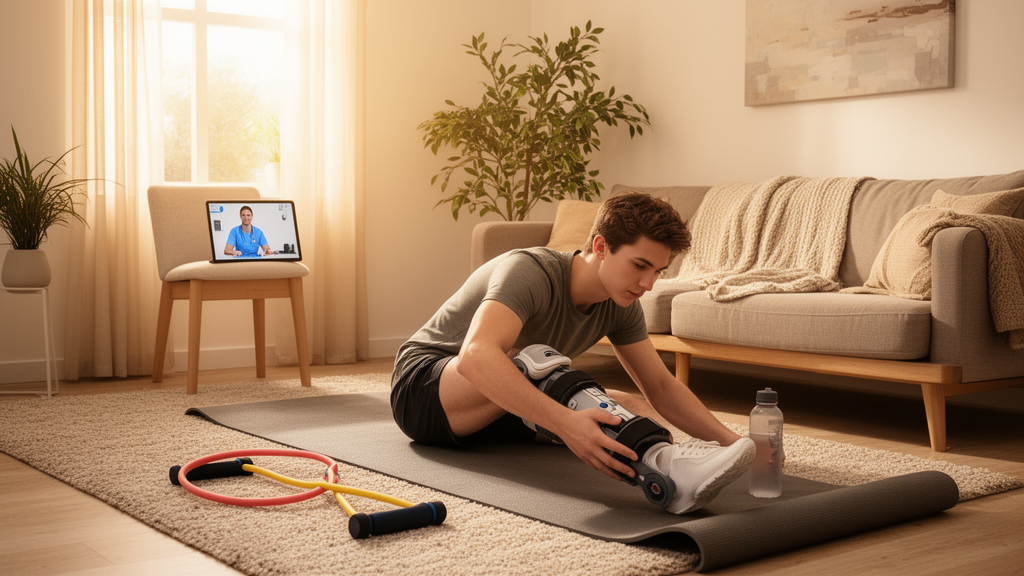
Home-based rehabilitation, abbreviated HbR in the study, refers to rehab services delivered in the patient’s own home rather than in a clinic. The concept has gained attention internationally because it can reach people who cannot easily travel to facilities, and because it allows therapy to be embedded directly in the environment where patients actually live and function. The Freiburg team asked whether HbR, if conceptualized across all indications rather than for a single diagnosis, could serve as a needs-based complement for younger patients whose rehabilitation needs must be treated in their entirety.
The survey results paint a consistent picture. The experts tend to see a high level of unmet care needs in current rehabilitation services for people under 60 with complex impairments. In other words, from the perspective of the professionals who refer, treat, and pay for rehab, the existing system does not adequately cover this group. The researchers also explored whether experts from different professional fields differed in their assessments, reporting descriptive statistics across a wide range of aspects of rehabilitation care and examining group differences on topics such as rehab services and access, home care and nursing homes, HbR in general, and the cross-indication approach.
On the central question, the experts’ assessments were positive on all three fronts the study examined. They saw a genuine need for home-based rehabilitation, they rated its benefits favorably, and they viewed a cross-indication approach, in which allocation is not tied to a single diagnosis, as a sensible way to organize such services. This alignment matters because a cross-indication model is a structural innovation: instead of asking which rehab clinic a patient qualifies for, the system would ask what functioning-related needs the patient has and allocate home-based rehab accordingly, drawing on the International Classification of Functioning, Disability, and Health as the conceptual frame for disability and rehabilitation.
The study also probed the practical question of indication and allocation criteria, asking experts which patients should be assigned to cross-indication home-based rehabilitation and on what grounds. This is where the findings become directly actionable for health services planners. If the experts’ views converge on criteria that reference complexity of impairment and insufficiency of existing services rather than specific diagnoses, then a cross-indication HbR service could be designed to fill precisely the gaps the survey identified, complementing rather than replacing the indication-specific landscape.
The authors are careful about the limits of their evidence. The survey is exploratory and cross-sectional, capturing expert opinion at a single point in time from a sample in which physicians in private practice predominated. Expert views are a crucial form of evidence for mapping care gaps that patient-level studies have not yet systematically covered, but they are not the same as outcome data. The authors conclude that cross-indication home-based rehabilitation is a promising but still empirically under-evaluated approach to optimizing the functioning of this patient group, a formulation that explicitly flags the need for evaluation studies before the model is rolled out at scale.
Why does this matter beyond Germany? The demographic structure of rehabilitation systems in many high-income countries is tilted toward older adults, and younger people with severe, combined impairments are a small but high-need population whose care often falls between the cracks of pediatric services, adult rehab, and long-term care. The German finding that experts across professional fields perceive substantial unmet needs in this group is likely to resonate with clinicians and researchers elsewhere who see the same pattern. Home-based rehabilitation, delivered across indications, offers a technically plausible answer because it decouples service allocation from diagnosis and embeds therapy in daily life, which is exactly where functioning is built or lost.
The study, conducted in accordance with the Declaration of Helsinki and approved by the ethics commission of the Albert-Ludwigs-University in Freiburg, with participants providing informed consent, received open access funding organized by Projekt DEAL. Its conclusions point to a concrete next step for the field: designing and evaluating cross-indication home-based rehabilitation services as a complementary layer in the care system, targeted at people under 60 with complex impairments whose needs the current landscape does not cover. If subsequent empirical studies confirm what these 136 experts perceive, the siloed architecture of rehabilitation could gain a flexible, home-based complement that finally reaches the patients the system currently misses.
Subject of Research: Health Services Research
Article Title: Bridging gaps in the care of people under the age of 60 with complex impairments through cross-indication home-based rehabilitation: a cross-sectional survey with experts in Germany
Article References: Armbruster, C., Schlett, C., & Farin-Glattacker, E. (2026). Bridging gaps in the care of people under the age of 60 with complex impairments through cross-indication home-based rehabilitation: a cross-sectional survey with experts in Germany. BMC Health Services Research, 26(1), Article 1305. https://doi.org/10.1186/s12913-026-15682-w
Image Credits: AI Generated
DOI: 10.1186/s12913-026-15682-w
Keywords: rehabilitation, home-based rehabilitation, care gaps, complex impairments, health services research, Germany, cross-indication care, disability, Bridging, gaps, care, people
News Source: Ophelia Keating. (October 18, 2026). Home-Based Rehabilitation Could Close Care Gaps for Younger Patients With Complex Impairments. Scienmag.