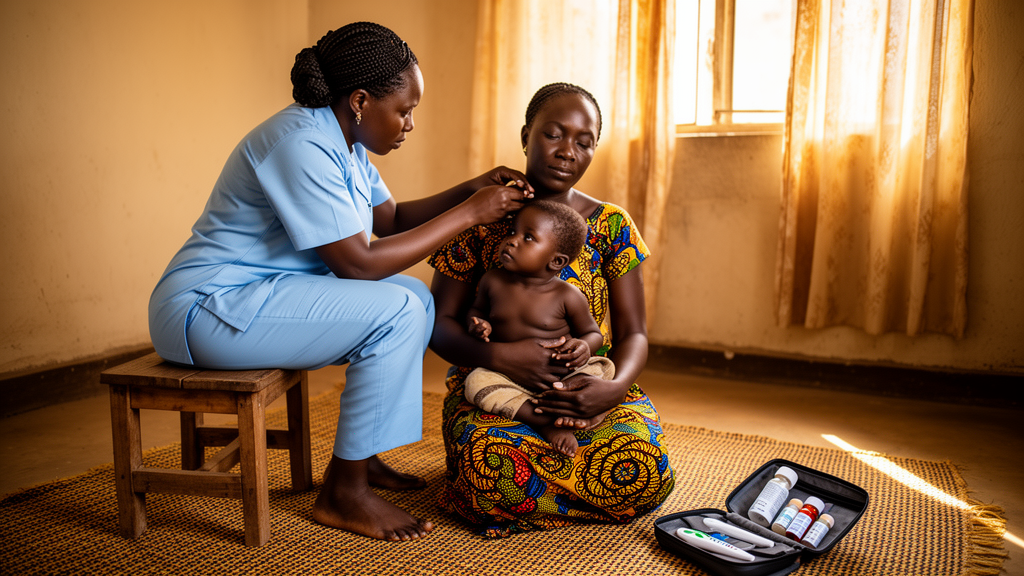
During Nigeria's largest recorded diphtheria epidemic, first notified on 1 December 2022 and exceeding 40,000 confirmed cases by January 2026, hospital capacity in Kano State was overwhelmed. In response, Médecins Sans Frontières introduced home-based care for patients with mild disease, a departure from the standard practice of treating all cases in dedicated diphtheria treatment centres. The study compared patients with mild diphtheria notified between January 2023 and January 2024 who were treated either at home or in a diphtheria treatment centre.
Cases were exactly matched on sex, age group, vaccination status, and ward of residence, and were interviewed between September and October 2024, a median of 421 days after notification. Of the 986 patients originally sampled, 491, or 49.8 percent, were interviewed; with 178 replacement patients of similar characteristics, 669 patients were analysed, comprising 362 in home-based care and 307 in treatment centres. The researchers used conditional logistic regression, adjusted for age, vaccination status, and treatment delay, to estimate the association between treatment modality and mortality, with robustness checked through propensity score weighting and sensitivity analyses.
After adjustment, mortality was lower among patients treated at home than in treatment centres, but the confidence interval included the null value, with an odds ratio of 0.36 (95 percent confidence interval 0.12 to 1.07; p = 0.066). Adding calendar time to the model gave a similar estimate (odds ratio 0.35, 95 percent confidence interval 0.08 to 1.57; p = 0.170). In other words, the data were consistent with a survival advantage for home-based care but could not rule out no difference between the settings.
Notably, home-based care was not associated with increased household transmission or long-term sequelae, addressing two of the principal concerns that might have made decentralised care risky. Two other factors emerged as more clearly linked to survival. Each additional day of delay before treatment was associated with increased mortality, with an odds ratio of 1.29 per day (95 percent confidence interval 1.00 to 1.67; p = 0.048).
Vaccination was associated with lower odds of death, with an odds ratio of 0.32 (95 percent confidence interval 0.10 to 0.98; p = 0.047). The authors are careful to spell out the limitations of the analysis. Only 24 deaths occurred in the cohort, which limits the statistical power to detect differences between care settings, and residual confounding by disease severity cannot be excluded, since patients treated at home were triaged as mild cases while those in treatment centres may have included patients whose condition was harder to classify.
The use of replacement patients when originally selected individuals could not be interviewed introduces further uncertainty, and roughly half of the sampled patients were never reached. The retrospective design also means the results reflect associations observed in one epidemic setting rather than the effects of a randomised comparison. Even with those caveats, the study carries practical weight for epidemic response.
The authors conclude that vaccination and early treatment were associated with survival, while the care setting itself was not clearly associated with outcomes. When supported by clinical triage and structured follow-up, decentralised care may be an option for managing mild cases during diphtheria epidemics in settings with constrained hospital capacity.
Subject of Research: Outcomes of home-based versus facility-based care for mild diphtheria during the Kano State, Nigeria epidemic
Article Title: Outcomes of home-based versus facility-based care for mild diphtheria during a large epidemic in Kano State, Nigeria: A retrospective matched cohort study
Article References: Polonsky, J., Hudu, S., Uthman, K., Katuala, Y., Evbuomwan, P. E., Osman, H. J. O., Sulaiman, A. K., Adjaho, I. I., Doumbia, C. O., Gignoux, E., & Ale, F. (2026). Outcomes of home-based versus facility-based care for mild diphtheria during a large epidemic in Kano State, Nigeria: A retrospective matched cohort study. PLOS Medicine, 23(10), e1005097. https://doi.org/10.1371/journal.pmed.1005097
Image Credits: AI Generated
DOI: 10.1371/journal.pmed.1005097
Keywords: diphtheria, Nigeria, Kano State, home-based care, Médecins Sans Frontières, retrospective cohort study, mortality, vaccination, household transmission, epidemic response, treatment delay, Outcomes
News Source: Kristina Jarvis. (October 27, 2026). Home-based care for mild diphtheria matched hospital outcomes in Nigeria’s record epidemic, study finds. Scienmag.