• HOME
  • NEWS
  • EXPLORE
    • CAREER
      • Companies
      • Jobs
    • EVENTS
    • iGEM
      • News
      • Team
    • PHOTOS
    • VIDEO
    • WIKI
  • BLOG
  • COMMUNITY
    • FACEBOOK
    • INSTAGRAM
    • TWITTER
Thursday, June 25, 2026
BIOENGINEER.ORG
No Result
View All Result
  • Login
  • HOME
  • NEWS
  • EXPLORE
    • CAREER
      • Companies
      • Jobs
        • Lecturer
        • PhD Studentship
        • Postdoc
        • Research Assistant
    • EVENTS
    • iGEM
      • News
      • Team
    • PHOTOS
    • VIDEO
    • WIKI
  • BLOG
  • COMMUNITY
    • FACEBOOK
    • INSTAGRAM
    • TWITTER
  • HOME
  • NEWS
  • EXPLORE
    • CAREER
      • Companies
      • Jobs
        • Lecturer
        • PhD Studentship
        • Postdoc
        • Research Assistant
    • EVENTS
    • iGEM
      • News
      • Team
    • PHOTOS
    • VIDEO
    • WIKI
  • BLOG
  • COMMUNITY
    • FACEBOOK
    • INSTAGRAM
    • TWITTER
No Result
View All Result
Bioengineer.org
No Result
View All Result
Home NEWS Science News Chemistry

Holographic fluorescence imaging

Bioengineer by Bioengineer
November 30, 2020
in Chemistry
Reading Time: 2 mins read
0
IMAGE
Share on FacebookShare on TwitterShare on LinkedinShare on RedditShare on Telegram

IMAGE

Credit: ICFO

Holography is best known for its ability to produce 3D images (holograms) by recording an interference pattern of light scattered by an object with some reference wave. This simple optical experiment records the amplitude as well as the normally invisible phase of the underlying electric field. Once known, this information can be used to simultaneously localize many individual particles in all 3 dimensions.

In biology though holography is less common, as the most suitable technique, combining sensitivity, resolution and specificity, is fluorescence imaging which is widely used in live cell imaging. It would be fantastic if one could combine fluorescence microscopy with holography and thus retrieve the full 3D distribution of fluorescently labeled entities inside a cell. Unfortunately, fluorescence is incoherent, with a very short path-length and phase memory, complicating the creation of a reference wave for any fluorescence interference and hence holography.

Now holographic fluorescence imaging is presented by ICFO researchers Matz Liebel and Jaime Ortega-Arroyo, working the groups of ICREA professors at ICFO Niek van Hulst and Romain Quidant. They implemented a scheme that eliminates the need for a reference wave. Instead, they used the intrinsic phase information of each individual photon to access its phase via a technique called lateral shearing-interferometry. In essence, rather than directly measuring the phase they measured the position-dependent phase change in wide-field using a CMOS camera. Next, they computationally integrated this information to recover the full electric field of fluorescent light with single-molecule sensitivity. The novel scheme expands the principle of digital holography to fast fluorescent detection by eliminating the need for phase cycling and enables 3D-tracking of individual nanoparticles with an in-plane resolution of 15 nm and a z-range of 8 micrometer.

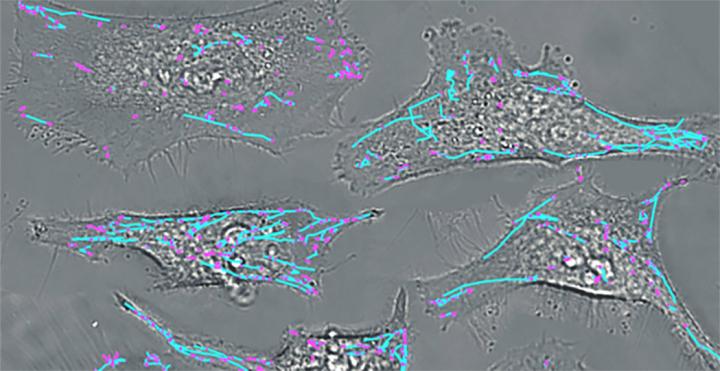
Liebel and Ortega-Arroyo then teamed up with the group of Hakho Lee at the Massachusetts General Hospital in Boston, to image and track the 3D motion of extracellular vesicles (EVs) inside live cells. They resolved both near-isotropic 3D diffusion as well as directional transport. Interestingly, for extended observation windows, they observed a transition toward anisotropic motion with the EVs being transported over long distances in the axial plane, confined in the horizontal dimension.

The fluorescence holography is directly compatible with present-day super-resolution modalities and equally well suited for other volumetric imaging challenges, such as tracking in tissue or calcium imaging. The work was recently published in Science Advances.

###

Media Contact
Alina Hirschmann
[email protected]

Tags: Biomechanics/BiophysicsChemistry/Physics/Materials SciencesMaterialsMolecular PhysicsNanotechnology/MicromachinesOptics
Share12Tweet8Share2ShareShareShare2

Related Posts

AI and Physics Collaborate to Design Advanced Hydrogen Storage Materials

June 25, 2026

International Team Including Dresden Scientists Develops Novel Designer Proteins for Advanced Study of Living Tissue

June 25, 2026

New Study Uncovers Key Factors Driving Water Chemistry in Nanoscale Environments

June 25, 2026

Plasma Technology Extends Catalyst Lifespan in Hydrogen Production

June 24, 2026
Please login to join discussion

POPULAR NEWS

  • Saying Goodbye to PGY-6: Pediatric Fellowship Realities

    103 shares
    Share 41 Tweet 26
  • Multi-Hospital Study Reveals Long Covid Burden Is Twice as High as Current Estimates

    92 shares
    Share 36 Tweet 23
  • Detection of EDCs in Breast Milk and Infant Urine Up to Six Months Highlights Early Exposure Risks

    77 shares
    Share 31 Tweet 19
  • New Drug Candidate Developed at McMaster Shows Potential for Treating Brain Cancer

    58 shares
    Share 23 Tweet 15

About

We bring you the latest biotechnology news from best research centers and universities around the world. Check our website.

Follow us

Recent News

Tracking Lanthanide-Labeled Microplastics in Plants

POSTECH Researchers Slash Cost of Reconstituted Cell-Free Systems by 95%

AI and Physics Collaborate to Design Advanced Hydrogen Storage Materials

Subscribe to Blog via Email

Enter your email address to subscribe to this blog and receive notifications of new posts by email.

Join 82 other subscribers
  • Contact Us

Bioengineer.org © Copyright 2023 All Rights Reserved.

Welcome Back!

Login to your account below

Forgotten Password?

Retrieve your password

Please enter your username or email address to reset your password.

Log In
No Result
View All Result
  • Homepages
    • Home Page 1
    • Home Page 2
  • News
  • National
  • Business
  • Health
  • Lifestyle
  • Science

Bioengineer.org © Copyright 2023 All Rights Reserved.