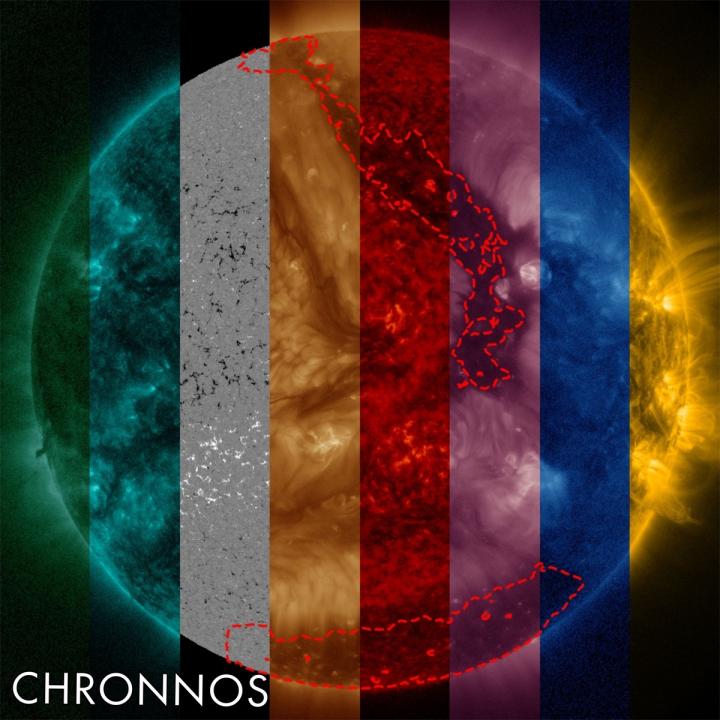
Scientists from the University of Graz (Austria), Skoltech and their colleagues from the US and Germany have developed a new neural network that can reliably detect coronal holes from space-based observations. This application paves the way for more reliable space weather predictions and provides valuable information for the study of the solar activity cycle. The paper was published in the journal Astronomy & Astrophysics.
Much like our life on Earth depends on the light of the Sun, our electronic “life” depends on the activity of our closest star and its interactions with Earth’s magnetic field. For the human eye, the Sun appears almost constant, but the Sun is very active, frequently showing eruptions and causing geomagnetic storms on Earth. For this reason, the outer solar atmosphere, the solar corona, is constantly being monitored by satellite-based telescopes.
In these observations, one of the prominent features are extended dark regions called coronal holes. They appear dark because plasma particles can escape along the magnetic field from the solar surface into interplanetary space, leaving a ‘hole’ in the corona. The escaping particles form high-speed solar wind streams that can eventually hit Earth, causing geomagnetic storms. The appearance and location of these holes on the Sun varies in dependence of the solar activity, giving us also important information on the long-term evolution of the Sun.
“The detection of coronal holes is a difficult task for conventional algorithms and is also challenging for human observers, because there are also other dark regions in the solar atmosphere, like filaments, that can be easily confused with a coronal hole,” says Robert Jarolim, a research scientist at the University of Graz and the lead author of the study.
In their paper, the authors describe a convolutional neural network called CHRONNOS (Coronal Hole RecOgnition Neural Network Over multi-Spectral-data) that they developed to detect coronal holes. “Artificial intelligence allows us to identify coronal holes based on their intensity, shape, and magnetic field properties, which are the same criteria as a human observer takes into account,” Jarolim says.
“The solar atmosphere appears very different when observed at different wavelengths. We used images recorded at different extreme ultraviolet (EUV) wavelengths along with magnetic field maps as input to our neural network, which enables the network to find relations in the multi-channel representation,” Astrid Veronig, professor at the University of Graz and co-author of the publication, adds.
The authors trained their model with about 1700 images in the 2010-2017 time range and showed that the method is consistent for all solar activity levels. The neural network was evaluated by comparing the results to 261 manually identified coronal holes, matching human labels in 98% of the cases. In addition, the authors examined the detection of coronal holes based on magnetic field maps, that appear vastly different than EUV observations. For a human, the coronal holes cannot be identified from these images alone, but the AI learned to perceive the images differently and was able to identify coronal holes.
“This is a promising result for future ground-based coronal hole detection, where we cannot directly observe coronal holes as dark regions as in space-based extreme ultraviolet and soft X-ray observations, but where the solar magnetic field is measured on a regular basis,” says Tatiana Podladchikova, assistant professor at the Skoltech Space Center and a co-author of the paper.
“And whatever storms may rage, we wish everyone a good weather in space”, concluded Podladchikova.
###
The new method was developed with the support of Skoltech’s high-performance cluster for the anticipated Solar Physics Research Integrated Network Group (SPRING) that will provide an autonomous monitoring of the Sun using cutting-edge technology of observational solar physics. SPRING is a part in the SOLARNET project launched in preparation to the European Solar Telescope (EST) initiative supported by the EU research and innovation funding program Horizon 2020. UniGraz and Skoltech represent Austria and Russia in the SOLARNET consortium of 35 international partners. Other institutions involved in this research include Columbia University (USA), Max-Planck-Institut für Sonnensystemforschung (Germany) and NorthWest Research Associates (USA).
Skoltech is a private international university located in Russia. Established in 2011 in collaboration with the Massachusetts Institute of Technology (MIT), Skoltech is cultivating a new generation of leaders in the fields of science, technology and business, is conducting research in breakthrough fields, and is promoting technological innovation with the goal of solving critical problems that face Russia and the world. Skoltech is focusing on six priority areas: data science and artificial intelligence, life sciences, advanced materials and modern design methods, energy efficiency, photonics and quantum technologies, and advanced research. Web: https:/
Video [https:/
Media Contact
Ilyana Zolotareva
[email protected]
Original Source
https:/
Related Journal Article
http://dx.