Repairing or replacing injured tendons or similar load-bearing tissues represents one of the major challenges in clinical medicine. Natural tendons are water-rich tissues exhibiting outstanding mechanical strength and durability. Their mechanical properties originate from sophisticated microscale structures involving stiff collagen fibrils aligned in parallel and interlaced with soft water-retaining biopolymers.
Credit: The University of Hong Kong
Repairing or replacing injured tendons or similar load-bearing tissues represents one of the major challenges in clinical medicine. Natural tendons are water-rich tissues exhibiting outstanding mechanical strength and durability. Their mechanical properties originate from sophisticated microscale structures involving stiff collagen fibrils aligned in parallel and interlaced with soft water-retaining biopolymers.
Over the past decades, researchers have been trying to use synthetic hydrogels, a class of water-rich materials involving polymer networks, to replicate the structures and properties of natural tendons. It remains difficult since synthetic hydrogels are usually weak and brittle. Resolving this mismatch would enable critical applications in tissue repair, biomedical robots, implantable devices, and many other technologies.
A research team led by Dr Lizhi Xu of the Department of Mechanical Engineering in the Faculty of Engineering at the University of Hong Kong (HKU) has developed a new type of tendon-mimetic hydrogel with outstanding mechanical properties matching those of natural tendons combined with multifunctionalities for biomedical applications.
The research was published in Science Advances, in an article entitled “Multifunctional tendon-mimetic hydrogels”. The research was also featured in Nature as a Research Highlight.
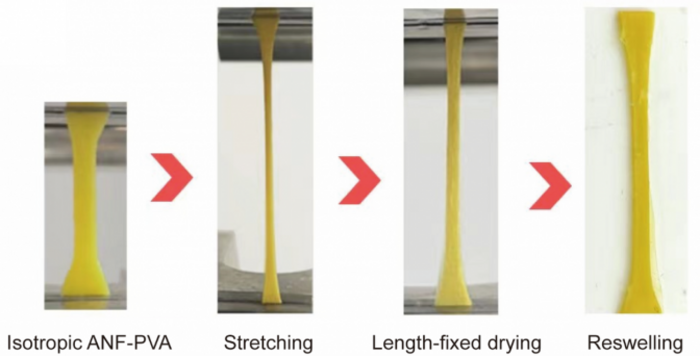
In this study, aramid nanofibers derived from Kevlar, a polymer material used in bullet-proof vests and helmets, were mixed with polyvinyl alcohol, another synthetic polymer, for the construction of tendon-mimetic hydrogels. With tensile stress applied during the fabrication process, aramid nanofibers aligned with each other according to the direction of stretching, leading to an anisotropic network mimicking the structural features of natural tendons.
The interactions between the stiff nanofibers and soft polymers further confer high mechanical toughness on the composites. This hydrogel consists of 60% water while showing an excellent Young’s modulus of ~1 GPa and strength of ~80 MPa, outperforming other synthetic hydrogels by orders of magnitude. The surface of the hydrogels can be further functionalised for directing the behaviours of cells or integrating with soft bioelectronic sensors.
“We developed a biomimetic materials platform for advanced biomedical applications. The materials building blocks captured many structural features of natural tendons, leading to amazing properties that are inaccessible with other synthetic hydrogels,” said Dr Xu, adding that “these hydrogels are not only mechanically strong but also functionalised with bioactive molecules and soft electronic sensors, providing critical capabilities for tissue repair and implantable medical devices.”
Link of the paper: https://www.science.org/doi/10.1126/sciadv.ade6973
Link of the Nature Research Highlight: https://www.nature.com/articles/d41586-023-00492-5
Media Enquiries
Ms Celia Lee, Faculty of Engineering, HKU (Tel: 3917 8519; Email: [email protected]) or
Ms Charis Lai, Faculty of Engineering, HKU (Tel: 3917 1924; Email: [email protected])
Journal
Science Advances
DOI
10.1126/sciadv.ade6973
Method of Research
Experimental study
Subject of Research
Not applicable
Article Title
Multifunctional tendon-mimetic hydrogels
Article Publication Date
17-Feb-2023