• HOME
  • NEWS
  • EXPLORE
    • CAREER
      • Companies
      • Jobs
    • EVENTS
    • iGEM
      • News
      • Team
    • PHOTOS
    • VIDEO
    • WIKI
  • BLOG
  • COMMUNITY
    • FACEBOOK
    • INSTAGRAM
    • TWITTER
Sunday, May 10, 2026
BIOENGINEER.ORG
No Result
View All Result
  • Login
  • HOME
  • NEWS
  • EXPLORE
    • CAREER
      • Companies
      • Jobs
        • Lecturer
        • PhD Studentship
        • Postdoc
        • Research Assistant
    • EVENTS
    • iGEM
      • News
      • Team
    • PHOTOS
    • VIDEO
    • WIKI
  • BLOG
  • COMMUNITY
    • FACEBOOK
    • INSTAGRAM
    • TWITTER
  • HOME
  • NEWS
  • EXPLORE
    • CAREER
      • Companies
      • Jobs
        • Lecturer
        • PhD Studentship
        • Postdoc
        • Research Assistant
    • EVENTS
    • iGEM
      • News
      • Team
    • PHOTOS
    • VIDEO
    • WIKI
  • BLOG
  • COMMUNITY
    • FACEBOOK
    • INSTAGRAM
    • TWITTER
No Result
View All Result
Bioengineer.org
No Result
View All Result
Home NEWS Science News Chemistry

HIV has been had

Bioengineer by Bioengineer
April 15, 2021
in Chemistry
Reading Time: 2 mins read
0
IMAGE
Share on FacebookShare on TwitterShare on LinkedinShare on RedditShare on Telegram

IMAGE

Credit: Department of Medicinal Chemistry, TMDU

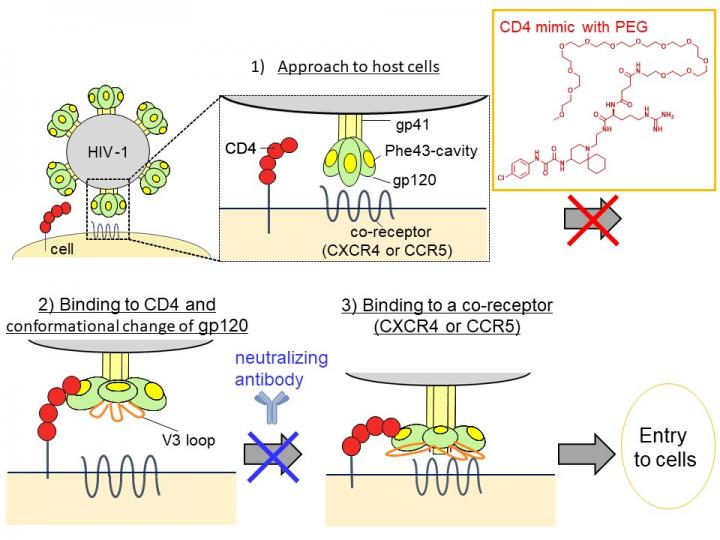
Tokyo, Japan – A team of scientists led by the Institute of Biomaterials and Bioengineering at Tokyo Medical and Dental University (TMDU) have created novel molecules that prevent human immunodeficiency virus (HIV) particles from attacking immune cells. This is accomplished by injecting compounds mimicking the protein the virus usually uses to enter the cells. This work may lead to new treatments for HIV that may be more effective at stopping the proliferation of the virus with fewer side effects.

HIV is a very dangerous pathogen because it attacks the very immune cells, including T helper cells, that are needed for the body to fight back. An HIV particle first gains entrance to a T helper cell by attaching to a CD4 protein on its surface. Once inside, the reproduction machinery of the T helper cell is hijacked to make copies of HIV, ultimately killing the host cell. Many treatments, such as antiretroviral drugs, attempt to block this reproduction process, but finding a way to prevent the HIV from attaching in the first place would be a better approach.

Now, a team of researchers led by Tokyo Medical and Dental University (TMDU) created a new family of molecules that act as decoy CD4 proteins. The HIV particles preferentially attach with the fake molecules, instead of those at the surface of a cell. The scientists found that adding a polyethylene glycol (PEG) improved the pharmacokinetics. “Hybrid molecules that mimic CD4 and also have a PEG unit attached with an uncleavable linker showed better anti-HIV activity with lower cytotoxicity,” first author Takuya Kobayakawa says.

Computer simulations run by the team supported the hypothesis that the hybrid molecule works better because it can interact electrostatically with a carboxylate group on the virus. In tests with a rhesus macaque, the hybrid molecule remained in the system longer compared with the parent compound. “These CD4 mimics have strong synergistic interactions with neutralizing antibodies for fighting HIV,” senior author Hirokazu Tamamura says. New combined treatment protocols may be developed to help take advantage of the new molecules. The work is published in the Journal of Medicinal Chemistry as “Hybrids of Small-Molecule CD4 Mimics with Polyethylene Glycol Units as HIV Entry Inhibitors.” (DOI:10.1021/acs.jmedchem.0c01153).

###

Media Contact
Hirokazu TAMAMURA
[email protected]

Original Source

https://www.tmd.ac.jp/english/press-release/20210127-1/

Related Journal Article

http://dx.doi.org/10.1021/acs.jmedchem.0c01153

Tags: Atomic/Molecular/Particle PhysicsBiochemistryBiomechanics/BiophysicsChemistry/Physics/Materials SciencesMolecular PhysicsPharmaceutical SciencesPharmaceutical/Combinatorial ChemistryPolymer Chemistry
Share13Tweet8Share2ShareShareShare2

Related Posts

Miniature Sensor Uses Light to Detect Touch — Chemistry

Miniature Sensor Uses Light to Detect Touch

May 8, 2026
Iron Minerals Determine Whether Dissolved Organic Matter Fuels Microbes or Becomes Long-Term Carbon Storage — Chemistry

Iron Minerals Determine Whether Dissolved Organic Matter Fuels Microbes or Becomes Long-Term Carbon Storage

May 8, 2026

Kate Evans Appointed Associate Lab Director for Biological and Environmental Systems Science at ORNL

May 8, 2026

Advancing Multiscale Modeling and Overcoming Operational Challenges in Autothermal CO₂-to-Methanol Reactors

May 8, 2026
Please login to join discussion

POPULAR NEWS

  • Research Indicates Potential Connection Between Prenatal Medication Exposure and Elevated Autism Risk

    840 shares
    Share 336 Tweet 210
  • New Study Reveals Plants Can Detect the Sound of Rain

    727 shares
    Share 290 Tweet 181
  • Scientists Investigate Possible Connection Between COVID-19 and Increased Lung Cancer Risk

    68 shares
    Share 27 Tweet 17
  • Salmonella Haem Blocks Macrophages, Boosts Infection

    61 shares
    Share 24 Tweet 15

About

We bring you the latest biotechnology news from best research centers and universities around the world. Check our website.

Follow us

Recent News

Evaluating Digoxin Use in Patients with Symptomatic Rheumatic Heart Disease

Evaluating the Effectiveness and Safety of Digitalis Glycosides in Treating Heart Failure

Urdu Fall Risk Questionnaire Adapted for Elderly

Subscribe to Blog via Email

Enter your email address to subscribe to this blog and receive notifications of new posts by email.

Join 82 other subscribers
  • Contact Us

Bioengineer.org © Copyright 2023 All Rights Reserved.

Welcome Back!

Login to your account below

Forgotten Password?

Retrieve your password

Please enter your username or email address to reset your password.

Log In
No Result
View All Result
  • Homepages
    • Home Page 1
    • Home Page 2
  • News
  • National
  • Business
  • Health
  • Lifestyle
  • Science

Bioengineer.org © Copyright 2023 All Rights Reserved.