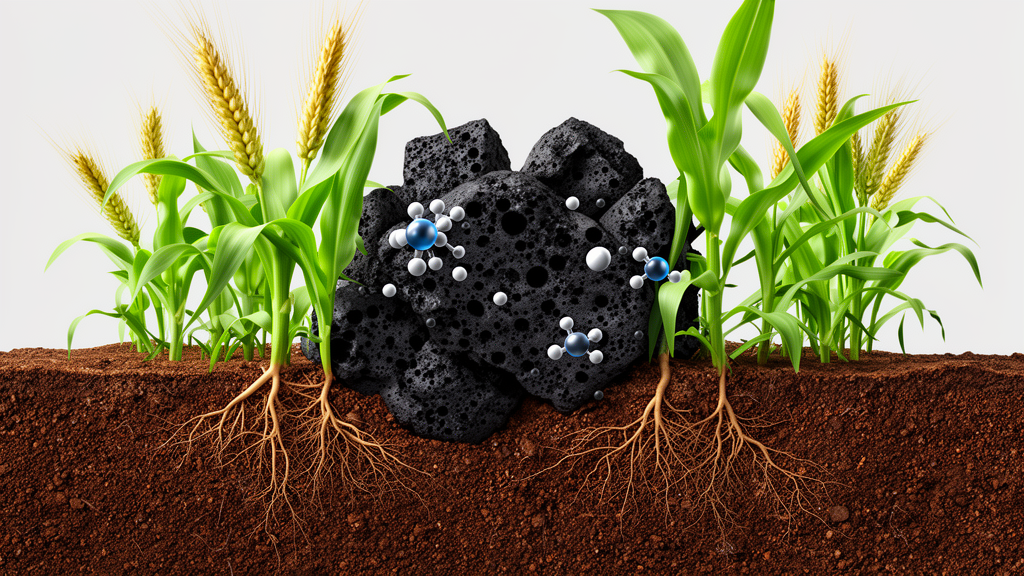
A study published in Chemical and Biological Technologies in Agriculture reports that nitrogen-enriched biochar with an optimized carbon-to-nitrogen ratio can enhance crop growth and yield while allowing for reduced application of chemical nitrogen fertilizers. The research, led by Muhammad Tauseef Jaffar and colleagues, evaluated the effects of different biochar types on maize and wheat under varying nitrogen fertilization levels. The findings suggest that specific biochar formulations can improve soil nitrogen dynamics and plant physiological efficiency, potentially offering a strategy to maintain agricultural productivity while decreasing reliance on synthetic fertilizers.
The study addressed a gap in understanding regarding the role of the carbon-to-nitrogen ratio in biochar and its interaction with nitrogen application rates. The researchers aimed to evaluate how nitrogen-enriched biochar affects nitrogen fractions, crop growth, and yield in cereal crops.
The experimental design involved three types of biochar: pristine biochar and two nitrogen-enriched types designated as NB1 and NB2. These were applied alongside a control group that received no biochar. The crops, maize and wheat, were subjected to three levels of nitrogen fertilization: 100%, 70%, and 40% of the recommended rate.
Results indicated that both nitrogen-enriched biochar types, NB1 and NB2, significantly increased nitrate nitrogen, available nitrogen, nitrogen uptake efficiency, and nitrogen partial factor productivity, regardless of the nitrogen application level.
At the 70% nitrogen fertilization level, the NB1 biochar showed particularly strong effects on soil organic matter. In maize, soil organic matter increased by 20.5% at maturity compared to the control group receiving the same nitrogen level. In wheat, the increase was 18.5% at maturity.
Under the 70% nitrogen level, NB1 significantly increased the activities of N-acetyl-glucosaminidase and leucine aminopeptidase in maize. At the tasseling stage, these activities rose by 114.9% and 98.5%, respectively, compared to the control. At maturity, the increases were 68.0% and 64.3%. In wheat, the corresponding increases were 70.1% and 47.1% at heading, and 30.1% and 42.0% at maturity.
Grain yield and harvest index were also improved by the biochar treatments. The greatest increase in grain yield and harvest index was observed with NB1 at the 70% nitrogen level.
Photosynthetic efficiency and chlorophyll content were enhanced by the nitrogen-enriched biochar, even at the reduced 70% nitrogen level.
The authors conclude that NB1 at 70% of the recommended nitrogen rate improved soil nitrogen dynamics, enzymatic activities, and photosynthetic efficiency, ultimately enhancing crop growth and yield. They highlight the potential of nitrogen-enriched biochar to reduce dependence on chemical nitrogen fertilizers while maintaining crop productivity. However, the study notes that long-term and multi-site studies are required to confirm these findings under diverse environmental conditions.
Subject of Research: Effects of nitrogen-enriched biochar on maize and wheat growth and soil properties under varying nitrogen fertilization
Article Title: N-enriched biochar with an optimized C:N ratio enhances crop growth by regulating enzymatic activities, soil properties, and photosynthetic efficiency under varying N fertilization
Article References: Jaffar, M. T., Ahmed, M., Zhang, F., Guo, J., Mukhtar, A., Li, X., Jabeen, S., Xue, S., Girkin, N., & Zhang, J. (2026). N-enriched biochar with an optimized C:N ratio enhances crop growth by regulating enzymatic activities, soil properties, and photosynthetic efficiency under varying N fertilization. Chemical and Biological Technologies in Agriculture. https://doi.org/10.1186/s40538-026-01104-w
Image Credits: AI Generated
DOI: 10.1186/s40538-026-01104-w
Keywords: biochar, nitrogen fertilization, maize, wheat, soil fertility, crop yield, carbon-to-nitrogen ratio, agricultural sustainability, soil enzymes, photosynthetic efficiency, N-enriched, optimized
News Source: Alan Morgan. (November 9, 2026). N-enriched biochar boosts maize and wheat yield at reduced nitrogen rates. Scienmag.