• HOME
  • NEWS
  • EXPLORE
    • CAREER
      • Companies
      • Jobs
    • EVENTS
    • iGEM
      • News
      • Team
    • PHOTOS
    • VIDEO
    • WIKI
  • BLOG
  • COMMUNITY
    • FACEBOOK
    • INSTAGRAM
    • TWITTER
Tuesday, May 19, 2026
BIOENGINEER.ORG
No Result
View All Result
  • Login
  • HOME
  • NEWS
  • EXPLORE
    • CAREER
      • Companies
      • Jobs
        • Lecturer
        • PhD Studentship
        • Postdoc
        • Research Assistant
    • EVENTS
    • iGEM
      • News
      • Team
    • PHOTOS
    • VIDEO
    • WIKI
  • BLOG
  • COMMUNITY
    • FACEBOOK
    • INSTAGRAM
    • TWITTER
  • HOME
  • NEWS
  • EXPLORE
    • CAREER
      • Companies
      • Jobs
        • Lecturer
        • PhD Studentship
        • Postdoc
        • Research Assistant
    • EVENTS
    • iGEM
      • News
      • Team
    • PHOTOS
    • VIDEO
    • WIKI
  • BLOG
  • COMMUNITY
    • FACEBOOK
    • INSTAGRAM
    • TWITTER
No Result
View All Result
Bioengineer.org
No Result
View All Result
Home NEWS Science News Biology

HIV-1 viral cores enter the nucleus collectively through the nuclear endocytosis-like pathway

Bioengineer by Bioengineer
June 1, 2020
in Biology
Reading Time: 2 mins read
0
IMAGE
Share on FacebookShare on TwitterShare on LinkedinShare on RedditShare on Telegram

IMAGE

Credit: ©Science China Press

It is widely acknowledged that the process of HIV-1 infecting cells undergoes the following steps: membrane fusion, viral core release, reverse transcription, capsid disassembly in cytoplasm, nuclear entry of the viral genome, and viral genome integration, followed by reproducing themselves using the host cell system. However, recent studies have found that viral capsid also exist in the nucleus, and play functions such as integration site selection and immune escape. The latest report proves that the HIV-1 viral capsid uncoated near the site of chromosome integration. Considering that the size of the virus carrying the capsid is much larger than the nuclear pores, how the viral cores pass through the nuclear membrane barrier remains mysterious.

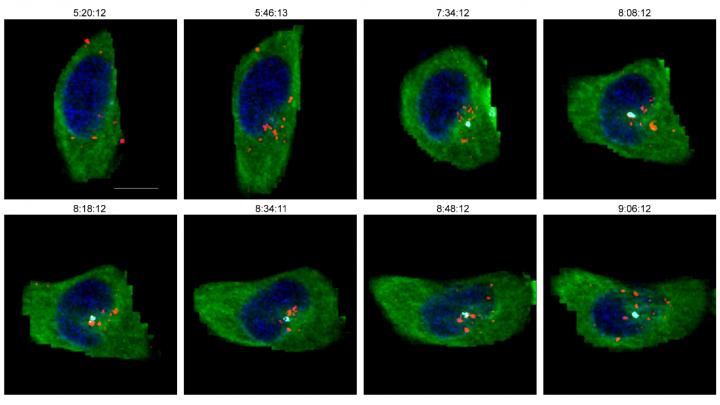
In response to this puzzle concerning, selected components of HIV-1 and the host cells are differentially labelled so that the Virus-host cell interaction can be dynamically tracked. It was found that after entering the cell, the viral particles moved along the microtubules and selectively gathered at the microtubule organization center (MTOC), leading the nearby nuclear envelope (NE) to undergo deformation, invagination and restoration to form a nuclear vesicle in which the viral particles were wrapped; then, the inner membrane of the nuclear vesicle ruptured to release HIV-1 into the nucleus. This phenomenon is similar to cell endocytosis and therefore called the “nuclear endocytosis-like pathway”. Factors involving in the process were preliminarily investigated. This discovery expands our understanding of the complexity of HIV-1 nuclear entry, which may provide new insights to HIV-1 virology. The molecular details and viral biology of the mechanism need further elucidation.

###

Institute of Biophysics, Chinese Academy of Sciences, Huazhong University, and other two CAS institutes the Wuhan Institute of Virology and the Institute of Synthetic Biology, Shenzhen Institutes of Advanced Technology participated in the study. This work was supported by the Strategic Priority Research Program of the Chinese Academy of Sciences (Grant No. XDB29050100).

See the article:

Li, X., Wang, D., Cui, Z., Li, Q., Li, M., Ma, Y., Hu, Q., Zhou, Y., and Zhang, X.E. (2020). HIV-1 viral cores enter the nucleus collectively through the nuclear endocytosis-like pathway. Sci China Life Sci 63, https://doi.org/10.1007/s11427-020-1716-x

Media Contact
Xian-En Zhang
[email protected]

Related Journal Article

http://dx.doi.org/10.1007/s11427-020-1716-x

Tags: Biology
Share12Tweet8Share2ShareShareShare2

Related Posts

Decoding the Tumor Microenvironment Chemokine Network: From Immune Evasion to Innovative Multi-Target Therapies — Biology

Decoding the Tumor Microenvironment Chemokine Network: From Immune Evasion to Innovative Multi-Target Therapies

May 19, 2026
New Study Uncovers “Bet-Hedging” Strategy Enabling Gut Bacteria to Survive and Thrive — Biology

New Study Uncovers “Bet-Hedging” Strategy Enabling Gut Bacteria to Survive and Thrive

May 19, 2026

Transcription Attenuation Boosts Rifampicin-Resistant TB Weaknesses

May 19, 2026

Decoding Darkness: Photoreceptor Functions With and Without Light

May 19, 2026
Please login to join discussion

POPULAR NEWS

  • Research Indicates Potential Connection Between Prenatal Medication Exposure and Elevated Autism Risk

    845 shares
    Share 338 Tweet 211
  • New Study Reveals Plants Can Detect the Sound of Rain

    731 shares
    Share 292 Tweet 182
  • Salmonella Haem Blocks Macrophages, Boosts Infection

    62 shares
    Share 25 Tweet 16
  • Breastmilk Balances E. coli and Beneficial Bacteria in Infant Gut Microbiomes

    58 shares
    Share 23 Tweet 15

About

We bring you the latest biotechnology news from best research centers and universities around the world. Check our website.

Follow us

Recent News

Scientists Enhance AI’s Capacity to Master New Tasks While Maintaining Performance

Seeing and Treating Tumors Simultaneously: Harnessing Click Chemistry to End Blind Battles

Decoding the Tumor Microenvironment Chemokine Network: From Immune Evasion to Innovative Multi-Target Therapies

Subscribe to Blog via Email

Enter your email address to subscribe to this blog and receive notifications of new posts by email.

Join 82 other subscribers
  • Contact Us

Bioengineer.org © Copyright 2023 All Rights Reserved.

Welcome Back!

Login to your account below

Forgotten Password?

Retrieve your password

Please enter your username or email address to reset your password.

Log In
No Result
View All Result
  • Homepages
    • Home Page 1
    • Home Page 2
  • News
  • National
  • Business
  • Health
  • Lifestyle
  • Science

Bioengineer.org © Copyright 2023 All Rights Reserved.