


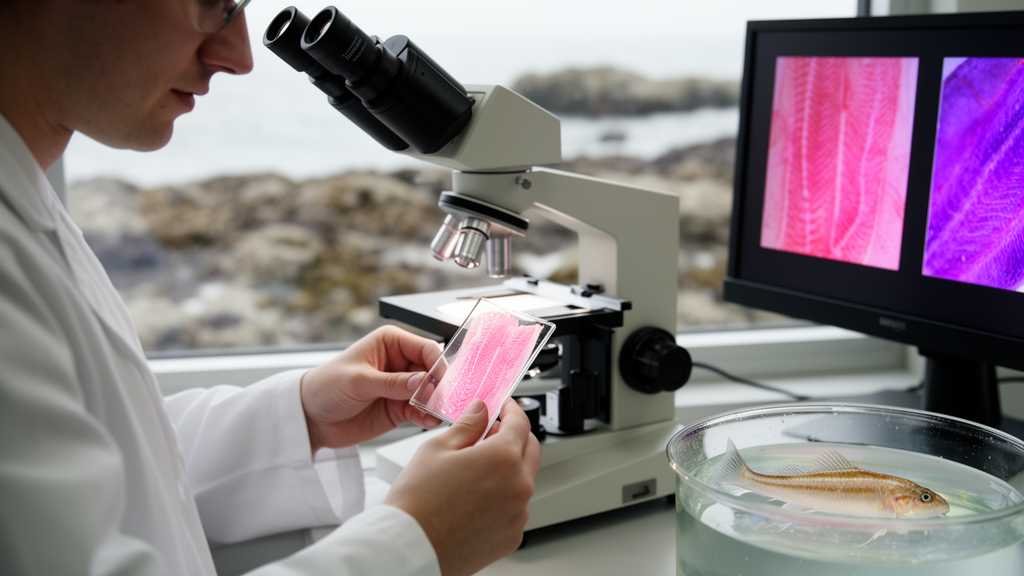
Published in Applied Microscopy, the study investigates how the structural organization of the integument supports the species’ survival in fluctuating coastal and estuarine environments. By examining skin samples from five distinct body regions, the authors identified specific adaptations that distinguish the ice goby from other teleost fishes, particularly regarding dermal complexity and cellular defense mechanisms.
Statistical analysis using SPSS software revealed significant regional variations in these morphometric parameters, providing a quantitative basis for understanding the fish’s cutaneous architecture.
The histological analysis confirmed that the skin of L. petersii follows the general teleost pattern, consisting of an epidermis and dermis separated by a distinct basement membrane, with underlying skeletal muscle. The epidermis was composed of outermost flattened cells, basal cells, club cells, and mucous cells. However, the dermis displayed a notable deviation from typical teleost structures. It was characterized by a well-developed stratum compactum with an almost complete absence of the stratum laxum, a layer of loose connective tissue commonly found in other fish species. This reduction in collagen-rich tissue may be associated with maintaining the species’ extremely thin and translucent body surface, facilitating physiological exchange across the skin.
Morphometric measurements highlighted clear regional differences in skin thickness. The head region exhibited the greatest epithelial thickness, with a mean of 102.9 micrometers, followed by the dorsal body at 89.7 micrometers and the lateral body at 75.7 micrometers. The ventral body and operculum were significantly thinner, measuring 46.0 and 37.9 micrometers, respectively. These differences were statistically significant, as indicated by the Kruskal–Wallis test. The basement membrane thickness also varied among regions, with the dorsal body showing the greatest thickness at 11.3 micrometers, while the ventral body was the thinnest at 7.8 micrometers.
A significant positive correlation was observed between epithelial thickness and basement membrane thickness, with a Pearson correlation coefficient of 0.417. This relationship suggests that increases in one structural variable are associated with increases in the other, potentially reinforcing the structural connection between the epidermis and dermis. Such concurrent thickening may enhance tissue stability and contribute to the protective function of the integument by buffering mechanical impacts, such as abrasion from suspended particles or substrate contact in the fish’s habitat.
The presence of club cells within the epidermis implies that the ice goby retains typical epidermal defense mechanisms. These cells are known to release biologically active substances associated with chemical alarm signaling and immune defense following tissue damage or environmental stress. Despite the fish’s thin body surface, the retention of these cells suggests a capability to respond to environmental disturbances. Similarly, mucous cells were predominantly distributed in the outermost epidermal layer, secreting mucus that forms a protective mucosal barrier. This mucus, rich in mucopolysaccharides and glycoproteins, serves multiple functions, including reducing friction during swimming and providing protection against pathogens and environmental stressors.
Compared to other estuarine gobiid fishes, such as Tridentiger brevispinis and Periophthalmus modestus, the Korean ice goby exhibits a relatively thinner overall skin thickness, with a mean of 70.5 micrometers across the surveyed locations. This histological adaptation is considered to enable more rapid and efficient material exchange between the skin and the external environment. Such an exchange is crucial for a species that inhabits transitional waters characterized by pronounced spatio-temporal fluctuations in salinity and hydrodynamic conditions, where rapid physiological adjustments are necessary for survival.
The study concludes that the skin structure of L. petersii reflects a morphological and histological adaptation to its unique ecological niche. The simplified dermal organization, characterized by the absence of the stratum laxum, is compensated by enhanced mucosal and cellular defense mechanisms. These features allow the fish to cope with the fluctuating environmental conditions of coastal and estuarine habitats, where it migrates from marine environments to brackish spawning grounds. The findings provide fundamental information on skin-based adaptive strategies in small migratory fishes, highlighting the importance of cutaneous form and function in ecological adaptation.
The skin of teleost fishes is more than a passive covering; it represents the sole boundary between the external aquatic environment and the internal tissues, and is therefore regarded as a critical organ system that determines survival. Aquatic environments expose fish continuously to pathogens, suspended particulates, and ongoing physical abrasion, so the skin and its secreted mucus generally function as the first line of defense, blocking external threats at the earliest point of contact. Beyond these defensive roles, the skin is broadly involved in sensory reception, coloration, and signaling both within and between species, making it a complex tissue system that integrates defense, homeostasis, environmental sensing, and ecological interaction.
The Korean ice goby offers an unusually instructive case for studying such functions. The species is distributed in the northwestern Pacific, including the coastal waters and estuaries of Korea, Japan, and China, and exhibits anadromous migratory behavior: individuals grow in marine environments and migrate into estuarine and brackish waters for spawning. Its life cycle unfolds in transitional environments characterized by pronounced spatio-temporal fluctuations in salinity and hydrodynamic conditions, during which the fish is continuously exposed to abrupt changes in osmotic pressure and water flow. The species also possesses an extremely thin and transparent external morphology, a taxonomically important trait distinguishing it from other gobiid fishes, which directly suggests the presence of specialized skin structures. Despite this distinctive life history and unusual appearance, virtually no prior studies had examined the morphological and structural strategies of its skin.
The cellular composition of the epidermis showed characteristic staining patterns that aid interpretation. Outermost flattened cells displayed flattened to oval nuclei with relatively translucent cytoplasm, while basal cells occupied the deepest portion of the epidermis immediately above the basement membrane. Club cells, situated in the middle epidermal layer, contained comparatively small oval to round nuclei positioned centrally within the cell. Mucous cells maintained their structural integrity while producing and secreting mucus to the external surface, which appeared purple in hematoxylin and eosin preparations and reddish-purple with Masson’s trichrome. The basement membrane itself was clearly distinguishable in both stains, appearing pink and red respectively, and displayed a markedly undulating morphology.
The functional interpretation of these findings rests on the interplay between structural simplicity and chemical defense. Because the ice goby possesses such a thin and translucent body surface, the mechanical protective function of the integument itself may be relatively limited. Under these conditions, mucus from mucous cells, together with substances released from club cells, may serve as the primary chemical and physiological defense mechanisms protecting the epidermis. Such defenses may be particularly important in coastal and estuarine environments where fluctuations in salinity, suspended particles, and microbial loads frequently occur. Club cells, which lack direct openings to the external surface, are known to release biologically active substances associated with chemical alarm signaling and immune defense following tissue damage or environmental stress.
Comparative context further sharpens the picture. Reported epithelial thickness values for other estuarial gobiid fishes include 137.3 micrometers in Tridentiger brevispinis and a range of 130 to 188 micrometers in Periophthalmus modestus, whereas the ice goby averaged 70.5 micrometers across the surveyed locations. The authors suggest that this thinner skin enables more rapid and efficient material exchange between the skin and the external environment in response to rapidly changing conditions. As the authors caution in framing their conclusions, these histological features may reflect adaptive responses to the species’ thin body surface and fluctuating habitats; the study provides fundamental descriptive and morphometric information on skin-based strategies in small migratory fishes inhabiting transitional waters, rather than direct experimental demonstration of function.
Subject of Research: Histology and morphometry of the skin of the Korean ice goby Leucopsarion petersii (Gobiiformes, Gobiidae), in relation to its ecology and habitat
Article Title: Histology and morphometry of the skin of the Korean ice goby Leucopsarion petersii (Gobiiformes, Gobiidae), in relation to its ecology and habitat
Article References: Sung, M. S., & Kim, H. T. (2026). Histology and morphometry of the skin of the Korean ice goby Leucopsarion petersii (Gobiiformes, Gobiidae), in relation to its ecology and habitat. Applied Microscopy, 56(1), Article 14. https://doi.org/10.1186/s42649-026-00136-8
Image Credits: AI Generated
DOI: 10.1186/s42649-026-00136-8
Keywords: Histology, morphometry, skin, Korean, goby, Leucopsarion, petersii, Gobiiformes, Gobiidae, relation, ecology, habitat
News Source: Gavin Prescott. (October 29, 2026). Histology and morphometry of the skin of the Korean ice goby Leucopsarion petersii (Gobiiformes, Gobiidae), in relation to its ecology and habitat. Scienmag.



