Children with unilateral spastic cerebral palsy who have stronger hip abductor muscles tend to sway less on an unstable platform, but only when the balance task is genuinely difficult, according to a new observational cross-sectional study published in the Bulletin of Faculty of Physical Therapy. The association, while statistically significant, was weak, and it disappeared entirely under the easiest testing conditions, a pattern that the researchers say underscores how multifactorial balance control really is in this population.
The study, conducted between September 2025 and March 2026 at the Faculty of Physical Therapy, Cairo University, recruited forty-eight children with unilateral spastic cerebral palsy, aged four to nine years, of both genders. All participants had spasticity of grade 1 or 1+ on the Modified Ashworth Scale and were classified at levels I, II, or III on the Gross Motor Functional Classification System. Children with other neurological or musculoskeletal conditions affecting mobility, a history of pelvic or hip osteotomies, tendon lengthening around the hip, botulinum injections around the hip muscles within the previous six months, or contractures of the hip adductors, flexors, or internal rotators were excluded.
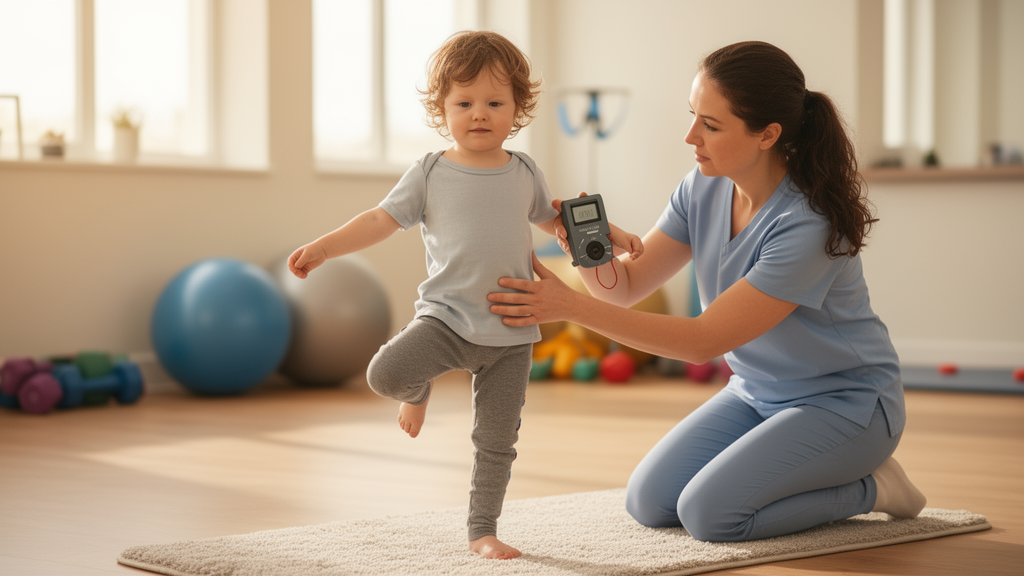
To measure strength, the researchers used a Lafayette handheld dynamometer with the children lying supine, the hip held neutral in all planes, the pelvis manually stabilized, and lateral resistance applied at mid-thigh level. Each child performed a make test, pushing gradually against the dynamometer for five seconds, and the best of three trials with thirty seconds of rest between them was recorded. The make test was chosen over the break test because the latter poses a greater risk of injury to children and has shown poor reliability across most muscle groups in handheld dynamometry. Force values were converted to Newtons and normalized to body weight, yielding a relative force expressed in Newtons per kilogram, because absolute muscle force depends on body size. The mean relative hip-abduction force in the sample was 3.63 plus or minus 0.7 N/kg, and the mean absolute force was 83.66 plus or minus 15.6 N.
Balance was assessed with the Biodex Balance System, which quantifies postural sway through three stability indices: the overall stability index, the mediolateral stability index, and the anteroposterior stability index. Higher scores on these indices reflect greater postural sway and poorer balance. Children stood barefoot at the center of the platform with handrails adjusted only for safety, watched a screen for feedback, and tried to keep the cursor centered as the platform moved. Testing proceeded through stability levels 8, 6, 4, and 2, from least to most challenging, with each level lasting twenty seconds and one minute of rest between trials. The relationship between relative hip-abductor force and each stability index at each level was then examined with Pearson correlation coefficients.
The results showed a clear pattern tied to task difficulty. At stability level 8, the easiest setting, the correlations were weak and non-significant: r = -0.25 (p = 0.08) for the overall index, r = -0.28 (p = 0.06) for the mediolateral index, and r = -0.12 (p = 0.41) for the anteroposterior index. At level 6, the overall index (r = -0.32, p = 0.03) and the mediolateral index (r = -0.31, p = 0.03) became significantly and negatively correlated with relative abductor force, while the anteroposterior index remained non-significant (r = -0.2, p = 0.18). At level 4, all three indices reached significance: r = -0.36 (p = 0.01) for the overall index, r = -0.34 (p = 0.02) for the mediolateral index, and r = -0.29 (p = 0.046) for the anteroposterior index. At level 2, the most challenging setting, the overall index (r = -0.33, p = 0.02) and the mediolateral index (r = -0.33, p = 0.02) were again significant, while the anteroposterior index was not (r = -0.18, p = 0.21).
Because lower stability index scores indicate better postural control, the negative correlations mean that stronger hip abductors were associated with steadier posture, but only when the platform was moderately to highly unstable. The authors interpret this as evidence that hip abductor strength contributes more to frontal-plane, or mediolateral, postural control than to sagittal-plane control in children with unilateral spastic cerebral palsy. The mediolateral index correlated significantly with abductor force at every level except level 8, whereas the anteroposterior index was significant only at level 4. The researchers themselves express suspicion about that isolated level 4 finding, noting that if it reflected a true relationship, significance would also be expected at level 6 or level 2, and its absence there raises the possibility of a chance result.
The mechanistic account offered by the authors draws on the biomechanics of single-limb support. During single-leg stance, the body’s center of mass lies above and medial to the stance hip, creating an external hip adduction moment that the stance-limb hip abductors must counteract with an internal abduction moment to maintain pelvic alignment and limit contralateral pelvic drop. When abductor capacity is reduced, the available torque may be insufficient to counteract this moment, particularly during conditions that increase mediolateral excursions of the center of mass, such as unstable surfaces, narrow bases of support, or rapid weight shifts. The resulting insufficiency can appear as increased pelvic obliquity and lateral trunk displacement, shifting the whole-body center of mass closer to the limits of the base of support and increasing mediolateral sway. In children with unilateral spastic cerebral palsy, who already show altered recruitment patterns and reduced selective motor control, even modest abductor weakness may diminish the effectiveness of the hip strategy used to control frontal-plane balance and increase reliance on compensatory trunk, ankle, or stepping strategies.
The level-dependent pattern also has a plausible explanation. At the most stable setting, small perturbations can be managed largely by ankle strategies and passive stiffness, minimizing the need for large hip abduction torque. As platform stability decreases, the amplitude and velocity of mediolateral center-of-mass displacement increase, demanding greater abduction torque to keep the center of mass within the base of support. Sagittal-plane control, by contrast, relies more on ankle plantarflexors and dorsiflexors and knee extensor mechanisms than on the hip abductors, which may explain why the anteroposterior index showed weaker and less consistent associations. Additional neuromotor factors in cerebral palsy, including spasticity, diminished selective muscle activation, sensory asymmetry, and impaired perception of weight on the affected side, can further delay or miscale abductor torque responses, and the authors suggest these factors help explain why the observed correlations, although statistically significant, remained weak.
Contextual comparisons support the interpretation that the sample had reduced hip abductor strength. Reported mean hip abductor forces in typically developing children aged four to nine years range from 104 N to 174 N depending on age and sex, and the mean absolute force of 83.66 N in this sample falls below that entire range, consistent with previously reported reductions in hip abductor strength on the involved side in children with unilateral spastic cerebral palsy. The authors caution, however, that those reference values were obtained with a break test and a different dynamometer, so the comparison should be read carefully. They also note that no validated USCP-specific reference values for handheld dynamometer-based hip abductor strength currently exist, which is why strength was treated as a continuous variable rather than classified as normal or impaired.
The clinical implications offered by the authors are deliberately modest. They suggest that assessing hip abductor strength with handheld dynamometry, described as a cost-effective and reliable method for this population, may complement balance evaluation in children with unilateral spastic cerebral palsy, especially during moderately to highly demanding postural tasks, while assessment under minimally demanding conditions alone provides limited information. Because the associations were weak and the design was cross-sectional, the results are described as hypothesis-generating rather than sufficient to establish intervention protocols, and the potential benefit of specifically targeting hip abductor strength requires further investigation through longitudinal intervention studies. The authors also flag several limitations: no control group was used; the cross-sectional design cannot establish causality; the analysis involved twelve correlation tests across three indices and four levels without correction for multiple comparisons, raising the risk of Type I errors; and body weight and BMI were recorded only as descriptive variables, so their potential confounding effects remain unaddressed. Balance in this population, they conclude, depends on the interplay of strength, motor control, spasticity, sensory integration, and compensatory movement patterns, not on muscle strength alone.
Subject of Research: The relationship between isometric hip abductor muscle strength and postural balance in children with unilateral spastic cerebral palsy
Article Title: Relationship between hip abductor muscle strength and balance in unilateral spastic cerebral palsy: an observational cross-sectional study
Article References: El-Dahshoury, H., Al-Tohamy, A., & Anter, E. (2026). Relationship between hip abductor muscle strength and balance in unilateral spastic cerebral palsy: an observational cross-sectional study. Bulletin of Faculty of Physical Therapy, 31(1), Article 39. https://doi.org/10.1186/s43161-026-00377-4
Image Credits: AI Generated
DOI: 10.1186/s43161-026-00377-4
Keywords: cerebral palsy, hip abductor strength, balance, postural control, handheld dynamometry, Biodex Balance System, cross-sectional study, pediatric rehabilitation, mediolateral stability, GMFCS, spasticity, correlation analysis
News Source: Ophelia Keating. (October 28, 2026). Hip abductor strength shows weak link to balance in children with unilateral cerebral palsy. Scienmag.