Credit: Dr. Tsuyoshi Shuto
Researchers at Kumamoto University in Japan have discovered that uric acid, an antioxidant, protects against declining lung function from age or lung disease, especially in women. High uric acid levels can cause health problems such as gout and renal damage, but this study showed that it protects against lung function decline in females. The function of uric acid and other antioxidants in the lungs, as well as gender differences, will likely be considered for prospective management of lung diseases.
While uric acid can cause gout and kidney disease, it is also a known antioxidant–reducing tissue damaging oxidative stress–and is an essential factor for the living body. It can be found in lung tissue but, until now, its function in the lung was unknown. Because of this, and the fact that men and women differ in the degree of lung function decline that accompanies aging and disease, the researchers decided to analyze the role of uric acid in the lungs.
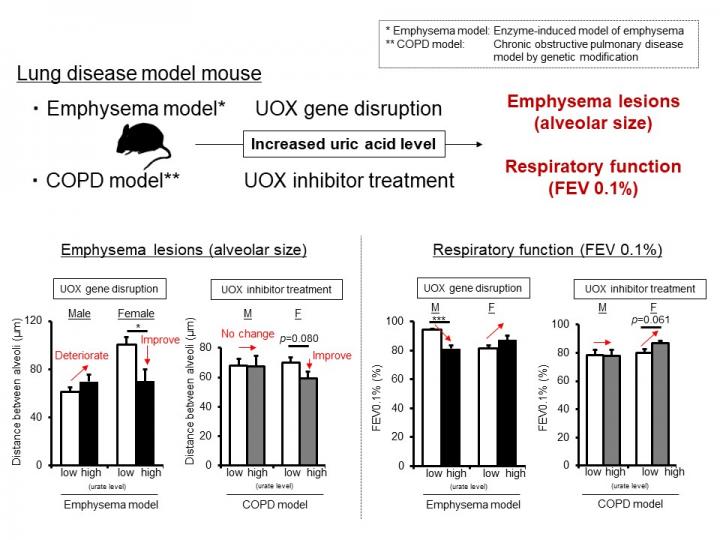
First, they created a murine lung disease model with high uric acid levels in the blood. Compared to humans, mouse uric acid levels are low so the researchers used gene disruption and inhibitor treatments to suppress uricase (UOX), a murine urate-metabolizing enzyme, to increase uric acid levels. They then created lung disease mouse model with emphysema or chronic obstructive pulmonary disease (COPD) with elevated uric acid blood levels. They found that uric acid levels were high in female mice that had UOX gene disruption or UOX inhibitor treatments, and that their respiratory functions had improved. On the other hand, when uric acid levels in male mice increased, symptoms of lung disease did not change or even worsened. This surprising finding suggests that uric acid protects the lungs of female mice.
Further experiments revealed that uric acid also suppresses oxidative stress in human lung epithelial cells. An analysis of female lung epithelial cells showed that the antioxidant effect of uric acid disappeared in the presence of female hormones. In other words, women with lower female hormone levels are more likely to benefit from the antioxidant effect of uric acid in lung tissue. This suggests that the protective effect of uric acid may be strongly exerted in elderly women who have decreased female hormone levels.
Epidemiological analyses targeting people 50 years or older revealed that uric acid levels and FEV1/FVC ratios (an indicator of respiratory function) were high among females with the SLC2A9/GLUT9 T/T genotype–a genotype known to have protective lung function qualities. Structural equation modeling further showed that this genotype is involved in lung function maintenance via elevated uric acid levels. Previous studies reported that female hormone therapy for menopausal women has a positive effect on maintaining lung function. It is therefore suggested that the antioxidative effect of uric acid is particularly important for the protection of lung function in women whose hormones decrease with menopause.
This is the first study to show that uric acid protects women against the lung function decline that progresses with aging and lung disease.
“The results of this study strongly suggest that antioxidants such as uric acid are important for maintaining lung function in women with advanced age and advanced disease,” said study leader Associate Professor Tsuyoshi Shuto. “We also previously reported that the antioxidant vitamin C and the antioxidant N-acetylcysteine slow the progression of lung disease. In the future, we expect that the functions of uric acid and other antioxidants in the lungs will be reexamined, taking gender differences into account, so that they may be applied to improve health and treat lung diseases.”
###
This research was posted online in Antioxidants on 6 May 2020.
[Source]
Fujikawa, H., Sakamoto, Y., Masuda, N., Oniki, K., Kamei, S., Nohara, H., … Shuto, T. (2020). Higher Blood Uric Acid in Female Humans and Mice as a Protective Factor against Pathophysiological Decline of Lung Function. Antioxidants, 9(5), 387. doi:10.3390/antiox9050387
Media Contact
J. Sanderson & N. Fukuda
[email protected]
Related Journal Article
http://dx.