• HOME
  • NEWS
  • EXPLORE
    • CAREER
      • Companies
      • Jobs
    • EVENTS
    • iGEM
      • News
      • Team
    • PHOTOS
    • VIDEO
    • WIKI
  • BLOG
  • COMMUNITY
    • FACEBOOK
    • INSTAGRAM
    • TWITTER
Tuesday, June 9, 2026
BIOENGINEER.ORG
No Result
View All Result
  • Login
  • HOME
  • NEWS
  • EXPLORE
    • CAREER
      • Companies
      • Jobs
        • Lecturer
        • PhD Studentship
        • Postdoc
        • Research Assistant
    • EVENTS
    • iGEM
      • News
      • Team
    • PHOTOS
    • VIDEO
    • WIKI
  • BLOG
  • COMMUNITY
    • FACEBOOK
    • INSTAGRAM
    • TWITTER
  • HOME
  • NEWS
  • EXPLORE
    • CAREER
      • Companies
      • Jobs
        • Lecturer
        • PhD Studentship
        • Postdoc
        • Research Assistant
    • EVENTS
    • iGEM
      • News
      • Team
    • PHOTOS
    • VIDEO
    • WIKI
  • BLOG
  • COMMUNITY
    • FACEBOOK
    • INSTAGRAM
    • TWITTER
No Result
View All Result
Bioengineer.org
No Result
View All Result
Home NEWS Science News

High-sensitivity cameras reveal the atomic structure of metal-organic frameworks

Bioengineer by Bioengineer
February 21, 2017
in Science News
Reading Time: 2 mins read
0
Share on FacebookShare on TwitterShare on LinkedinShare on RedditShare on Telegram
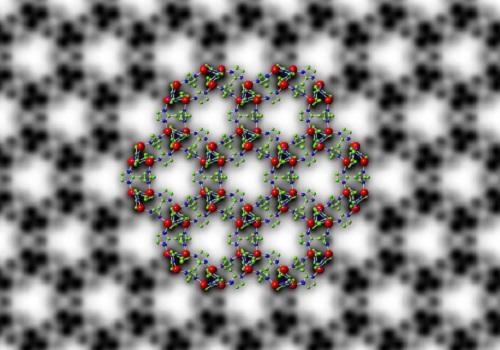
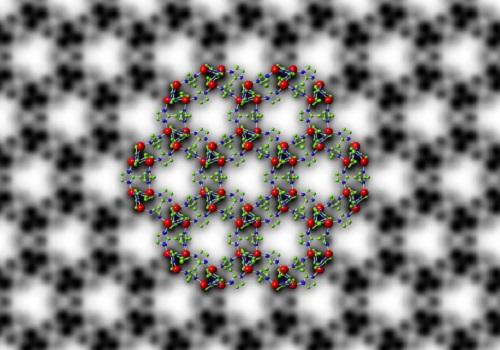
IMAGE

Credit: © 2017 KAUST

Researchers at KAUST have developed a method for fine-scale imaging of metal-organic frameworks (MOFs), three-dimensional structures made up of metal ions connected by organic ligands. MOFs are useful for gas storage and separation because they can be designed to have precise pore sizes of molecular dimensions and large void spaces (porosity) within their frameworks.

Typically, high-resolution transmission electron microscopy (HRTEM) is used to visualize structures with atomic resolution; however, this method is unsuitable for observing MOFs because the electron beams destroy their structures.

"To thoroughly understand the performance of metal-organic frameworks in various applications, we need to know their structures at the atomic level because their macroscopic behavior is determined by their microscopic structure," explained KAUST Associate Professor of Chemical Science Yu Han. By visualizing these structures, researchers can uncover important clues about how these materials self-assemble to create their trademark pores.

Several members of the University's Advanced Membranes and Porous Materials Center, including Han's research scientist and first author of the paper, Yihan Zhu, Associate Professor of Chemical and Biological Engineering Zhiping Lai and Professor of Chemical and Biological Engineering and Director of the Center Ingo Pinnau, joined forces with the University's Imaging and Characterization Core Lab and with colleagues from Gatan, Lawrence Berkeley National Laboratory and others in China. Their collaboration resulted in an adaptation of HRTEM using state-of-the-art direct-detection electron-counting cameras.

The high sensitivity of these detectors enabled them to acquire images with an electron dose low enough that it does not damage the structure of MOFs, allowing the group to produce high-resolution images of their atomic structures.

The team applied their method to ZIF-8, a MOF comprising zinc ions connected by organic 2-methylimidazole linkers. They were able to image its structure with a resolution of 0.21 nanometers (one nanometer is one billionth of a meter), a resolution high enough to image the individual columns of zinc atoms and organic linkers.

This helped the researchers to reveal the surface and interfacial structures of ZIF-8 crystals. "The results unraveled that porosity generated at the interfaces of ZIF-8 crystals is different from the intrinsic porosity of ZIF-8, which influences how gas molecules transport in ZIF-8 crystals," explained Han.

###

Media Contact

Michelle D'Antoni
[email protected]

http://kaust.edu.sa/

############

Story Source: Materials provided by Scienmag

Share13Tweet8Share2ShareShareShare2

Related Posts

Locus Coeruleus α-Synuclein Triggers Early Parkinson’s Signs

June 9, 2026

AI Predicts Delirium in Elderly ICU Hypothyroid Patients

June 9, 2026

Bacterial Shifts Under Arsenic and Cadmium Pollution

June 9, 2026

New Study Reveals Brain Changes That Occur During Menopause

June 9, 2026
Please login to join discussion

POPULAR NEWS

  • ESMO 2025: mRNA COVID Vaccines Enhance Efficacy of Cancer Immunotherapy

    323 shares
    Share 129 Tweet 81
  • Multi-Hospital Study Reveals Long Covid Burden Is Twice as High as Current Estimates

    89 shares
    Share 35 Tweet 22
  • Saying Goodbye to PGY-6: Pediatric Fellowship Realities

    87 shares
    Share 35 Tweet 22
  • Common Food Preservatives Associated with Elevated Blood Pressure and Increased Heart Disease Risk

    58 shares
    Share 23 Tweet 15

About

We bring you the latest biotechnology news from best research centers and universities around the world. Check our website.

Follow us

Recent News

Locus Coeruleus α-Synuclein Triggers Early Parkinson’s Signs

AI Predicts Delirium in Elderly ICU Hypothyroid Patients

Bacterial Shifts Under Arsenic and Cadmium Pollution

Subscribe to Blog via Email

Enter your email address to subscribe to this blog and receive notifications of new posts by email.

Join 82 other subscribers
  • Contact Us

Bioengineer.org © Copyright 2023 All Rights Reserved.

Welcome Back!

Login to your account below

Forgotten Password?

Retrieve your password

Please enter your username or email address to reset your password.

Log In
No Result
View All Result
  • Homepages
    • Home Page 1
    • Home Page 2
  • News
  • National
  • Business
  • Health
  • Lifestyle
  • Science

Bioengineer.org © Copyright 2023 All Rights Reserved.