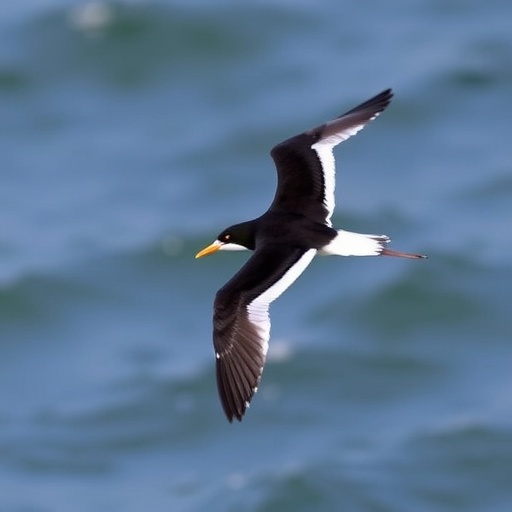
In a groundbreaking citizen science initiative, a high school teacher dedicated five years to meticulously tracking the migration patterns of Black Skimmers (Rynchops niger) along the Eastern United States. This long-term study has provided unprecedented insights into the extraordinary range and breeding dispersal of this distinctive seabird species, revealing far-reaching movements previously undocumented. Known for their striking black and white plumage and their unique foraging behavior, Black Skimmers are now better understood thanks to the rigorous data collection by an engaged citizen scientist, bridging the gap between amateur observation and professional ornithological research.
Black Skimmers are remarkable for their specialized feeding technique, skimming the water’s surface with their elongated lower mandible to catch small fish and crustaceans. This behavior suits their coastal habitats, but the extent of their migratory routes has remained largely obscure until now. Over the past half-decade, through careful observation and banding efforts, this teacher-scientist has mapped out annual movements spanning from the warmer Gulf states to the mid-Atlantic regions, challenging previous assumptions about their breeding and wintering limits.
The survey relied heavily on a combination of field observations and banding records, utilizing uniquely coded bands placed on individual birds’ legs to monitor their whereabouts over seasons and years. One notable observation, captured at Huguenot Memorial Park, spotlighted a bird identified as Black C05, offering a tangible marker to trace its travel and habitat fidelity across years. This banding effort has allowed the research to identify shifts in nesting sites and migratory corridors, suggesting environmental and climatic influences shaping their distribution.
What makes this data particularly valuable is its grassroots origin. As an uncredentialed yet thoroughly passionate naturalist, the high school educator exemplifies the critical role citizen scientists play in contemporary ecological research. Their dedication democratizes science, offering large-scale, longitudinal data that complements institutional projects and fills gaps often neglected due to funding or manpower constraints. This work underscores the potential of community-driven initiatives to contribute meaningful scientific knowledge on a species of ecological interest.
The findings also highlight the species’ remarkable adaptability and resilience in the face of changing coastal environments. By analyzing the geographic dispersal of breeding colonies, the study hints at possible shifts driven by habitat loss, climate variability, and human activity impacts along the Atlantic and Gulf coasts. The extended breeding dispersal noted in this survey suggests that Black Skimmers may be expanding their nesting range, possibly as a survival strategy in response to environmental pressures.
Moreover, the methodological approach blending citizen observations with systematic banding protocols reinforces the reliability of the data collected. The study employed standardized observation techniques aimed at minimizing biases and increasing reproducibility, making its conclusions compelling within the scientific community. Such rigor demonstrates how citizen science can meet the quality benchmarks required for peer-reviewed research and ecological monitoring frameworks.
This research is timely, given the increasing concern about coastal habitat degradation and the urgency to develop conservation strategies for vulnerable species. Black Skimmers serve as an indicator species for coastal ecosystem health, and understanding their population dynamics and movement patterns is vital for habitat preservation efforts. The extended dispersal documented here prompts a reevaluation of protected area boundaries and resource management plans to accommodate the dynamic nature of avian populations.
The implications of these migration data extend beyond academic interest; they influence practical conservation measures. Resource managers can utilize this newfound knowledge to optimize monitoring programs, prioritize critical breeding sites for protection, and anticipate future changes driven by global warming and human encroachment. The data’s granularity allows for targeted interventions aimed at sustaining Black Skimmer populations and the broader ecological communities dependent on coastal wetlands and beaches.
Importantly, the study also raises awareness on the value of birds as sentinels for environmental change. The Black Skimmer’s sensitivity to habitat modifications coupled with migratory behavior makes it a model organism for tracking the ecological impacts of climate change along the Eastern seaboard. The citizen science framework employed here could be replicated for other species, amplifying our ability to monitor biodiversity shifts at regional and global scales.
The high school teacher’s project culminated in a peer-reviewed publication in PLOS One, signifying robust academic validation of the findings. The study’s open-access nature facilitates the dissemination of this crucial knowledge to a wide audience, including educators, conservationists, policy-makers, and fellow citizen scientists. By situating the research in a reputable scientific journal, the work bridges the divide between grassroots data collection and formal scientific discourse.
Looking forward, this initiative paves the way for collaborative networks of citizen scientists and professionals to advance avian ecology, particularly in under-studied migratory species. The integration of technological tools such as GPS tracking and mobile data reporting platforms could further enhance future studies’ scope and precision. This project exemplifies how passion-driven inquiry, sustained over years, can generate impactful science with broad implications for biodiversity conservation.
In summary, the meticulous survey of Black Skimmer populations along the Atlantic and Gulf states reveals significant new data on their extensive migratory and breeding range, shedding light on their adaptability amid environmental challenges. This achievement not only enriches ornithological knowledge but also exemplifies the transformative potential of citizen science in modern ecological research and conservation strategies.
Subject of Research: Movements and breeding dispersal of Black Skimmer (Rynchops niger) populations in the Atlantic and Gulf states.
Article Title: A citizen scientist’s survey provides insights into the movements of Atlantic and Gulf states’ populations of Black Skimmers (Rynchops niger)
News Publication Date: 6-May-2026
Web References: DOI link
Image Credits: Brett R. Moyer, CC-BY 4.0
Keywords: Black Skimmer, Rynchops niger, migration, breeding dispersal, citizen science, coastal ecology, ornithology, banding, Atlantic coast, Gulf states, conservation, habitat adaptation
Tags: banding and tracking of migratory birdsBlack Skimmer coastal habitatsBlack Skimmer migration patterns Eastern USbreeding dispersal of Black Skimmerscitizen science bird tracking projectcitizen scientist contributions to ornithologycoastal seabird feeding behaviorGulf to mid-Atlantic bird migrationhigh school teacher ornithology researchlong-term seabird migration studymigratory routes of Rynchops nigerseabird population monitoring techniques