

• HOME
  • NEWS
  • EXPLORE
    • CAREER
      • Companies
      • Jobs
    • EVENTS
    • iGEM
      • News
      • Team
    • PHOTOS
    • VIDEO
    • WIKI
  • BLOG
  • COMMUNITY
    • FACEBOOK
    • INSTAGRAM
    • TWITTER
Tuesday, October 6, 2026
BIOENGINEER.ORG
No Result
View All Result
  • Login
  • HOME
  • NEWS
  • EXPLORE
    • CAREER
      • Companies
      • Jobs
        • Lecturer
        • PhD Studentship
        • Postdoc
        • Research Assistant
    • EVENTS
    • iGEM
      • News
      • Team
    • PHOTOS
    • VIDEO
    • WIKI
  • BLOG
  • COMMUNITY
    • FACEBOOK
    • INSTAGRAM
    • TWITTER
No Result
View All Result
Bioengineer.org
No Result
View All Result
Home NEWS Science News

High-resolution MRI imaging inspired by the humble antenna

Bioengineer by Bioengineer
October 31, 2018
in Science News
Reading Time: 3 mins read
0
Share on FacebookShare on TwitterShare on LinkedinShare on RedditShare on Telegram
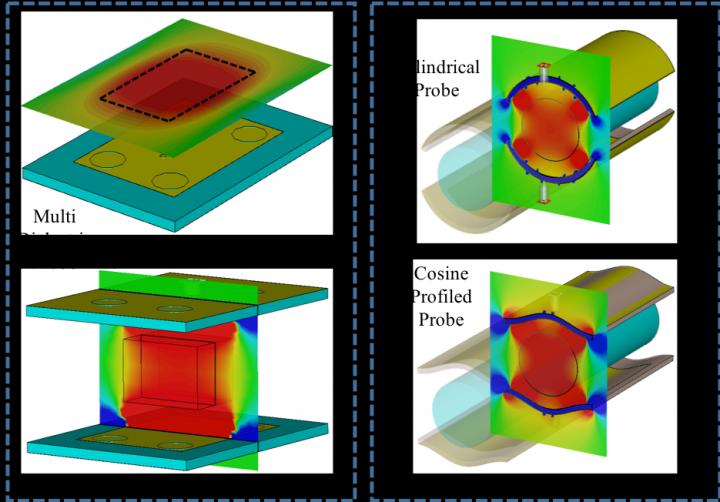
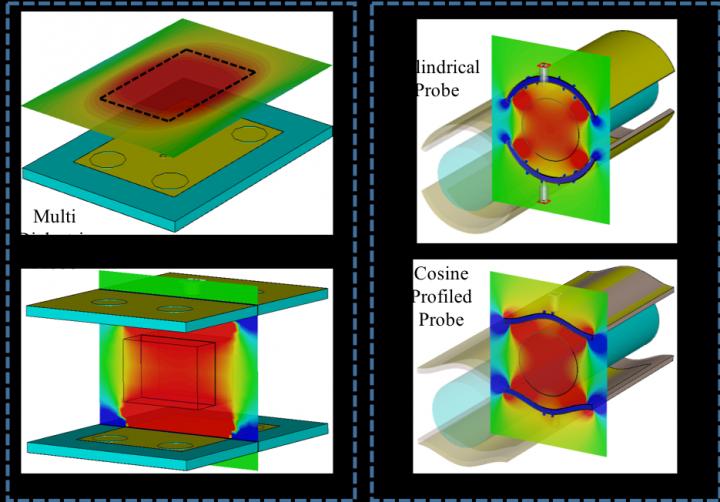
IMAGE

Credit: Navid P. Gandji

High-resolution magnetic resonance imaging (MRI) machines can work better by changing the structure of radio probes from coils to antennas.

How can you make a high-frequency MRI machine more precise? By taking an electrical engineering approach to creating a better, uniform magnetic field.

In a new study published in Transactions on Microwave Theory and Techniques, researchers have discovered that radio frequency probes with structures inspired by microstrip patch antennas increase MRI resolution in high-frequency MRI machines, when compared to conventional surface coils used now.

"When frequencies become higher, wavelengths become shorter, and your magnetic field loses uniformity," says Elena Semouchkina, an associate professor of electrical and computer engineering at Michigan Tech. "Uniformity is important for high resolution images, so we proposed a new approach to developing these probes."

Semouchkina explains that kind of antenna that you see on the top of a building isn't quite the same thing used here, but instead, the team's design was inspired by microstrip patch antenna (MPA). The design is relatively simple: MPAs are made of a flat piece of metal grounded by a larger piece of metal. They're cheap, simple, and easy to make, which is why they're so often used in telecommunications.

MRIs work by issuing radio frequency pulses in a magnetic field via probes with coils or bird-cage like structures. That's then used to create an image.

But those conventional coils have frequency limits: too high and they can't create uniformed magnetic fields at the volume researchers need.

MPAs are an alternative where waves oscillate in the cavity formed between the patch and ground plane electrodes, which are accompanied by currents in the patch electrode and, respectively, oscillating magnetic fields around the patch, providing a magnetic field that is both even and strong.

"While the complexity of birdcage coils increases with the increase in operation frequency, patch-based probes can provide quality performance in the higher microwave range while still having a relatively simple structure," Semouchkina says. They also showed smaller radiation losses, making them competitive with, even better, than conventional coils.

Because of the damage high-frequency radio waves cause to humans, the study was limited to high frequency machines–not the metal tube that we're used to seeing in hospitals and medical centers. Humans can only sustain frequencies up to seven Teslas, but ultrahigh fields up to 21.1 Teslas can be used in testing on animal models, and in tissue samples.

Semouchkina is already known for her work involving invisibility cloaks, which involve redirecting electromagnetic waves around an area to hide an object. "We use some of the same approaches that we developed in cloaking devices here, like making antenna smaller," she said.

###

This study was conducted with Navid P. Gandji and George Semouchkin of Michigan Tech and Gangchea Lee, Thomas Neubereger and Micheal Lanagan of Pennsylvnia State University. The team's next step is to keep applying electrical engineering to modify those probes to make them work better, and to further expand the possibilities for high-frequency MRI machines, and the images they create.

Media Contact

Allison Mills
[email protected]
906-487-2343
@michigantech

http://www.mtu.edu

Original Source

https://www.mtu.edu/news/stories/2018/october/updating-highresolution-mri.html http://dx.doi.org/10.1109/TMTT.2018.2874266


Share12Tweet8Share2ShareShareShare2

Related Posts

Dynamic MRI Reveals How the Young Pelvic Floor Moves From Rest to Strain to Squeeze

Dynamic MRI Reveals How the Young Pelvic Floor Moves From Rest to Strain to Squeeze

October 6, 2026
Soil bacterium's genome reveals how it unlocks phosphorus to boost maize growth

Soil bacterium’s genome reveals how it unlocks phosphorus to boost maize growth

October 6, 2026

Wrist-Worn Sleep Trackers May Mislead: Researchers Flag Statistical Cracks in Landmark Actigraphy Study

October 6, 2026

Eggshell Membrane Turned Zinc Oxide Nanohybrid Protects Sperm and Restores Fertility in Rats

October 6, 2026
Please login to join discussion

POPULAR NEWS

  • Alloys That Shrink Their Own Grains: New PIX Mechanism Refines Metals With Heat Alone

    Alloys That Shrink Their Own Grains: New PIX Mechanism Refines Metals With Heat Alone

    29 shares
    Share 12 Tweet 7
  • Endurance Exercise Reshapes the Liver in Males and Females Through Distinct Molecular Routes

    29 shares
    Share 12 Tweet 7
  • Single Transcription Factor PU.1 Rapidly Converts Fibroblasts into Macrophage-Lineage Cells

    29 shares
    Share 12 Tweet 7
  • New Scale Measures How Ready Nurse Educators Really Are for the AI Era

    29 shares
    Share 12 Tweet 7

About

We bring you the latest biotechnology news from best research centers and universities around the world. Check our website.

Follow us

Recent News

Alloys That Shrink Their Own Grains: New PIX Mechanism Refines Metals With Heat Alone

Endurance Exercise Reshapes the Liver in Males and Females Through Distinct Molecular Routes

Single Transcription Factor PU.1 Rapidly Converts Fibroblasts into Macrophage-Lineage Cells

Subscribe to Blog via Email

Success! An email was just sent to confirm your subscription. Please find the email now and click 'Confirm' to start subscribing.

Join 85 other subscribers
  • Contact Us

Bioengineer.org © Copyright 2023 All Rights Reserved.

Welcome Back!

Login to your account below

Forgotten Password?

Retrieve your password

Please enter your username or email address to reset your password.

Log In
No Result
View All Result
  • Homepages
    • Home Page 1
    • Home Page 2
  • News
  • National
  • Business
  • Health
  • Lifestyle
  • Science

Bioengineer.org © Copyright 2023 All Rights Reserved.
