Coral-type, high-efficiency, silver nano catalyst electrode developed for large areas; basis established for the commercialization of an electrochemical carbon dioxide conversion system that uses carbon dioxide in a gaseous state
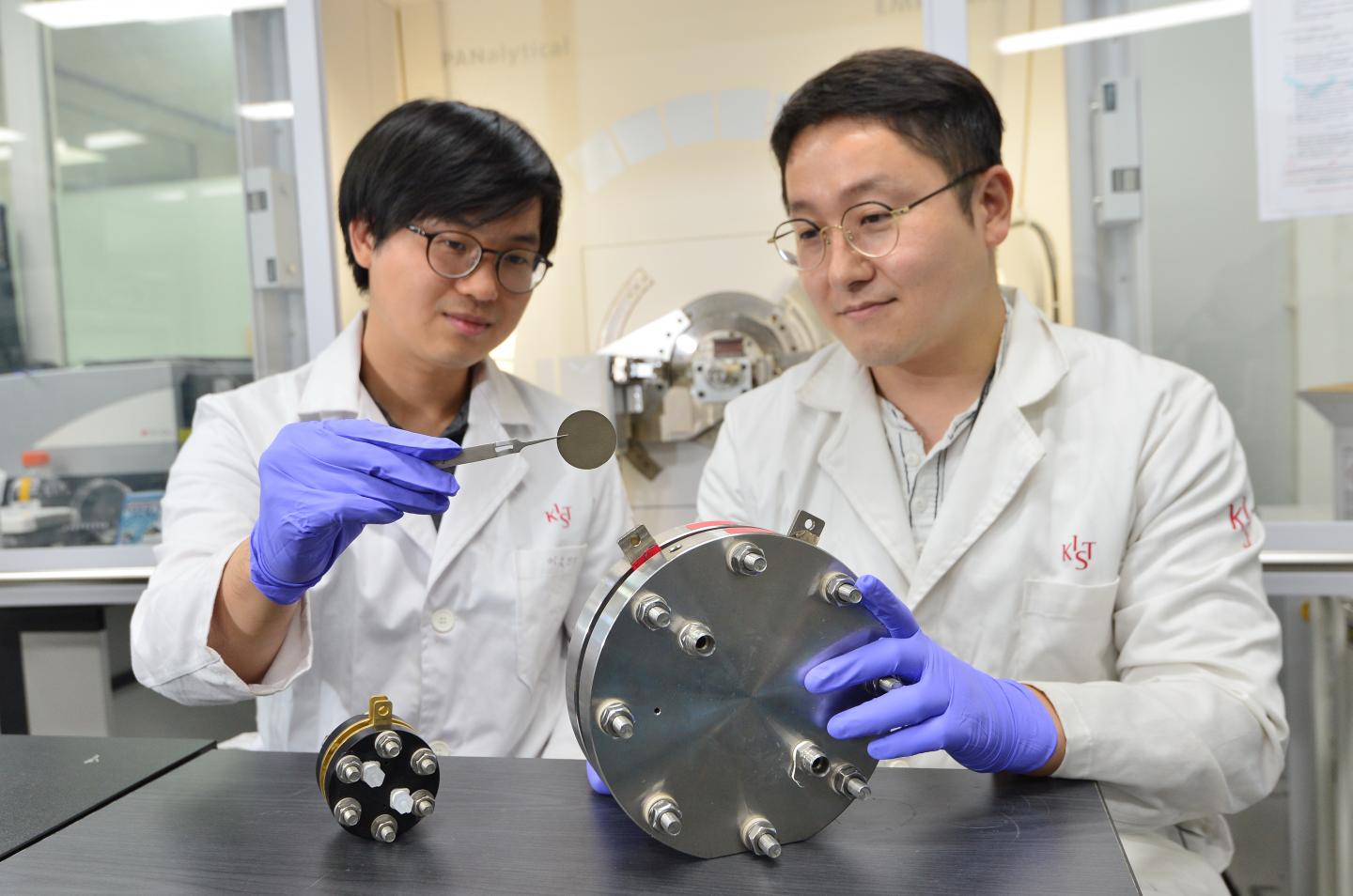
Credit: Korea Institue of Science and Technology(KIST)
A research team, led by Dr. Hyung-Suk Oh and Dr. Woong Hee Lee of the Clean Energy Research Center of the Korea Institute of Science and Technology (KIST), working in cooperation with the Technische Universität Berlin (TUB), announced that they had developed a nano-sized, coral-shaped silver catalyst electrode and large-area, high-efficiency carbon dioxide conversion system, which can be used to obtain *carbon monoxide. In recent years, this type of electrochemical carbon dioxide conversion system has been a major area of research in the field of artificial photosynthesis.
* Carbon monoxide: Chemically stable and can be used as a reducing agent at high temperatures, and thus can be used in chemical, metallics, and electronic industries.
Artificial photosynthesis is a technology that converts carbon dioxide, a cause of global warming, into usable chemical substances with high values. In order words, this type of technology removes carbon dioxide from the environment, decreasing pollution, and converts it to obtain useful chemical substances. The electrochemical carbon dioxide conversion field, in particular, has recently been receiving much interest from the scientific community.
In the past, carbon dioxide conversion research was mainly conducted on the compound in its liquid state. When using liquid, however, the performances of different conversion systems have to be measured by immersing electrodes in water. Since carbon dioxide does not dissolve well in water, it is difficult to obtain sufficient efficiency using this process, compared to the amount of energy used. Recently, a system was developed that could convert carbon dioxide using the compound in its gaseous state. This raised the expectation that a high-efficiency conversion system would soon be achieved; however, this proved difficult due to a lack of catalysts and electrodes that could be applied to the new system.
To solve this problem, the joint KIST-TUB research team developed coral-shaped, nano-sized silver catalyst electrodes that could be applied to high-efficiency carbon dioxide conversion systems utilizing carbon dioxide in its gaseous state. Compared to other silver catalysts, the newly developed catalyst requires a low amount of energy to achieve a reaction and can produce over 100 times more carbon monoxide than liquid-based systems. The electrodes of the carbon dioxide reducing system were also successfully applied to large areas (50 cm2), showing great promise for commercialization.
The KIST-TUB researchers were also able to develop a catalyst through various **operando analysis. The team confirmed that the coral-shaped, silver nano electrode catalyst, produced using chlorine ions through a real-time, x-ray absorption analysis method, has high substance delivery capacities, thanks to its large surface area and porous structure. This means that the catalysts demonstrates high efficiency in the carbon dioxide conversion process. They further found that the carbon dioxide conversion process was less efficient when there was no hydrophobicity during the reaction; this means that a certain level of hydrophobicity must be maintained when developing carbon dioxide conversion electrodes in the future.
**Operando analysis: A technology that monitors, in real-time, the actual behavior of a catalyst or electrode structure during a reaction. X-rays, electron microscopes, and laser analysis technologies (etc.) are used in operando analysis.
*** Hydrophobicity: The physical property of not being able to easily combine with water molecules. Normally, materials without polarity demonstrate hydrophobicity.
Dr. Hyung-Suk Oh of the KIST, who jointly led the research, said, “By developing nanometer-sized, coral-shaped silver catalyst electrodes, we were able to greatly improve current density and the performance of the electrochemical carbon dioxide conversion system, thereby suggesting directions for future research.” He added, “It is expected that this study will greatly contribute to the R&D of electrochemical carbon dioxide conversion systems.”
###
The research, backed by the Ministry of Science and ICT (MSIT), was conducted as part of the Institutional Research Program of the Korea Institute of Science and Technology (KIST) and as part of the Climate Change Response Technology Development Project. The study was published in the latest issue of the international journal on energy environment, Nano Energy (IF: 15.548, JCR ranking top 3.716%).
Media Contact
Kim, Do-Hyun
[email protected]
Related Journal Article
http://dx.