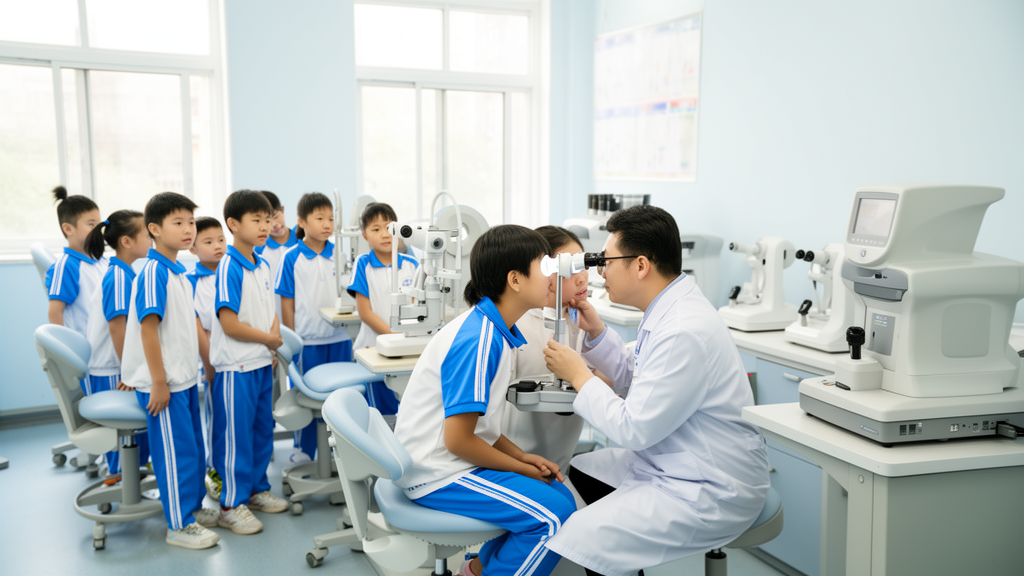
High myopia affected 4.87% of 1,126,311 children and adolescents aged 6 to 18 years in Hubei Province, China, according to a school-based, prospective cross-sectional study conducted from September 2021 to December 2023. Prevalence increased with educational grade, was higher among females than males at every educational stage, and exceeded the rate among urban students compared with their rural counterparts. An XGBoost analysis ranked educational grade, parental myopia, sleep duration, maternal education and preterm birth as the five leading factors associated with high myopia.
The study population included 604,130 males, representing 53.60% of all participants, and had a mean age of 11.44 ± 3.42 years. Researchers collected basic demographic information and conducted non-cycloplegic autorefraction examinations. They used chi-square and Mann–Whitney U tests to compare high-myopia prevalence across participant characteristics, while XGBoost was used to rank factors contributing to the prevalence of the condition.
Because the study was cross-sectional, its results describe associations within the sampled population rather than changes in the same participants over time. High-myopia prevalence followed a nonlinear upward curve across educational grades. The sharpest increase was reported between the ninth and tenth grades, where the source reports an increase of 2.84%.
The findings therefore show that prevalence was not distributed uniformly across school grades. The cross-sectional design cannot establish when myopia developed in an individual participant, and the ranked factors do not demonstrate that changing any of them would prevent high myopia or its progression. Educational grade emerged as the leading factor in the XGBoost analysis, followed by having parents with myopia, sleep duration, the mother’s education level and preterm birth.
Female students had higher rates of high myopia across all educational stages included in the analysis. Urban children and adolescents also had a higher prevalence than their rural counterparts, a difference the researchers reported as highly statistically significant (χ² = 3665.29, P < 0.001). The questionnaire component was narrower than the overall survey: the investigators conducted detailed surveys about visual habits and influencing factors among a subgroup of 31,695 students, of whom 28,543 provided valid questionnaires for analysis.
Findings from that subgroup should therefore be distinguished from the prevalence estimate based on the full population of 1,126,311 participants. Together, the observations identify three main population patterns: an overall prevalence of 4.87%, higher rates among girls and urban students, and a marked rise in prevalence across school grades, especially between grades nine and 10. The machine-learning analysis adds a ranked set of correlates but does not resolve the causal mechanisms behind these patterns.
Its scope was limited to school-based participants in Hubei Province, while the more detailed questionnaire analysis covered only a selected subgroup. Within those boundaries, the study offers a large-scale description of high-myopia prevalence and its distribution across sex, residence, educational stage and several demographic and behavioral factors.
Subject of Research: Cross-sectional assessment of high myopia prevalence and associated factors among Hubei students aged 6 to 18 years
Article Title: The distribution characteristics and influencing factors of high myopia among children and adolescents in Hubei Province: a cross-sectional study
Article References: Zhang, C., Lu, Y., Tu, Y., Yu, L., Gong, Q., Yuan, Q., Duan, O., & Zhou, L. (2026). The distribution characteristics and influencing factors of high myopia among children and adolescents in Hubei Province: a cross-sectional study. BMC Public Health. https://doi.org/10.1186/s12889-026-29714-x
Image Credits: AI Generated
DOI: 10.1186/s12889-026-29714-x
Keywords: high myopia, children, adolescents, Hubei Province, myopia prevalence, school-based study, refractive error, XGBoost, sleep duration, parental myopia, distribution, characteristics
News Source: Ophelia Keating. (October 26, 2026). High myopia prevalence reaches 4.87% in Hubei schoolchildren. Scienmag.