• HOME
  • NEWS
  • EXPLORE
    • CAREER
      • Companies
      • Jobs
    • EVENTS
    • iGEM
      • News
      • Team
    • PHOTOS
    • VIDEO
    • WIKI
  • BLOG
  • COMMUNITY
    • FACEBOOK
    • INSTAGRAM
    • TWITTER
Saturday, June 27, 2026
BIOENGINEER.ORG
No Result
View All Result
  • Login
  • HOME
  • NEWS
  • EXPLORE
    • CAREER
      • Companies
      • Jobs
        • Lecturer
        • PhD Studentship
        • Postdoc
        • Research Assistant
    • EVENTS
    • iGEM
      • News
      • Team
    • PHOTOS
    • VIDEO
    • WIKI
  • BLOG
  • COMMUNITY
    • FACEBOOK
    • INSTAGRAM
    • TWITTER
  • HOME
  • NEWS
  • EXPLORE
    • CAREER
      • Companies
      • Jobs
        • Lecturer
        • PhD Studentship
        • Postdoc
        • Research Assistant
    • EVENTS
    • iGEM
      • News
      • Team
    • PHOTOS
    • VIDEO
    • WIKI
  • BLOG
  • COMMUNITY
    • FACEBOOK
    • INSTAGRAM
    • TWITTER
No Result
View All Result
Bioengineer.org
No Result
View All Result
Home NEWS Science News

High energy Li-Ion battery is safer for electric vehicles

Bioengineer by Bioengineer
March 4, 2020
in Science News
Reading Time: 2 mins read
0
IMAGE
Share on FacebookShare on TwitterShare on LinkedinShare on RedditShare on Telegram

IMAGE

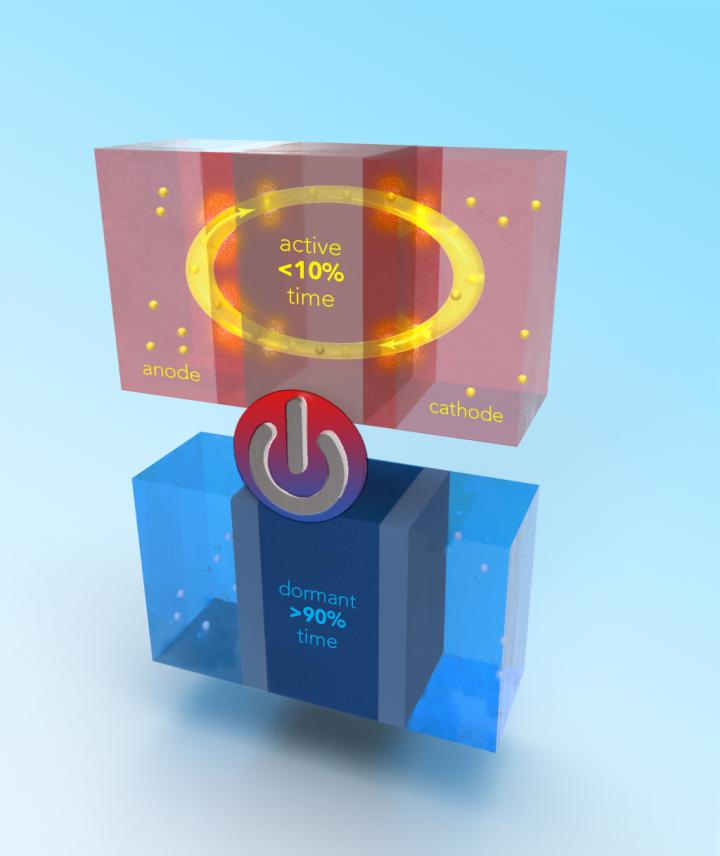
Credit: Jennifer McCann/Penn State


A lithium-ion battery that is safe, has high power and can last for 1 million miles has been developed by a team in Penn State’s Battery and Energy Storage Technology (BEST) Center.

Electric vehicle batteries typically require a tradeoff between safety and energy density. If the battery has high energy and power density, which is required for uphill driving or merging on the freeway, then there is a chance the battery can catch fire or explode in the wrong conditions. But materials that have low energy/power density, and therefore high safety, tend to have poor performance. There is no material that satisfies both. For that reason, battery engineers opt for performance over safety.

“In this work we decided we were going to take a totally different approach,” said Chao-Yang Wang, professor of mechanical, chemical and materials science and engineering, and William E. Diefenderfer Chair in Mechanical Engineering, Penn State. “We divided our strategy into two steps. First we wanted to build a highly stable battery with highly stable materials.”

Their second step was to introduce instant heating. About four years ago, Wang developed a self-heating battery to overcome the problem of poor performance in cold climates. The battery uses an electric current to heat up in seconds compared to the hours an external heater required. By heating the battery from room temperature to around 140 degrees Fahrenheit — 60 degrees Celsius — the battery gets an instant boost in reactivity because the law of kinetics is that reactivity increases exponentially with temperature.

“With these two steps I can get high safety when the battery is not being used and high power when it is,” he said.

The self-heating battery, called the All Climate battery, has been adopted by several car companies, including BMW, and was chosen to power a fleet of 10,000 vehicles that will be used to ferry people between venues at the next Winter Olympics in Beijing.

The BEST Center tests the safety of the battery using nail penetration equipment. They drive the nail into the cell causing short circuiting. They then monitor the cell for temperature and voltage. The difference in temperature for the passivated cell was 212 degrees F — 100 degrees C –compared to a standard battery cell which was 1,832 degrees F — 1000 degrees C, an enormous improvement.

Because their batteries are built using stable materials, they have a long cycle life. Even at 140 degrees F, their cycle number is over 4000, which translates to over a million miles.

The team’s next project will be to develop a solid-state battery, which will likely require heating as well.

The current work appears in the journal Science Advances and is titled “A new approach to both safety and high performance of lithium-ion batteries.” Wang’s coauthors are research assistant professors Shanhai Ge, Yongjun Leng and Xiao-Guang Yang, and doctoral students Teng Liu, Ryan Longchamps, Yue Gao and Daiwei Wang. Donghai Wang, professor of mechanical and of chemical engineering, Penn State, also participated in this work.

The Department of Energy funded this work.

###

Media Contact
A’ndrea Elyse Messer
[email protected]
814-865-5689

Tags: Electrical Engineering/ElectronicsMechanical EngineeringTechnology/Engineering/Computer ScienceVehicles
Share12Tweet8Share2ShareShareShare2

Related Posts

Tracking Lanthanide-Labeled Microplastics in Plants

June 25, 2026

POSTECH Researchers Slash Cost of Reconstituted Cell-Free Systems by 95%

June 25, 2026

AI and Physics Collaborate to Design Advanced Hydrogen Storage Materials

June 25, 2026

Natural Hallucinogens: Evolution’s Ecological Tools, Not Mere Chemical Byproducts

June 25, 2026
Please login to join discussion

POPULAR NEWS

  • Saying Goodbye to PGY-6: Pediatric Fellowship Realities

    103 shares
    Share 41 Tweet 26
  • Multi-Hospital Study Reveals Long Covid Burden Is Twice as High as Current Estimates

    92 shares
    Share 36 Tweet 23
  • Detection of EDCs in Breast Milk and Infant Urine Up to Six Months Highlights Early Exposure Risks

    77 shares
    Share 31 Tweet 19
  • New Drug Candidate Developed at McMaster Shows Potential for Treating Brain Cancer

    58 shares
    Share 23 Tweet 15

About

We bring you the latest biotechnology news from best research centers and universities around the world. Check our website.

Follow us

Recent News

Tracking Lanthanide-Labeled Microplastics in Plants

POSTECH Researchers Slash Cost of Reconstituted Cell-Free Systems by 95%

AI and Physics Collaborate to Design Advanced Hydrogen Storage Materials

Subscribe to Blog via Email

Success! An email was just sent to confirm your subscription. Please find the email now and click 'Confirm' to start subscribing.

Join 82 other subscribers
  • Contact Us

Bioengineer.org © Copyright 2023 All Rights Reserved.

Welcome Back!

Login to your account below

Forgotten Password?

Retrieve your password

Please enter your username or email address to reset your password.

Log In
No Result
View All Result
  • Homepages
    • Home Page 1
    • Home Page 2
  • News
  • National
  • Business
  • Health
  • Lifestyle
  • Science

Bioengineer.org © Copyright 2023 All Rights Reserved.