In the relentless pursuit of elevating visual experiences, holographic display technology has emerged as a transformative frontier in three-dimensional imaging. Rooted in the foundational principles that once earned the Nobel Prize, holography offers the unparalleled ability to reconstruct wavefronts with authentic depth cues, positioning it as one of the most promising true 3D display technologies to date. Yet, despite its inherent capabilities, the challenge of simultaneously achieving a wide viewing angle, vivid color fidelity, and high brightness remains a formidable barrier in developing practical holographic displays for everyday applications.
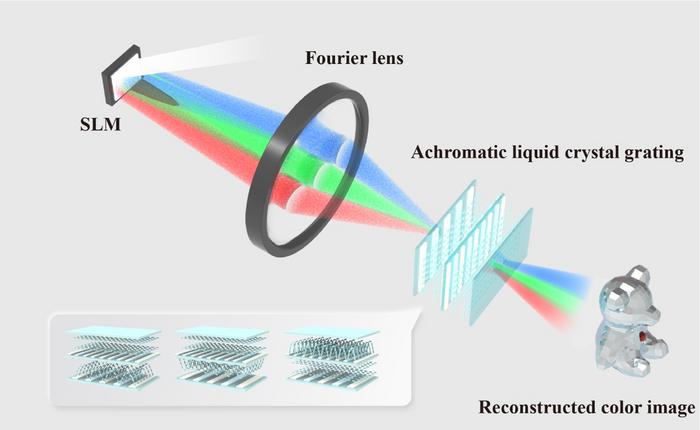
A breakthrough, however, has recently been reported by a research team spearheaded by Professor Qiong-Hua Wang at Beihang University, China. Their work, published in the prestigious journal PhotoniX, introduces a novel color holographic 3D display system that remarkably expands the viewing angle and enhances brightness, setting new benchmarks in the domain. This pioneering system employs a custom-engineered achromatic liquid crystal grating designed to overcome the intrinsic spectral dispersion issues that have hampered previous designs, enabling a wide-angle color holographic display with unprecedented luminosity.
At the heart of the proposed system lies the achromatic liquid crystal grating, a sophisticated multilayered optical component. Unlike conventional gratings that suffer from chromatic aberrations causing different colors to diffract at disparate angles, this grating is meticulously structured with multiple liquid crystal layers and strategically arranged pixel and common electrodes. By applying a sequence of driving voltages to these electrodes, the device dynamically adjusts its molecular alignment, facilitating simultaneous diffraction of red, green, and blue primary light components at an identical large angle.
This ingenious manipulation of the liquid crystal molecular orientation permits the system to magnify the effective viewing angle approximately ninefold, reaching around 65 degrees—a remarkable enhancement that substantially broadens the spectator’s field of view without compromising image integrity. Such an expansive viewing angle is critical for immersive applications like augmented reality (AR) and virtual reality (VR), where naturalistic, three-dimensional perception across a wide range of observer positions is essential.
In addition to the optical innovations, the research team complements their hardware breakthrough with a cutting-edge hologram encoding method tailored to boost brightness. This method incorporates a composite loss function integrating frequency loss, real component loss, and imaginary component loss, enabling an advanced learning mechanism that simultaneously captures spatial and frequency domain features during hologram generation. By optimizing these interconnected parameters, the encoding process significantly improves energy utilization efficiency, achieving roughly a fivefold increase in brightness compared to traditional approaches.
Such enhanced brightness not only intensifies the visual clarity in holographic reconstructions but also extends usability in environments with variable ambient lighting. This leap forward addresses a major bottleneck in holographic display technology, where previously dim images and limited color accuracy prevented widespread adoption outside controlled laboratory settings.
Beyond its technical merits, this advancement portends significant ramifications for a diversified range of applications. In medical imaging, for instance, the ability to render highly detailed, vividly colored three-dimensional holograms from various viewing angles could revolutionize surgical planning and diagnostics. In entertainment and communication, immersive holographic displays promise deeply engaging user experiences by projecting life-like 3D content without the need for cumbersome eyewear or constrained viewing zones.
Furthermore, this technology offers transformational potential in industrial design and education, where interactive and accurate 3D visualizations can enhance collaboration, prototyping, and conceptual understanding. The research embodies a strategic answer to longstanding industry demands for holistic holographic display systems that reconcile viewing angles, brightness, and color fidelity in a compact, performant package.
The journey to this point has, of course, involved overcoming significant material and engineering challenges. The custom achromatic liquid crystal grating fabrication required precise layering and electrode patterning to enable dynamic voltage control without introducing unwanted optical artifacts. Simultaneously, developing the hologram encoding algorithm necessitated integrating multidisciplinary computational theories to balance the competing demands of image quality and energy efficiency.
This research thus marks a watershed moment in holographic technology, demonstrating how synergistic innovation across optical hardware and computational algorithms can yield breakthrough performance. As Professor Qiong-Hua Wang’s team continues to refine and scale this system, the pathway to commercial and industrial adoption becomes increasingly tangible, heralding a new era where holographic 3D displays move from conceptual demonstrations to integrated components of daily life.
Ultimately, the implications of this work extend far beyond merely refining display hardware. They represent an evolutionary step towards truly immersive digital experiences, converging optics and computation to enable tangible, hyper-realistic 3D visual interactions. The enhanced viewing angle and brightness achieved here are poised to unlock new creative possibilities for developers and users alike, from next-generation AR/VR headsets to medical visualization tools, potentially reshaping how we perceive and interact with digital content on a fundamental level.
As holographic display technology edges closer to widespread adoption, breakthroughs such as those presented by the Beihang University team will undoubtedly inspire further research and innovation. By pushing the boundaries of what is technically feasible and expanding the experience frontier, this research lays a solid foundation for the next generation of visual technologies that promise to enrich human-machine interfaces profoundly.
Subject of Research: Not applicable
Article Title: Wide-viewing-angle color holographic 3D display system with high brightness encoding
News Publication Date: 21-Feb-2025
Web References: http://dx.doi.org/10.1186/s43074-025-00162-x
Image Credits: Qiong-Hua Wang
Keywords
Holographic display, achromatic liquid crystal grating, 3D display, wide viewing angle, high brightness, color holography, hologram encoding, spatial domain, frequency domain, AR, VR, optical engineering
Tags: 3D imaging advancementsachromatic liquid crystal gratinghigh-brightness color displaysholographic display technologymultilayered optical componentsovercoming spectral dispersion issuesPhotoniX journal publicationProfessor Qiong-Hua Wang researchrevolutionary 3D display systemtrue 3D display technologiesvisual experience enhancementwide-viewing-angle displays