Deep beneath the oak forests of southwestern Virginia, in the airless dark between soil and bedrock, scientists have just pulled off something that has never been done before in North America: a full-scale census of the animals living more than 10 centimeters underground. What they found is staggering. In just four weeks of sampling, a team of researchers recovered 2,260 arthropod specimens representing 345 distinct morphospecies from eight classes, 33 orders, and 94 families — a menagerie of beetles, ants, flies, springtails, mites, spiders, millipedes, and centipedes that nobody had ever systematically surveyed in this region. Many of the species, the researchers suspect, are entirely new to science, quietly living out their lives in a habitat most people never realize exists.
The study, published in the journal Subterranean Biology, targeted what ecologists call shallow subterranean habitats, or SSHs — underground zones close enough to the surface that they lack light entirely, yet remain intimately connected to the soil ecosystem above. Within these habitats, the team focused on a particularly elusive microhabitat known by its French name, the milieu souterrain superficiel, abbreviated MSS. The MSS is not a cave and not quite soil; it is the network of air-filled gaps between buried rocks, a labyrinthine interstitial space where tiny animals can crawl, feed, and breed in perpetual darkness. While European, Japanese, and Australian scientists have sampled these zones for decades, no one had ever conducted a broad, taxonomically comprehensive survey of North American soil-dwelling arthropods at these depths — until now.
The technical challenge of sampling this hidden world explains why it has remained terra incognita for so long. The research team, led by scientists at Virginia Tech, deployed subterranean pitfall traps modeled on a design first developed by López and Oromí in 2010. Each trap consists of a perforated polyvinyl chloride pipe buried vertically in the ground, with entry holes positioned between 10 and 67 centimeters below the soil surface — deep enough to exclude most surface-dwelling animals, shallow enough to capture the SSH community. Inside the pipe hangs a removable polypropylene collecting cup, baited with a pungent chunk of Limburger cheese whose powerful odor wafts through the interstitial spaces to lure arthropods in. The cup is filled with propylene glycol, a preservative chosen specifically for its ability to preserve DNA, thermal buffering, and moisture resistance — a critical detail, because the team planned to sequence the genetic barcodes of nearly everything they caught.
Twenty traps were installed across three forested sites in southwestern Virginia: five near a university dolomite quarry, five on university land near Blacksburg, and ten in Floyd County. The sites span two distinct ecoregions — the Ridge and Valley, with its sedimentary dolomite substrate, and the Blue Ridge, underlain by hard metamorphic quartzite. Each trap operated for two weeks in winter and two weeks in spring, giving the researchers a seasonal perspective on who lives down there and when they are active. The choice of locations was deliberate: the Appalachian Mountains are recognized as one of the world’s great biodiversity hotspots, yet they have suffered tremendous habitat loss from mining, timber harvesting, and land conversion, making the race to document their hidden diversity all the more urgent.
Back in the laboratory, the real detective work began. Every specimen was examined under a stereomicroscope and assigned to a morphospecies — an operational taxonomic unit defined by observable physical characteristics. Each was photographed from multiple angles using a high-resolution focal-stacking system that merges seven to twelve images into a single razor-sharp composite, producing 717 images now publicly archived. Then came the molecular analysis. The team extracted DNA from each morphospecies using a minimally destructive technique: instead of grinding the specimen to pulp, they made a single pinprick in its cuticle, allowing the lysis buffer to reach the soft tissues inside while keeping the animal’s body intact for future morphological study and potential species description. A roughly 500 to 600 base-pair fragment of the mitochondrial cytochrome c oxidase subunit I gene — the workhorse barcode region used across arthropod genetics — was amplified and sequenced for 272 specimens.
The genetic data revealed a hidden layer of complexity beneath the morphological one. Using a technique called objective sequence clustering at a 3% dissimilarity threshold, the researchers sorted their sequenced specimens into 256 molecularly distinct species bins, or mOTUs. Sixteen of the morphospecies clusters turned out to contain two to four separate species each — cryptic species that look identical under a microscope but are genetically distinct lineages. Perhaps most strikingly, 102 of the mOTUs were entirely absent from the two largest genetic repositories, NCBI and the Barcode of Life Data System, meaning their DNA sequences had never before been documented anywhere. All 272 barcodes have now been published, creating a molecular foundation that future researchers can build upon — a permanent reference library for a fauna that was, until this month, essentially invisible to science.
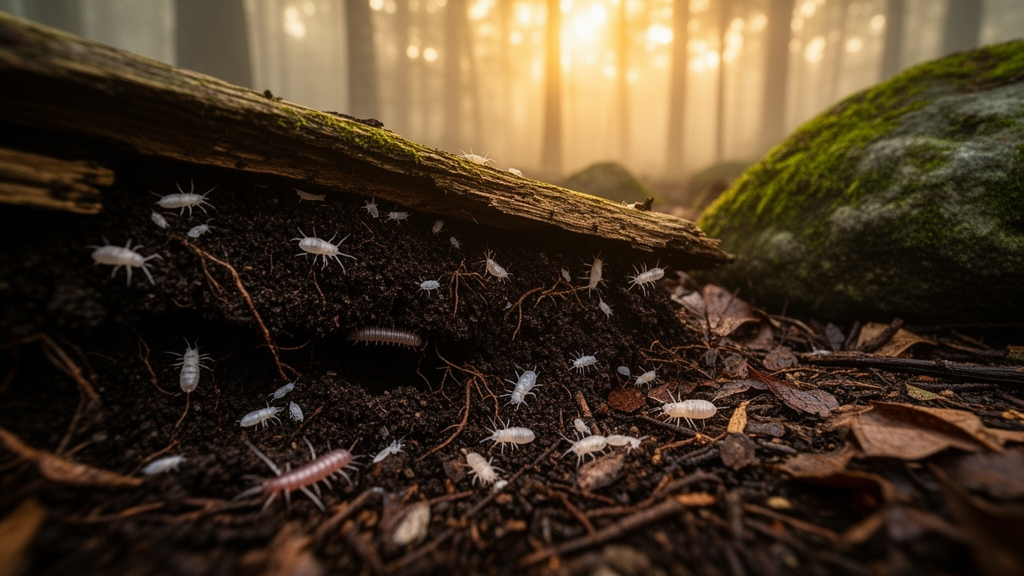
So who actually lives in this underground realm? The community was dominated by hexapods and chelicerates, with springtails of the order Entomobryomorpha, mites of the order Sarcoptiformes, flies, ants, and beetles topping the abundance charts. Within the insects, flies made up just over 40% of specimens, beetles about a third, and ants roughly 16% — with ants alone accounting for nearly 85% of the hymenopterans. Among the arachnids, mites ruled at two-thirds of specimens. But abundance tells only part of the story. A substantial fraction of the morphospecies displayed the classic hallmarks of subterranean life: loss of body pigmentation, reduction or absence of eyes, and modified appendages. Six of thirteen ant morphospecies, fifteen of fifty-three beetles, eighteen of sixty-two flies, and six of seven two-pronged bristletails showed these adaptations, suggesting they may be obligate subterranean inhabitants — animals that cannot survive anywhere else.
One of the most intriguing findings is what the community composition reveals about how these habitats function. Most individuals collected were morphologically typical of surface-dwelling species, consistent with European studies showing that shallow subterranean habitats act as ecotones — transitional zones where above-ground and deep-underground faunas mix and exchange. The researchers also found remarkably little overlap in species between their three sites: only two species were shared between any pair of sites, and just one ant species, Stenamma schmittii, appeared across all three. This pattern echoes earlier work on oribatid mites in the Carolinas and supports the growing consensus that subterranean arthropod communities are highly specific to the individual habitats they occupy — each rocky interstitial microcosm may harbor its own distinct evolutionary experiment.
The completeness analysis adds an important caveat that is also a promise. Using Hill-number-based rarefaction curves, the team estimated that sample coverage ranged from roughly 90% to 95% across sites — high, but not yet asymptotic. In plain terms: they caught a lot, but they did not catch everything. The effective number of species, a metric that weights both richness and evenness, was highest at the quarry site at 39.5, and the extrapolated coverage estimates suggest that doubling the sampling effort would still leave species undiscovered. Based on their results, the researchers recommend that future surveys deploy at least ten traps per site with at least four weeks of baited collection time, and they flag open questions about bait bias — Limburger cheese, it turns out, preferentially attracts ants and phorid flies — and about the digging-in effects that may temporarily inflate the abundance of surface species in freshly installed traps.
Why does all this matter beyond the sheer thrill of discovery? Arthropods are the most species-rich animal group on Earth, with an estimated 7 million species, and they underpin the soil food webs that make forests function — decomposing organic matter, dispersing spores, cycling nutrients, and feeding the vertebrates above. Yet global reviews suggest twice as many arthropod species are declining as increasing, and subterranean species, with their tiny ranges, slow dispersal, and specialized physiology, face an elevated risk of what biologists call anonymous extinction: vanishing before anyone ever records their existence. This study is the first step toward making sure the Appalachian underworld does not disappear uncounted. Every barcode deposited, every image archived, and every morphospecies documented is a name added to the ledger of life before the ledger closes — and as this team has just demonstrated, that ledger has far more pages than anyone imagined.
Subject of Research: Arthropod diversity in Appalachian shallow subterranean habitats
Article Title: Arthropod diversity in shallow subterranean habitats of the Appalachian Mountains
Article References: Harrison, G. T., Dunleavy, H. P., Vasquez-Valverde, L. F., Del Pozo-Valdivia, A. I., Ivanov, K., & Marek, P. E. (2024). Arthropod diversity in shallow subterranean habitats of the Appalachian Mountains. Subterranean Biology, 49, 75-95. https://doi.org/10.3897/subtbiol.49.128521
Image Credits: AI Generated
DOI: 10.3897/subtbiol.49.128521
Keywords: subterranean arthropods, Appalachian Mountains, shallow subterranean habitats, MSS, DNA barcoding, COI, biodiversity hotspot, soil ecology, Subterranean Biology, Virginia, cryptic species, pitfall traps
News Source: Drew Townsend. (October 19, 2026). Hidden World Beneath Appalachia Reveals Hundreds of Unknown Soil Arthropods. Scienmag.