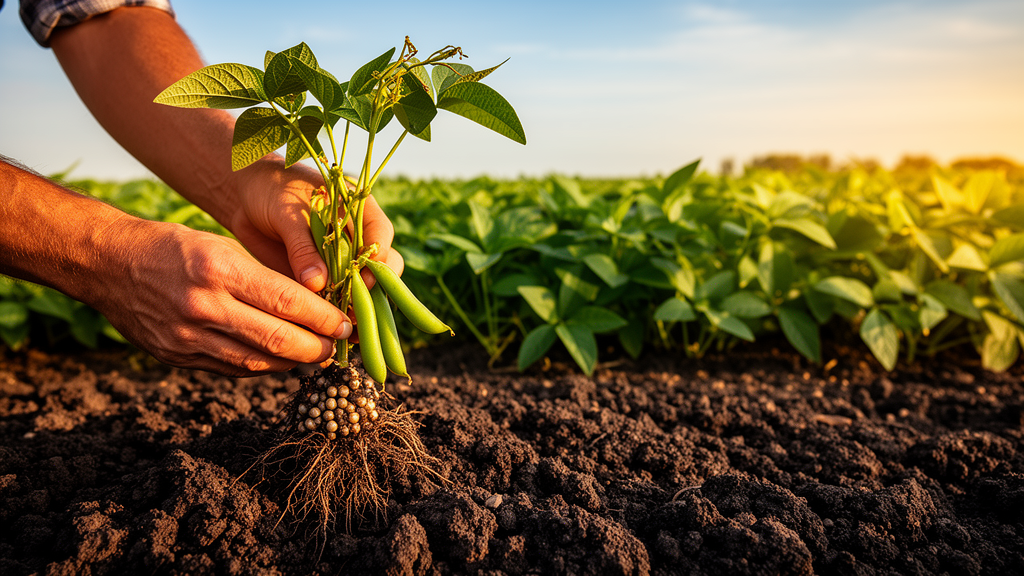
Beneath every farm field lies an invisible economy. Billions of bacteria and fungi trade nutrients with plant roots, decompose organic matter, suppress disease, and buffer crops against stress. A new collection of studies published in Frontiers in Microbiology takes a hard look at how two of agriculture’s oldest diversification strategies — legume intercropping and crop rotation — reshape these underground communities, and the results challenge the idea that there is one simple microbial recipe for sustainable farming.
The editorial, which synthesizes a Research Topic on legume intercropping and rotation and their impacts on soil microbiomes, brings together eight original research contributions. Six of them focus on legumes or legume-associated cropping systems, while two extend the logic to medicinal plant cultivation. Soil microbiomes underpin nutrient cycling, organic matter turnover, disease suppression, and plant resilience, and legumes are uniquely positioned to influence them: through symbiotic nitrogen fixation with rhizobia and through rhizodeposition, the steady release of carbon compounds from roots that feeds microbial life. Yet the editors are candid about the collection’s limits — the evidence is geographically concentrated, with seven studies conducted in China and one in the Peruvian Amazon, and intercropping is far better represented than rotation.
The strongest signals come from cereal-legume systems. In a wheat rotation study, Nan and colleagues found that rotating wheat with peanut or soybean improved both yield and grain quality compared with a wheat-maize rotation, with the wheat-peanut system delivering the largest gains. Beneath the visible improvement, the soil told its own story: beneficial shifts in bacterial communities, with enrichment of Acidobacteria and Chloroflexi, and a more complex architecture of fungal co-occurrence networks — a sign that the fungal community had become more interconnected and, potentially, more functionally coordinated.
Soybean-maize strip intercropping produced perhaps the most instructive finding of the entire collection. Liu and colleagues reported that maize yield was maintained in the intercrop while the abundance of nifH genes — the molecular marker for nitrogen-fixing bacteria — increased in the soybean rhizosphere. Surprisingly, however, the diversity and richness of the nitrogen-fixing community declined, with Shannon diversity dropping by 18.2 percent and Chao1 richness by 12.5 percent. When the researchers reduced nitrogen fertilizer input by 25 percent, Shannon diversity rebounded by 15.7 percent, driven primarily by greater evenness among species rather than by more species overall. Abundance and diversity, in other words, do not move in lockstep — a decoupling that carries real consequences for how scientists interpret microbiome data.
Phosphorus management added another layer of nuance. In a maize-peanut intercropping system, Zheng and colleagues found that phosphorus fertilization combined with intercropping increased productivity and shifted the microbial balance: the relative abundance of Nitrospirae and Mortierellomycota rose, while Ascomycota — a fungal phylum that harbors numerous plant-pathogenic taxa — declined. The intercropping yield advantage grew by 60.77 percent, although the gain in land equivalent ratio, the standard metric for intercropping efficiency, was a modest 2.54 percent. Meanwhile, in sugarcane-peanut intercropping, Wu and colleagues demonstrated that combining chemical and microbial fertilizers increased microbial diversity relative to chemical fertilizer alone, enriched rhizobia, raised soil organic matter, and alleviated soil acidification. Together, these studies show that microbiome responses to crop diversification are inseparable from nutrient management decisions.
Perennial systems joined the picture through tea plantations. Liu and colleagues found that intercropping tea with leguminous green manures — hairy vetch in particular — was associated with greater nutrient availability, altered soil enzyme activities, and shifts in predicted microbial functional potential related to carbon, nitrogen, and phosphorus cycling. The editors caution, however, that much of the evidence across the collection remains associative. Predicted functions inferred from sequencing data still require direct experimental validation before they can be treated as proven mechanisms.
Two studies pushed beyond conventional legume cropping into medicinal plant systems, and their contrasting outcomes drive home how context-specific intercropping really is. In monoculture Polygonatum cyrtonema, Zheng and colleagues tested intercropping with Paris polyphylla or the reishi fungus Ganoderma lucidum. Both combinations promoted rhizosphere nutrient accumulation, but neither significantly affected yield; only intercropping with P. polyphylla improved selected quality traits, raising water-soluble extract content by 2.8 percent and polysaccharide content by 12.1 percent. By contrast, Su and colleagues found that intercropping P. polyphylla with G. lucidum increased available potassium by 50.28 percent, strongly enriched the biocontrol fungus Trichoderma, and boosted yield by 51.30 percent along with polyphyllin content, while intercropping with P. cyrtonema instead enriched nitrogen-fixing taxa and increased available phosphorus by 26.78 percent. Same genus, opposite results — intercropping effects are system-specific rather than universally positive.
The collection’s geographical breadth came from the Peruvian Amazon, where Ramos Armaulia and colleagues turned to cadmium-affected cocoa agroforestry systems. From nodules of Inga trees, roots of Quararibea, and rhizosphere soil, the team obtained 93 bacterial isolates, of which 53 grew under cadmium screening and 12 yielded high-quality 16S rRNA sequences. In a striking result, no rhizobia sensu stricto were recovered from the Inga nodules; the nodule isolates were instead non-rhizobial endophytes. Cadmium tolerance proved strongly strain-dependent, with some isolates showing hormetic responses — stimulation at low doses of the metal and inhibition at higher ones. The authors caution that the apparent absence of rhizobia may reflect the cultivation conditions rather than true ecological absence, underscoring the enduring value of pairing culture-dependent work with culture-independent molecular methods.
Across all eight studies, several cross-cutting lessons emerge. Legume-based diversification was frequently associated with improved soil nutrient status, shifts toward potentially beneficial microbial taxa, and enhanced crop performance, but the responses varied with cropping system, soil conditions, fertilizer management, companion species, and the microbial groups examined. Microbial abundance, diversity, and predicted function did not necessarily respond in parallel, and reduced nitrogen inputs could support diversity while simultaneously reshaping the nitrogen-fixing community. The methodological toolkit was admirably broad — spanning culture-dependent isolation, amplicon sequencing, functional-gene quantification, microbial fingerprinting, functional prediction, and enzyme assays — but that breadth also constrains direct quantitative comparison among the studies.
The path forward, the editors argue, lies in moving beyond descriptive community profiling toward stronger functional and causal inference. Their priorities include culture-independent verification of rhizobial occurrence in legume nodules under environmental stress, multi-year rotation experiments that remain scarce relative to intercropping studies, direct validation of microbial functions inferred from sequencing, and explicit linkage of community structure with expressed genes, nutrient fluxes, and crop performance. Coordinated multi-site experiments that integrate microbiome analyses with diversified cropping trials under real field conditions will ultimately determine whether these effects hold across different soils, climates, and management systems. For now, the collection delivers a clear message: there is no single microbial signature of successful intercropping or rotation. Instead, plant identity, nutrient management, environmental context, and the intricate web of microbial interactions jointly determine what happens below ground — and, in turn, what farmers harvest above it.
Subject of Research: Impacts of legume intercropping and crop rotation on soil microbial communities and sustainable agroecosystems
Article Title: Editorial: Legume intercropping and rotation: impacts on soil microbiomes
Article References: Editorial: Legume intercropping and rotation: impacts on soil microbiomes. (n.d.). https://doi.org/10.3389/fmicb.2026.2006730
Image Credits: AI Generated
DOI: 10.3389/fmicb.2026.2006730
Keywords: legume intercropping, crop rotation, soil microbiome, nitrogen fixation, microbial diversity, nifH, rhizobia, sustainable agriculture, agroecosystems, rhizosphere, Trielderma, phosphorus cycling
News Source: Morgan Morrow. (October 16, 2026). Hidden Underground Allies: How Legume Farming Rewires Soil Microbes for Bigger Harvests. Scienmag.