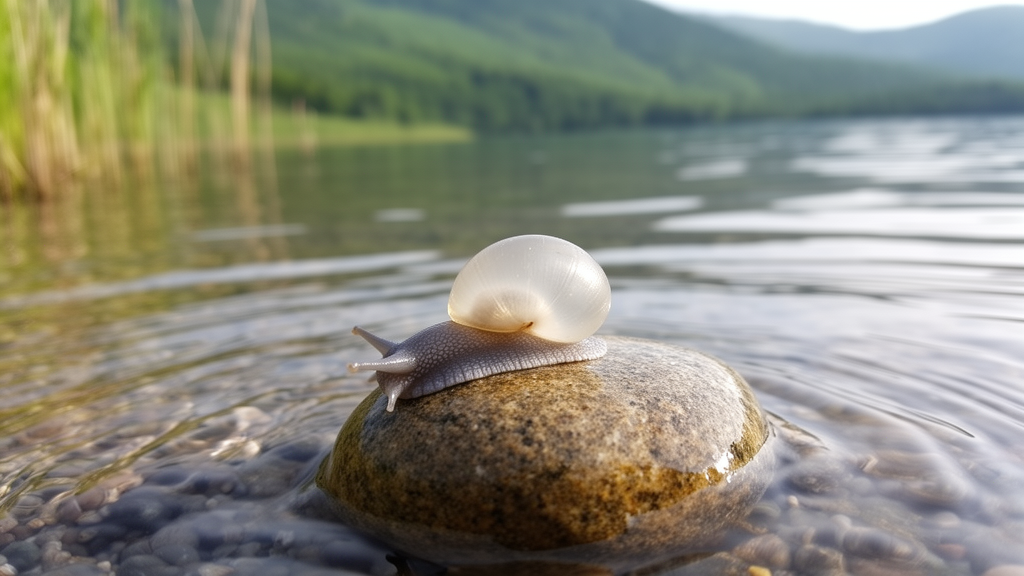
Beneath the surface of Lake Biwa, one of Japan’s oldest and most biodiverse lakes, an international team of researchers has uncovered a previously unknown species of freshwater snail, revealing a hidden layer of diversity in a lake already famous for its remarkable endemic fauna. The new species, named Semisulcospira nishimurai, was identified through a combination of genome-wide genetic analysis and detailed morphological examination, alongside a comprehensive redescription of its close relative, Semisulcospira reticulata, a species whose taxonomic status had remained uncertain for decades.
Semisulcospira is a genus of viviparous freshwater snails belonging to the family Semisulcospiridae, distributed across Japan, Korea, Taiwan, and China. Lake Biwa, located in central Japan, hosts a particularly rich assemblage of these snails, with 18 of the 30 known extant species being endemic to the lake’s water system. These snails exhibit remarkable diversity in shell morphology, chromosome numbers, and habitat preferences, making them an ideal model for studying evolutionary diversification in ancient lakes.
Despite recent taxonomic advances that have clarified the relationships among many Lake Biwa endemics, the species Semisulcospira reticulata, first described in 1961, remained poorly characterized. Its phylogenetic position within the genus, along with details of its shell variation, radula structure, and reproductive anatomy, had never been thoroughly documented. Compounding this gap, the sandy mud habitats along the lake’s coastal margins had received little attention from researchers surveying Semisulcospira diversity, leaving open the possibility that additional species remained undiscovered in these environments.
To address these questions, the research team collected 221 specimens from seven localities across Lake Biwa between 2019 and 2022, using snorkeling equipment and dredges to sample snails from depths ranging from shallow rocky shores to deeper muddy bottoms. Among these were 45 specimens of S. reticulata and 49 individuals of an unidentified species whose shell morphology partially resembled other members of the S. niponica species group but did not match any known taxon.
The researchers employed Multiplexed ISSR Genotyping by sequencing (MIG-seq), a genome-wide approach that generates thousands of single nucleotide polymorphisms (SNPs) across the genome, to reconstruct the evolutionary relationships among the S. niponica-group species. After quality filtering, the pipeline detected 19,767 SNPs from 12,417 loci across 107 specimens. Maximum-likelihood phylogenetic trees and coalescent-based SVDquartets analyses both strongly supported the genetic distinctiveness of most species in the group, including the monophyly of S. reticulata and the newly identified species.
Complementing the phylogenetic analyses, the team used ADMIXTURE clustering to assess population structure and admixture among four closely related species: S. reticulata, the unidentified species, S. decipiens, and S. habei. The results clearly separated S. reticulata and the new species into independent genetic clusters, confirming that they represent distinct evolutionary lineages rather than variants of a single species. The analysis also revealed shared ancestry between S. decipiens and S. habei at lower cluster numbers, consistent with their close relationship.
Morphological examination focused on 24 shell characters measured from mature females, given the known sexual dimorphism in the genus. Principal component analysis of 14 normalized morphological characters showed that the first principal component, explaining 35.7% of total variation, effectively separated S. reticulata, the new species, and S. decipiens, with the new species occupying an intermediate position. A Random Forest classification algorithm correctly assigned 93.3% of specimens to their respective species, demonstrating that shell morphology, when combined with genetic data, provides a reliable basis for species delimitation.
The most striking morphological finding concerned the protoconch, the embryonic shell retained at the apex of the adult shell. Semisulcospira reticulata possesses a uniquely large protoconch, averaging 5.1 mm in shell length, that lacks the distinct keels found in related species. In contrast, the new species, now formally described as Semisulcospira nishimurai, is characterized by a small, less elongated teleoconch and a tiny protoconch averaging only 2.4 mm. These differences in protoconch size likely reflect divergent life history strategies, with the large protoconch of S. reticulata potentially associated with a slower life history in the deeper, more stable areas of the lake.
Radula morphology, the microscopic tooth structure used for feeding, also revealed meaningful differences among the species. Both S. reticulata and S. nishimurai possess narrow, pointed cusps on their rachidian and lateral teeth, contrasting with the wider, more rounded cusps of S. decipiens and S. habei. This pattern suggests that the two species may have specialized feeding habits adapted to their particular substrates, echoing patterns documented in other lacustrine snail groups where radula morphology correlates with trophic niche partitioning.
The discovery of S. nishimurai from sandy mud substrates, a habitat previously underexplored for Semisulcospira diversity, provides new insights into the diversification of the genus in ancient lakes. The new species is widely distributed in the northern basin of Lake Biwa, found on sandy mud to mud bottoms at depths of 1 to 8 meters, and frequently coexists with other Semisulcospira species including S. reticulata, S. decipiens, and members of the S. nakasekoae group. The finding that both the S. niponica and S. nakasekoae groups harbor species adapted to non-rupicolous habitats suggests that niche differentiation along substrate gradients has played a key role in the evolutionary radiation of Semisulcospira in Lake Biwa, and that further surveying of underexplored microhabitats may yet reveal additional hidden diversity in this remarkable ancient lake ecosystem.
Subject of Research: Integrative taxonomy and genomics of freshwater snails in Lake Biwa, Japan
Article Title: Redescription of Semisulcospira reticulata ( Mollusca , Semisulcospiridae ) with description of a new species from Lake Biwa, Japan
Article References: Sawada, N., Fuke, Y., Miura, O., Toyohara, H., & Nakano, T. (2024). Redescription of Semisulcospira reticulata (Mollusca, Semisulcospiridae) with description of a new species from Lake Biwa, Japan. Evolutionary Systematics, 8(1), 127-144. https://doi.org/10.3897/evolsyst.8.124491
Image Credits: AI Generated
DOI: 10.3897/evolsyst.8.124491
Keywords: Semisulcospira, Lake Biwa, freshwater snails, new species, integrative taxonomy, phylogenetics, SNP analysis, protoconch, radula, endemic species, Japan, biodiversity
News Source: Juliet Wilcox. (October 19, 2026). Hidden snail species uncovered in Japan’s ancient Lake Biwa. Scienmag.