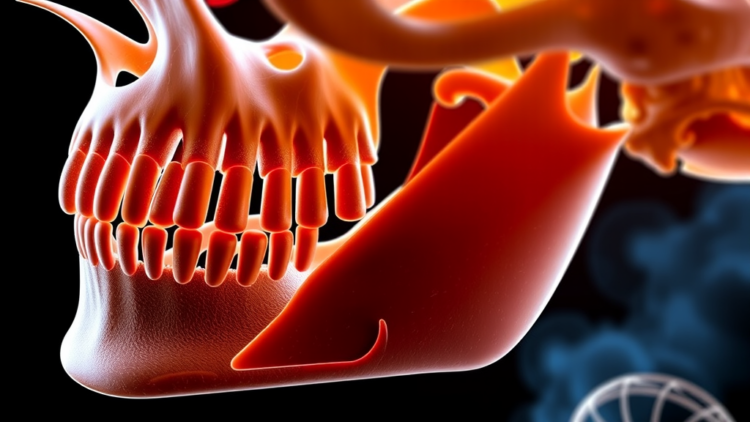
Temporomandibular joint osteoarthritis, a degenerative disorder that slowly erodes the cartilage cushioning the jaw, affects millions of people who struggle to chew, speak and yawn without pain. Current treatments largely target symptoms rather than the underlying biology, leaving patients with few options as the disease progresses. Now, a study published in the Journal of Cellular and Molecular Medicine has mapped a previously underappreciated molecular circuit that governs how jaw cartilage cells survive inflammatory attack, and the researchers showed that switching this circuit on can measurably slow joint destruction in rats.
The research team, led by Xuesong Xu and Shichong Qiao, began with a large-scale data trawl rather than a single hypothesis. They mined a publicly available bulk RNA-sequencing dataset from a rabbit model of post-traumatic temporomandibular joint osteoarthritis, using the limma statistical framework to identify genes whose activity shifted between healthy and diseased tissue. The screen was deliberately broad: genes with an absolute log2 fold change above 0.5 and a nominal p-value below 0.05 were flagged as differentially expressed, then fed into pathway enrichment analyses, gene set enrichment analysis and protein interaction network construction through the STRING database and Cytoscape. The results painted a coherent picture of a joint under siege.
Among the thousands of altered genes, a clear pattern emerged. Inflammatory mediators such as IL6, CXCL9, CXCL10 and STAT1 were ramped up, as were the catabolic enzymes MMP13 and ADAMTS5, which chew through cartilage matrix. Meanwhile, the structural genes that keep cartilage intact, including ACAN and COL2A1, were suppressed, and so was a cluster of genes tied to autophagy and oxidative stress control that orbit the transcription factor FOXO3. Pathway analysis confirmed the shift: TNF, NF-kB and chemokine signalling were positively enriched in osteoarthritic tissue, while FoxO signalling, autophagy and extracellular matrix organisation were negatively enriched. FoxO3, a forkhead box transcription factor known to regulate cell survival, inflammatory cascades and tissue repair, sat squarely at the centre of this storm.
To test whether restoring FoxO3 could protect the joint, the team turned to Sprague-Dawley rats. They delivered an adeno-associated virus vector, AAV5-CAG-rFoxO3-IRES-EGFP, directly into the temporomandibular joints to force FoxO3 expression, then induced osteoarthritis by injecting monosodium iodoacetate, a compound that disrupts chondrocyte metabolism. Eighteen rats were divided into three groups of six: a sham control, an osteoarthritis group receiving an empty vector, and an osteoarthritis group receiving the FoxO3 vector. Four weeks later, the joints were harvested and scrutinised with micro-computed tomography, histological staining and immunofluorescence.
The protective effect of FoxO3 was striking. Micro-CT revealed that the subchondral bone volume fraction was significantly higher in the FoxO3-treated group than in untreated osteoarthritic joints, with a corresponding reduction in trabecular separation, a measure of bone deterioration. Histology told the same story from the soft tissue side: cartilage surfaces were more intact, inflammatory cell infiltration was reduced, proteoglycan content was higher, and OARSI cartilage damage scores dropped significantly. At the molecular level, the catabolic enzymes MMP-13 and ADAMTS-5 were downregulated while the matrix markers Col2a1 and Aggrecan were upregulated, indicating that FoxO3 had shifted chondrocytes from a destructive, inflammatory state back toward matrix production and repair.
In cultured primary rat chondrocytes, the team confirmed the mechanism in finer detail. Overexpressing FoxO3 enhanced the deposition of acidic glycosaminoglycans, visible through Alcian blue staining, boosted Col2a1 protein levels and accelerated cell proliferation in a 24-hour scratch assay. But the central question remained: what controls FoxO3 in the first place? The answer came from small RNA sequencing of diseased and healthy joints, which identified 34 dysregulated microRNAs. Machine learning feature selection, combining LASSO regression and a linear support vector machine, converged on a single candidate: rno-miR-223-3p, which was significantly elevated in osteoarthritic tissue.
MicroRNAs are short regulatory RNAs that silence genes by binding complementary sequences in messenger RNA. Bioinformatic prediction with TargetScan suggested that rno-miR-223-3p could bind not only to the 3-prime untranslated region of FoxO3 mRNA but also to a long non-coding RNA called OIP5-AS1. This is where the study’s regulatory architecture becomes elegant. Long non-coding RNAs longer than 200 nucleotides can act as competing endogenous RNAs, effectively molecular sponges that soak up microRNAs and prevent them from repressing their targets. When the researchers transfected chondrocytes with a miR-223-3p mimic, FoxO3 expression fell at both the mRNA and protein levels; blocking the microRNA with an inhibitor had the opposite effect, restoring FoxO3 and, with it, Col2a1 expression and matrix synthesis.
The emerging model is a three-way regulatory axis. In healthy cartilage, OIP5-AS1 binds and neutralises miR-223-3p, keeping FoxO3 active and chondrocytes resilient. During disease, inflammatory signals such as interleukin-1 beta, which prior work has shown to suppress OIP5-AS1 in a dose- and time-dependent manner through presumed NF-kB pathway activation, reduce the sponge’s capacity. Free miR-223-3p rises, directly represses FoxO3, and the chondrocyte loses its antioxidant defences, its matrix production and its resistance to apoptosis. FoxO3 is known to activate downstream targets such as SOD2 and CAT that buffer oxidative stress, so its loss leaves cells vulnerable to the very inflammatory environment that osteoarthritis creates.
The authors are careful about the limits of their work. The mechanistic experiments relied primarily on cell models, and the OIP5-AS1 arm of the axis has not yet been directly manipulated in living animals; they propose constructing OIP5-AS1 knockdown and overexpression rat models combined with the monosodium iodoacetate challenge as the next step. They also note that FoxO3 activity is modulated by phosphorylation through the PI3K/Akt pathway, and that crosstalk with NF-kB signalling remains unexplored. No clinical samples were analysed, so the expression pattern of the axis in human temporomandibular joint osteoarthritis patients is still unknown. Beyond chondrocytes, miR-223-3p is a recognised regulator of macrophage polarisation and FoxO3 influences osteoblast and osteoclast behaviour, suggesting the axis may also shape synovial inflammation and subchondral bone remodelling across the whole joint.
Even with those caveats, the study delivers a genuinely actionable target. The demonstration that a single viral vector delivering FoxO3 into the joint can preserve bone architecture, cartilage integrity and matrix composition in a rat model of temporomandibular joint osteoarthritis provides proof of concept for gene-based therapy in a condition that currently has no etiological treatment. The OIP5-AS1/miR-223-3p/FoxO3 axis, the authors conclude, holds promise both as a diagnostic biomarker and as a therapeutic lever, offering a molecularly precise strategy for intervening in a disease that has long been managed only with pain relief and, eventually, surgery. For the millions whose jaws grind through daily life, that precision cannot come soon enough.
Subject of Research: The OIP5-AS1/miR-223-3p/FoxO3 regulatory axis in temporomandibular joint osteoarthritis and chondrocyte survival
Article Title: OIP5‐AS1 Sponges miR‐223‐3p to Upregulate FoxO3 and Ameliorate Temporomandibular Joint Osteoarthritis by Inhibiting Chondrocyte Apoptosis
Article References: Xu, X., & Qiao, S. (2026). OIP5 ‐ AS1 Sponges miR ‐223‐3p to Upregulate FoxO3 and Ameliorate Temporomandibular Joint Osteoarthritis by Inhibiting Chondrocyte Apoptosis. Journal of Cellular and Molecular Medicine, 30(17), Article e71359. https://doi.org/10.1111/jcmm.71359
Image Credits: AI Generated
DOI: 10.1111/jcmm.71359
Keywords: temporomandibular joint osteoarthritis, FoxO3, OIP5-AS1, miR-223-3p, chondrocyte apoptosis, long non-coding RNA, cartilage degeneration, gene therapy, micro-CT, extracellular matrix, inflammation, AAV5 vector
Cite Scienmag News
APA MLA Chicago
Juliet Wilcox. (September 25, 2026). Hidden RNA Switch Protects Jaw Cartilage From Osteoarthritis Damage. Scienmag. https://scienmag.com/hidden-rna-switch-protects-jaw-cartilage-from-osteoarthritis-damage/
Juliet Wilcox. “Hidden RNA Switch Protects Jaw Cartilage From Osteoarthritis Damage.” Scienmag, 25 September 2026, https://scienmag.com/hidden-rna-switch-protects-jaw-cartilage-from-osteoarthritis-damage/. Accessed 25 September 2026.
Juliet Wilcox. “Hidden RNA Switch Protects Jaw Cartilage From Osteoarthritis Damage.” Scienmag. September 25, 2026. https://scienmag.com/hidden-rna-switch-protects-jaw-cartilage-from-osteoarthritis-damage/
Copy citation Download RIS
Tags: AAV5 vectorcartilage cell survival pathwayscartilage degenerationchondrocyte apoptosisextracellular matrixFOXO3gene expression profiling in osteoarthritisgene set enrichment analysis in osteoarthritis researchgene therapyinflammationinflammatory response in joint tissuesLong non-coding RNAmicro-CTmiR-223-3pmolecular mechanisms of cartilage protectionnovel RNA switches in joint healthOIP5-AS1potential therapeutic targets for osteoarthritisrat models of temporomandibular joint degenerationRNA sequencing in joint diseaseRNA-based molecular circuitstemporomandibular joint osteoarthritis