


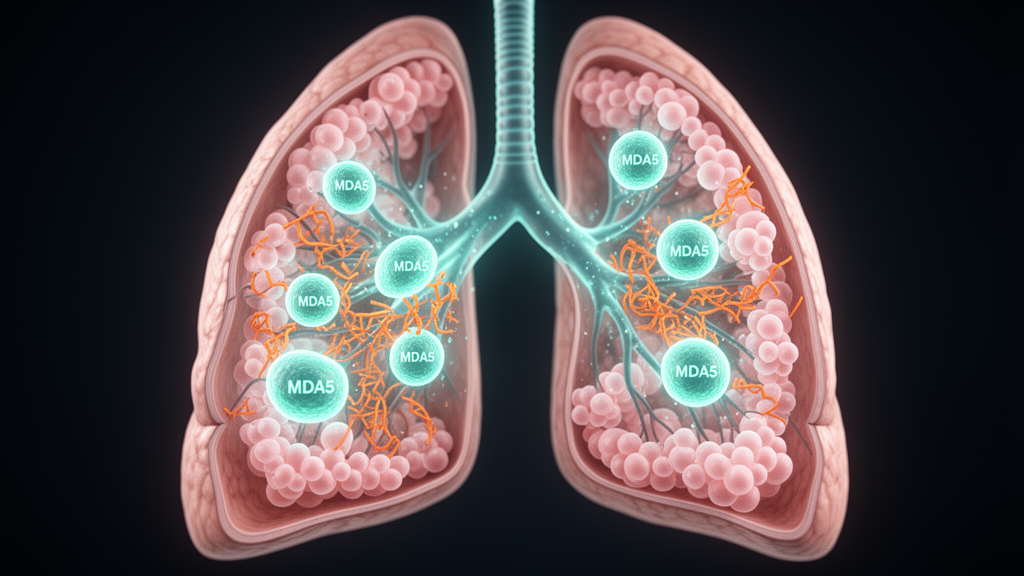
The innate immune receptor MDA5, long known as a cytoplasmic sensor that detects viral RNA and triggers antiviral interferon responses, has now been shown to perform a completely different job on the surface of cells. According to a study published in EMBO Molecular Medicine, MDA5 translocates to the plasma membrane when lung tissue is injured, where it acts as a scavenger receptor that captures extracellular self-RNA and shuttles it into lysosomes for degradation. When this cleanup system fails, accumulating RNA hyperactivates the endosomal receptor TLR8, driving a chemokine storm that worsens lung fibrosis in mice. The work, led by Takashi Ishii and colleagues at Musashino University and collaborating institutions, reveals a previously unrecognized protective axis in interstitial lung disease.
The researchers began by asking how RNA-sensing innate immune receptors behave in non-pathogen-driven lung fibrosis, a question that had remained largely unexplored. Interstitial lung diseases, of which idiopathic pulmonary fibrosis is the most prevalent subtype, often progress rapidly despite treatment with the antifibrotic drugs pirfenidone and nintedanib. Patients with anti-MDA5 antibody-positive dermatomyositis frequently develop acute interstitial lung disease with a high mortality rate, hinting that the innate immune system is deeply involved in these conditions. Yet while the DNA-sensing cGAS-STING pathway had been linked to lung fibrosis before, the role of RNA receptors and self-RNA in the disease process was unclear.
To probe this, the team used a bleomycin-induced mouse model of pulmonary fibrosis, in which the chemotherapeutic agent is instilled directly into the airways to trigger injury, inflammation and scarring. Single-cell RNA sequencing data from a radiation pneumonitis dataset showed that Ifih1, the gene encoding MDA5, was predominantly expressed in alveolar macrophages, interstitial macrophages and monocyte-derived macrophages in mice. In human lung cells from patients with interstitial lung disease, IFIH1 was mainly expressed in immune cells and endothelial cells. When the researchers examined bronchoalveolar lavage fluid from mice, they found abundant MDA5 protein, which decreased after bleomycin treatment, and Western blotting of concentrated lavage fluid confirmed that the signal was specific to wild-type animals and absent in MDA5-deficient mice.
Flow cytometry without cell permeabilization revealed surface MDA5 on monocyte-derived macrophages and CD11b-positive macrophages in the lung, though not on lymphocytes. Immunofluorescence staining of bleomycin-treated bone marrow-derived macrophages confirmed surface localization without permeabilization. To obtain direct biochemical evidence, the team isolated cell-surface proteins from the human monocyte cell line U937 and showed by Western blotting that bleomycin stimulation substantially increased the amount of MDA5 anchored to the plasma membrane. When cells were treated with Brefeldin A, an inhibitor of endoplasmic reticulum-to-Golgi transport, the bleomycin-induced surface translocation was completely abolished, indicating that cellular stress actively drives MDA5 secretion through the classical ER-to-Golgi vesicular pathway.
The functional consequences of losing this pathway were striking. Three weeks after bleomycin instillation, MDA5-deficient mice showed aggravated infiltrative shadows and ground-glass opacities on computed tomography, prominent collagen deposition on histology, elevated lung hydroxyproline content, and increased expression of the fibrosis genes Col1a1, Fn1 and Tgfb1 compared with wild-type and MAVS-deficient mice. Respiratory mechanics measured with a flexiVent system deteriorated only in bleomycin-treated MDA5-deficient animals, with increased elastance, tissue damping and tissue elastance alongside reduced inspiratory capacity and static compliance. Critically, mice lacking both MDA5 and its downstream adaptor MAVS developed fibrosis just as severe as MDA5-deficient mice alone, and type I interferon signaling was not the explanation either: interferon alpha receptor 1-deficient mice showed fibrosis of comparable overall severity but with distinct chemokine and macrophage profiles. The protective effect of MDA5 therefore operates independently of both canonical signaling routes.
Immune profiling pointed to a specific inflammatory circuit. Bleomycin-treated MDA5-deficient mice had significantly more IL-17A-producing T cells, particularly IL-17A-producing gamma-delta T cells, and increased lung neutrophils expressing the chemotaxis markers Cxcl1 and Mip2. RNA sequencing of lung CD11b-positive macrophages revealed elevated expression of fibrosis-related genes including several collagens and Sparc, plus pathway terms tied to IL-17A signaling, chemotaxis and tissue fibrosis. Cross-referencing these results with RNA sequencing of bleomycin-treated bone marrow-derived macrophages identified seven commonly upregulated genes, among them the CCR2 ligands Ccl2, Ccl7 and Ccl12. In human U937 cells, knocking down IFIH1 further enhanced bleomycin-induced expression of CCL2, CCL7 and CCL8. Notably, stimulating macrophages with the profibrotic growth factor PDGF-BB did not reproduce this difference, showing the mechanism is specific to damage-associated stimuli rather than general profibrotic signaling.
Adoptive transfer experiments cemented macrophages as the key cellular drivers. When wild-type recipient mice received bleomycin-stimulated MDA5-deficient macrophages intratracheally alongside a low dose of bleomycin, they developed significantly worse inflammation and fibrosis than recipients of wild-type macrophages, as judged by imaging, histology, hydroxyproline assay and lung gene expression. Conversely, treating bleomycin-challenged MDA5-deficient mice with the CCR2 antagonist INCB3344 significantly reduced collagen deposition, lowered expression of Col1a1, Fn1 and Ccl2, and improved lung mechanics, including reduced tissue elastance and tissue damping. Together these results establish CCR2 ligands released by macrophages as essential mediators of the aggravated fibrotic phenotype.
The mechanistic core of the paper explains why. Because damaged cells release both RNA and DNA, the researchers treated U937 cells with bleomycin in combination with DNase or RNase. RNase, but not DNase, suppressed CCL2 and CCL8 expression in MDA5-suppressed cells, identifying extracellular RNA as the primary trigger. Blocking TLR8 with the inhibitor CUCPT9a, or with TLR8 siRNA, dampened the chemokine response, implicating this endosomal receptor in the hyperinflammation. Fluorescence microscopy showed increased RNA signal in MDA5-deficient macrophages, and in situ staining of lung sections from bleomycin-treated MDA5-deficient mice revealed substantial RNA accumulation in foci of severe inflammation and fibrosis, a signal abolished by RNase treatment and therefore extracellular in origin. Super-resolution microscopy of live-surface-stained macrophages showed spatial colocalization of MDA5 and RNA at the cell periphery, evidence of a physical interaction.
Functional clearance assays then demonstrated the fate of the captured RNA. The team labeled lung tissue-derived RNA with a fluorescent dye and administered it to U937 cells with or without IFIH1 knockdown. In control cells, bleomycin-induced cellular fluorescence rose only modestly and was partly susceptible to RNase digestion, reflecting normal turnover. In MDA5-suppressed cells, fluorescence increased significantly and became resistant to RNase, indicating that extracellular RNA was no longer properly processed and degraded. When wild-type cells were treated with chloroquine, a lysosomal inhibitor, fluorescent RNA accumulated inside cells in a dose-dependent manner, and under high-dose conditions the surface-retained RNA became highly susceptible to external RNase. The picture that emerges is of MDA5 capturing extracellular RNA at the plasma membrane and delivering it to lysosomes, with failure of this route leading to RNA buildup and TLR8-driven chemokine production.
Human datasets lent translational weight to the mouse findings. Re-analysis of single-cell RNA sequencing data from 20 patients with interstitial lung disease and 10 controls showed that SPP1-positive macrophages, whose proportions were expanded in patients, broadly and highly expressed CCL2 and CCL7, with some also expressing CCL8, and cell-to-cell interaction analysis revealed strong signaling between these macrophages and CCR2-expressing monocytes. In bronchoalveolar lavage cells from 175 patients with idiopathic pulmonary fibrosis, CCL2 and CCL7 were elevated while IFIH1 was reduced compared with healthy donors, and CCL2 and CCL7 expression inversely correlated with patient survival. Lung homogenate data from the Lung Genomics Research Consortium showed a similar pattern for CCL7 and IFIH1, and IFIH1 expression slightly correlated with percent-predicted diffusing capacity, a measure of disease severity. The authors note limitations, including reliance on publicly available transcriptomic cohorts with potential batch effects, the absence of primary human lung cell experiments, and the bleomycin model’s imperfect reflection of human disease. Still, they propose that enhancing MDA5-mediated RNA clearance, or dampening the downstream TLR8-CCR2 axis, could become a therapeutic strategy for inflammatory and fibrotic lung diseases, and they speculate that anti-MDA5 autoantibodies in dermatomyositis might even interfere with the receptor’s surface scavenging function, a hypothesis that awaits direct testing.
Subject of Research: A study showing that the RNA sensor MDA5 clears extracellular self-RNA from the cell surface to protect against bleomycin-induced lung fibrosis.
Article Title: Extracellular RNA clearance by non-canonical cell-surface MDA5 protects against lung fibrosis
Article References: Ishii, T., Horie, M., Urushiyama, H., Murakami, Y., Narita, T., Fukui, R., Miyake, K., Saito, A., Yamashita, N., Kumano, K., & Kage, H. (2026). Extracellular RNA clearance by non-canonical cell-surface MDA5 protects against lung fibrosis. EMBO Molecular Medicine, 18(10), 4001-4033. https://doi.org/10.1038/s44321-026-00513-6
Image Credits: AI Generated
DOI: 10.1038/s44321-026-00513-6
Keywords: MDA5, lung fibrosis, extracellular RNA, TLR8, macrophages, interstitial lung disease, bleomycin model, CCR2 ligands, lysosomal degradation, innate immunity, idiopathic pulmonary fibrosis, SPP1 macrophages
News Source: Kristina Jarvis. (October 29, 2026). Hidden RNA Cleanup Role of Immune Sensor MDA5 Shields Lungs from Fibrosis. Scienmag.



