Barley leaf rust, caused by the fungal pathogen Puccinia hordei, is one of the most damaging foliar diseases of barley worldwide, capable of slashing yields by up to 40 percent in susceptible varieties while degrading grain quality for food, feed and malting. The pathogen produces enormous numbers of urediniospores each growing season, spreading rapidly under warm, humid conditions and evolving quickly to overcome resistance genes that once worked. Now, a research team led by Shiva Azizinia, Md Arifuzzaman and Peter M. Dracatos has mined an underexplored gene pool for new weapons against this disease, publishing their findings in the journal Theoretical and Applied Genetics. Their study of 318 barley accessions of Eastern European origin has uncovered both familiar and potentially brand-new genetic sources of leaf rust resistance, including a dominant locus provisionally named RphCaspian, or RphCas, mapped to the long arm of chromosome 4H.
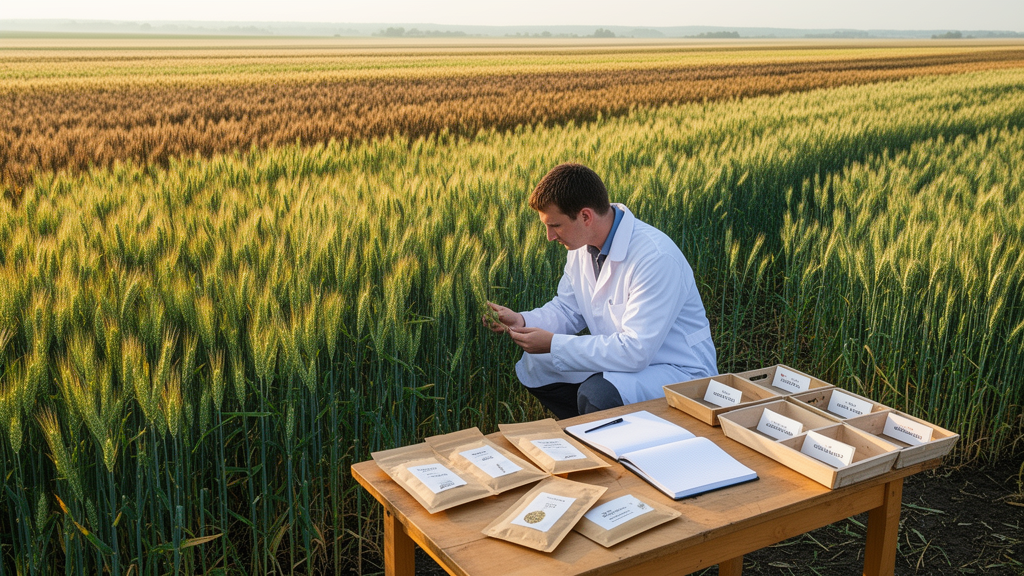
The Eastern European barley collection was assembled from the Australian Grains Genebank in Horsham, Australia, with accessions selected based on passport data indicating Eastern European origin. The researchers argue that this region has been historically underexploited for resistance breeding, partly because political isolation meant fewer alleles were likely to have been sourced from Eastern Europe compared with Western collections. Genebanks, they note, represent essential reservoirs of allelic diversity, and in Australia strict biosecurity requirements can limit the direct introduction of exotic germplasm, making the mining of existing collections a practical route to broaden the resistance base available for barley improvement. Each accession was purified by single-seed descent, with seed harvested from a single plant for both phenotypic evaluation and genomic DNA extraction.
Phenotyping was carried out at the seedling stage under controlled greenhouse conditions using 12 Australian Puccinia hordei pathotypes with diverse virulence profiles and two US-derived pathotypes, selected to capture virulence to a broad range of known Rph genes. Seedlings were inoculated with a suspension of urediniospores in mineral oil, incubated in darkness for 24 hours with ultrasonic mist, and then grown in microclimate rooms at 21 to 23 degrees Celsius. Disease responses were scored 9 to 10 days after inoculation using both the McNeal 1-to-9 scale and the modified Stakman 0-to-4 infection-type scale, with homogeneous ratings from at least 6 to 8 biological replicates per line used for the quantitative genomic analysis. The results were striking: only 1.3 percent of the accessions were broadly resistant, 21 percent were moderately resistant, and 77 percent were susceptible, with susceptibility increasing in line with the virulence of the pathotypes tested.
Three accessions stood out from the crowd. The Russian landrace Anska was completely immune to all 14 pathotypes tested, recording the lowest mean McNeal score of the entire collection at 1.4, while fellow Russian line Caspian produced an intermediate infection type suggesting a unique, uncharacterised resistance allele. Three Greek accessions, Athenais, Rodon and PI 249934, were broadly resistant to all pathotypes except one, indicating they likely carried the same uncharacterised resistance allele with pathotype specificity. The researchers hypothesised that these distinct infection types in the Russian landraces represented distinct resistance alleles, setting the stage for detailed genetic analysis of each source.
Genotyping was performed using two complementary marker platforms: a targeted genotyping-by-sequencing assay and the Infinium Wheat Barley 40K BeadChip array. After rigorous marker curation, filtering for biallelic SNPs with minor allele frequency above 1 percent, call rate above 80 percent and unique genome positions, 36,098 SNPs were retained for genome-wide association studies. The team applied the FarmCPU method within the GAPIT framework, an iterative multi-locus approach that combines fixed-effect and random-effect models to control for both population structure and multiple associated markers, reducing false positives while increasing detection power. A strict Bonferroni significance threshold was applied, and the results were independently validated using a Bayesian modelling approach called BayesR, which allows some SNPs to have larger estimated variances than methods such as GBLUP and can more closely approximate the true variance of quantitative trait loci.
The GWAS revealed significant peaks corresponding to known resistance loci, including Rph2, Rph3 and Rph12, as well as potentially uncharacterised resistance quantitative trait loci on chromosomes 1HL, 2HL, 3HS and 6HS. The cloned Rph3 locus, prevalent in the collection, served as an effective positive control, detected by both FarmCPU and BayesR only in response to Rph3-avirulent pathotypes. A significant peak proximal to Rph3 on the long arm of chromosome 7H was identified only with the Rph19-avirulent pathotype, providing a refined map location for Rph19. Notably, the novel QTL on the long arms of chromosomes 1H and 2H were identified in response to the most virulent pathotypes and do not correspond to any known Rph genes in cultivated barley, although previous studies have mapped partial resistance genes to chromosome 2HL. Remarkably, all three Greek accessions carried four of the novel QTLs identified in the study, on 1HL, 2HL, 3HS and 6HS.
To determine the inheritance of resistance in the standout accessions, the researchers crossed Caspian, Anska and Athenais with the leaf rust-susceptible cultivar Gus and assessed F3 generation populations. Chi-squared analysis revealed that resistance in Caspian was controlled by a single dominant gene, provisionally designated RphCas, whereas resistance in Athenais was consistent with two-gene inheritance. The inheritance of resistance in Anska was inconclusive, likely due to segregation distortion, although haplotype analysis suggested it carries QTLs on 1HS and 3HS that largely explain its exceptionally low infection type.
Mapping the Caspian resistance locus required a bulked segregant RNA sequencing approach, the first application of this technique to map barley leaf rust resistance. Equal quantities of leaf tissue from 38 resistant and 42 susceptible F2 individuals were pooled separately and sequenced at 50x coverage, alongside the parental lines. SNP frequency ratios plotted across the Morex v3 reference genome mapped RphCas to the long arm of chromosome 4H, in a similar region to the previously characterised Rph21 allele from the cultivar Ricardo. The approach was validated by re-mapping the Rph5.e resistance allele to its previously confirmed location on the short arm of chromosome 3H in a control population. Conventional bulked segregant analysis using a 15K SNP array further delineated the RphCas location to a 6.59 megabase region on 4HL, supporting the BSR-Seq results.
An allelism test was performed by crossing Ricardo, which carries Rph21, with Caspian, followed by rust testing of F3 families with a Puccinia hordei pathotype avirulent to both resistance sources. The segregation pattern, including the presence of 10 susceptible F3 lines and Chi-squared analysis closely conforming to a digenic inheritance model, suggests that RphCas is a distinct newly identified resistance gene on chromosome 4HL, separate from Rph21. However, the researchers caution that their close physical proximity and haplotypic similarity require further investigation before a formal gene designation can be made. Rph21 was originally mapped using bulked segregant analysis with a small set of polymorphic markers, so the resolution of its physical location is low, spanning an interval of approximately 18.3 megabases that overlaps with the 6.58 megabase RphCas region. A loose linkage cannot be excluded based on these data, as the population size may have limited the power to distinguish recombination frequencies close to 50 percent from complete independent assortment.
The study provides closely linked SNP markers on the 40K Infinium wheat barley array suitable for marker-assisted selection, and because the same array has been used to genotype all barley accessions of the Australian Grains Genebank, it permits haplotype-based predictions of leaf rust resistance in any accession, informing the efficient selection of core collections. In future, characterisation of resistance gene-linked haplotypes in this way can assist with more targeted selection of accessions that do not carry known genes, accelerating the discovery of novel resistance sources. The research was supported by funding from the Grains Research and Development Corporation and the Alexander von Humboldt Foundation, with part of the work funded by the Australian Grains Genebank Strategic Partnership, a 30 million dollar joint investment between the Victorian Government and the Grains Research and Development Corporation. Further studies will involve fine mapping and both sequence and haplotype-based analysis of Rph21 and RphCas to determine whether they are truly distinct leaf rust resistance alleles on chromosome 4HL, potentially adding a new tool to the arsenal against one of barley’s most persistent fungal foes.
Subject of Research: Genetics
Article Title: Genome-wide characterisation of leaf rust resistance loci in an Eastern European barley collection
Article References: Azizinia, S., Arifuzzaman, M., Tongson, E., Sandhu, K., Keeble-Gagnère, G., Khan, G. A., Forrest, K., Hayden, M., Perovic, D., Singh, D., & Dracatos, P. M. (2026). Genome-wide characterisation of leaf rust resistance loci in an Eastern European barley collection. Theoretical and Applied Genetics, 139(11), Article 307. https://doi.org/10.1007/s00122-026-05405-4
Image Credits: AI Generated
DOI: 10.1007/s00122-026-05405-4
Keywords: barley, leaf rust, Puccinia hordei, GWAS, RphCaspian, genebank genomics, disease resistance, chromosome 4HL, marker-assisted selection, Theoretical and Applied Genetics, Genome-wide, characterisation
News Source: Juliet Wilcox. (October 17, 2026). Hidden Resistance Genes Surface in Eastern European Barley Collection. Scienmag.