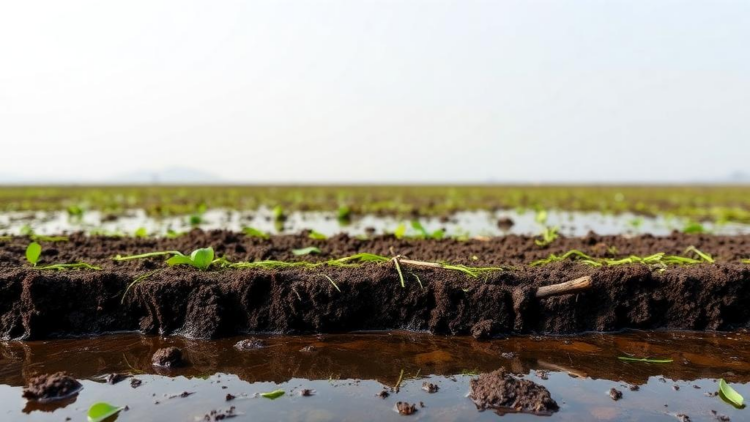
Wetlands are among the most biologically productive and ecologically sensitive ecosystems on Earth, yet they are also extraordinarily efficient at accumulating pollutants. Because their hydrological regimes alternate between flooded, oxygen-poor periods and drained, oxygen-rich phases, wetland soils undergo constant shifts in redox chemistry that govern how heavy metals enter, move through, transform within, and persist in the environment. Unlike organic contaminants, metals never degrade; they simply change form, becoming more or less bioavailable and more or less toxic to the organisms that encounter them. For wildlife and humans alike, this persistence translates into a long-term threat, particularly through bioaccumulation along food chains. A new study of two shallow, Yangtze-connected lakes in Anhui Province, China, now offers a detailed portrait of how five toxic metals are distributed across wetland soils and how the microbial communities living in those soils respond to them, with implications for the conservation of some of the world’s most endangered migratory birds.
The research focused on Shengjin Lake and Caizi Lake, two typical shallow river-connected lakes in the middle and lower reaches of the Yangtze River. Shengjin Lake, covering roughly 33,300 hectares on the southern bank of the Yangtze, is a nationally protected nature reserve. Caizi Lake, about half that size on the left bank, experiences more intensive human pressure from agriculture, inland waterway transport, and aquaculture. Both lakes sit in a humid subtropical monsoon climate zone and serve as critical stopover and wintering sites along the East Asian–Australasian Flyway, hosting hundreds of thousands of waterbirds each year, including the endangered oriental stork (Ciconia boyciana), hooded crane (Grus monacha), and Siberian crane (Grus leucogeranus). In December 2022, during the dry winter season when receding water exposes broad lakeshore grasslands, the researchers collected twenty composite soil samples from the top twenty centimeters of exposed, bird-frequented mudflats dominated by Carex sedges, deliberately choosing sites far from direct human activity.
The analytical approach combined rigorous soil chemistry with high-throughput DNA sequencing. For arsenic and mercury, soils were digested by microwave-assisted acid dissolution and quantified by atomic fluorescence spectrometry. Lead, cadmium, and chromium were measured after a tri-acid digestion of nitric, perchloric, and hydrofluoric acids using inductively coupled plasma mass spectrometry. A certified reference soil material was analyzed alongside the samples, with relative errors consistently below six percent, lending confidence to the measurements. To gauge contamination, the team calculated the geoaccumulation index, a logarithmic measure comparing measured concentrations against geochemical background values for the lower Yangtze river system. Microbial communities were profiled by amplifying the V3–V4 region of the bacterial 16S rRNA gene and sequencing the amplicons on a paired-end platform, yielding more than 1.2 million high-quality reads that clustered into 11,316 operational taxonomic units at a ninety-seven percent similarity threshold.
The headline finding on pollution was reassuring: all five metals—arsenic, cadmium, chromium, mercury, and lead—produced negative geoaccumulation indices in both lakes, indicating that the soils remain essentially uncontaminated. Across all samples, mean concentrations followed the order chromium greater than lead greater than arsenic greater than cadmium greater than mercury. Chromium was the most abundant metal, averaging 48.85 milligrams per kilogram at Shengjin Lake and 66.64 milligrams per kilogram at Caizi Lake, while mercury was the scarcest at just 0.03 and 0.05 milligrams per kilogram respectively. Notably, every metal except cadmium and chromium was significantly more concentrated in Caizi Lake soils. The authors attribute this asymmetry to differing land-use histories: Shengjin Lake’s status as a strictly protected reserve appears to shield it from the agricultural runoff, shipping emissions, and aquaculture discharges that likely elevate metal loads at Caizi Lake. Concentrations in both lakes were also considerably lower than those reported for nearby Chaohu, Poyang, and Taihu Lakes, and lower than previous measurements of the lakes’ own sediments.
The microbial story proved more complex. Proteobacteria, Actinobacteriota, and Chloroflexi dominated the communities, accounting for 31.7, 28.4, and 10.9 percent of all sequences. At the genus level, Massilia, Arthrobacter, Pseudarthrobacter, Pedobacter, Cryobacterium, Flavobacterium, Nocardioides, Anaerolinea, Gemmatimonas, and Pseudomonas were the most abundant taxa. Although the two lakes share a river connection and a broadly similar climate, their microbial assemblages were clearly distinct. Principal coordinate analysis based on Bray–Curtis distances separated the samples cleanly by lake, a pattern confirmed statistically by PERMANOVA. Counterintuitively, Caizi Lake—the lake with higher metal burdens—harbored significantly greater microbial species richness, as measured by the Chao1 index, and also contributed fewer unique operational taxonomic units than Shengjin Lake, which yielded 2,367 lake-specific taxa against Caizi Lake’s 1,089.
The researchers suggest that favorable soil conditions at Caizi Lake may explain this apparent paradox. Soil pH ranged from 5.98 to 6.90 at Shengjin Lake but was significantly more acidic at Caizi Lake, spanning 5.44 to 6.13, while organic matter content and cation exchange capacity did not differ significantly between the lakes. Moderately acidic pH combined with relatively high organic matter can create diverse microhabitats that buffer environmental stress and allow a wider range of microbial taxa to coexist. Linear discriminant analysis effect size, a method for identifying biomarker taxa, revealed that Pedobacter, Nocardioides, and Flavobacterium were significantly enriched at Shengjin Lake, whereas Arthrobacter was significantly more abundant at Caizi Lake—taxa with well-documented roles in nutrient cycling and, in some cases, metal tolerance.
Correlation analysis uncovered a striking lake-specific pattern. In Shengjin Lake soils, arsenic was strongly and negatively correlated with eight of the twenty most abundant genera, including Arthrobacter, Flavobacterium, Pseudomonas, and Pedobacter, suggesting that even at uncontaminated concentrations, this metalloid may be shaping which bacteria can thrive. In Caizi Lake soils, by contrast, none of the five metals showed significant correlations with the dominant genera, hinting that the community there may be adapted to, or buffered against, the prevailing metal levels. Functional predictions based on the Kyoto Encyclopedia of Genes and Genomes added another layer: at Shengjin Lake, arsenic correlated negatively with carbohydrate metabolism and secondary metabolite biosynthesis but positively with pathways for DNA replication and repair, translation, transcription, and energy metabolism—possibly reflecting a shift toward growth and maintenance processes under metal stress. At Caizi Lake, chromium showed a strong negative correlation with protein folding pathways.
The dominance of Proteobacteria and Actinobacteriota in both lakes is ecologically meaningful. Proteobacteria are among the most functionally versatile bacteria in terrestrial ecosystems, driving carbon, nitrogen, and phosphorus cycling, and many members secrete extracellular polysaccharides and enzymes that improve soil aggregation and accelerate decomposition. In metal-contaminated environments they are frequently among the survivors, and their abundance has been linked to bioremediation efficiency. Actinobacteriota, meanwhile, decompose refractory compounds such as cellulose and chitin, produce antibiotics that suppress soil-borne pathogens, and tolerate metals through biosorption onto cell wall functional groups, intracellular sequestration, biotransformation into less bioavailable forms, and bioleaching. These enzymatic detoxification strategies mean that soil microbes are not merely passive victims of metal pollution; they actively convert toxic ions into stable, immobile forms, helping to maintain ecosystem stability even under stress.
For the migratory birds that depend on these wetlands, the findings carry practical weight. Waterbirds foraging on exposed lakeshore grasslands can ingest metal-contaminated soil and biota, leading to bioaccumulation and sublethal physiological impairment even when concentrations appear modest. Because microbial communities respond rapidly and sensitively to chemical stress, tracking their composition and functional profiles could serve as an early warning system for habitat degradation before overt contamination appears. The authors caution that their study has limitations: sampling was confined to a single winter month, functional profiles were inferred bioinformatically rather than measured directly through metagenomics or metatranscriptomics, and twenty samples cannot capture full spatiotemporal variability. Future work with multi-season sampling and direct functional measurements will be needed to confirm the mechanisms at play. Even so, the study demonstrates that two neighboring, hydrologically connected lakes can harbor markedly different microbial worlds, and that those differences are legible in the chemistry of the soil itself—a reminder that protecting wetlands means monitoring not just the water and the birds, but the invisible communities beneath the mud.
Subject of Research: Heavy metal distribution and soil microbial community responses in wetland soils of Shengjin and Caizi Lakes, China
Article Title: Heavy Metal Characteristics and Their Association With Microbial Communities of Wetland Soils of Shengjin and Caizi Lakes, China
Article References: Geng, H., & Liu, G. (2026). Heavy Metal Characteristics and Their Association With Microbial Communities of Wetland Soils of Shengjin and Caizi Lakes, China. MicrobiologyOpen, 15(5), Article e70426. https://doi.org/10.1002/mbo3.70426
Image Credits: AI Generated
DOI: 10.1002/mbo3.70426
Keywords: heavy metals, wetland soils, microbial communities, Shengjin Lake, Caizi Lake, Yangtze River, 16S rRNA sequencing, geoaccumulation index, arsenic, migratory waterbirds, bioremediation, ecological risk assessment
Cite Scienmag News
APA MLA Chicago
Morgan Morrow. (October 3, 2026). Hidden Metal Signatures in Yangtze Wetland Soils Reveal Microbial Communities Under Pressure. Scienmag. https://scienmag.com/hidden-metal-signatures-in-yangtze-wetland-soils-reveal-microbial-communities-under-pressure/
Morgan Morrow. “Hidden Metal Signatures in Yangtze Wetland Soils Reveal Microbial Communities Under Pressure.” Scienmag, 3 October 2026, https://scienmag.com/hidden-metal-signatures-in-yangtze-wetland-soils-reveal-microbial-communities-under-pressure/. Accessed 3 October 2026.
Morgan Morrow. “Hidden Metal Signatures in Yangtze Wetland Soils Reveal Microbial Communities Under Pressure.” Scienmag. October 3, 2026. https://scienmag.com/hidden-metal-signatures-in-yangtze-wetland-soils-reveal-microbial-communities-under-pressure/
Copy citation Download RIS
Tags: 16S rRNA sequencingarsenicbioavailability and toxicity of heavy metalsbiodiversity protection in Yangtze River basinbioremediationCaizi Lakeconservation of Yangtze River wetlandsecological risk assessmentecological risks of heavy metals in wetlandsenvironmental monitoring of wetland ecosystemsgeoaccumulation indexheavy metal accumulation in aquatic ecosystemsheavy metalsimpact of toxic metals on migratory bird habitatsmicrobial communitiesmicrobial community responses to metal pollutantsmigratory waterbirdspollutant persistence in wetlandspollutant transformation processes in flooded soilsredox chemistry in wetland environmentsShengjin LakeWetland soil contaminationwetland soilsYangtze River