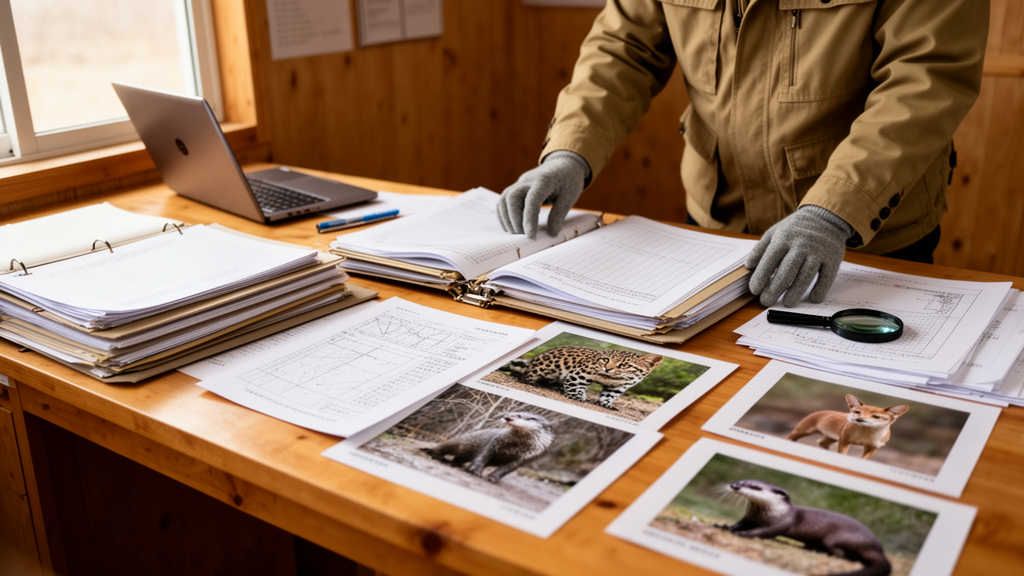
Some of the most valuable wildlife data in the world never makes it into a scientific database. It sits, instead, in the appendices of environmental impact assessments — thick, technical documents produced for developers, regulators and lawyers, read by almost nobody else. In the Republic of Korea, a team at the National Institute of Ecology has now rescued a slice of that hidden archive, compiling 5,000 occurrence records of endangered mammals from environmental impact assessment (EIA) and post-EIA monitoring reports and publishing them as an open, standardised dataset through the Global Biodiversity Information Facility (GBIF).
The dataset, described in the Biodiversity Data Journal, covers surveys conducted from March 2007 to June 2023 and documents six mammal taxa legally designated as Endangered Wildlife under Korea’s Wildlife Protection and Management Act: the Eurasian otter (Lutra lutra), the leopard cat (Prionailurus bengalensis), the Siberian flying squirrel subspecies Pteromys volans aluco, the yellow-throated marten (Martes flavigula), the least weasel (Mustela nivalis) and Ognev’s long-eared bat (Plecotus ognevi). Each record represents a detection of one of these animals tied to a specific development project, a specific project phase and a specific survey event, drawn from 73 development projects scattered across the country.
What makes the work technically interesting is not just the volume of records but the provenance. Environmental impact assessment is a decision-support process required before major development proceeds, and its ecological surveys generate species occurrence information that feeds into impact predictions and mitigation planning. Post-EIA monitoring then extends that record through the construction and operation phases of a project, producing repeated surveys over years. Together, these documents collectively contain an enormous volume of biodiversity data — but in Korea, as in many countries, that information has historically been dispersed across individual reports, locked in inconsistent formats and unavailable as structured data that researchers can actually reuse.
To unlock it, the researchers retrieved publicly available EIA and post-EIA monitoring reports through Korea’s national Environmental Impact Assessment Support System. They focused on projects whose EIA consultation process was completed between 2010 and 2019 and whose post-EIA monitoring had been completed by 2024, then filtered for projects in which endangered mammals had actually been documented. Road-construction projects were excluded because records from those projects had already been compiled and published in a previous study. Because assessment-phase surveys can precede the formal completion of the consultation process, some records carry survey dates earlier than 2010, stretching the temporal coverage back to 2007.
The extraction process was painstaking. For each report, the team pulled out species names, survey dates, detection methods and occurrence locations. Crucially, the locations of animal detections were often shown only as points on maps within the reports, so the researchers manually digitised those mapped locations using Google Earth Pro. The resulting coordinates therefore reflect the scale and detail of the source maps rather than original field GPS readings — a limitation the team handled explicitly. To protect sensitive location information for legally protected species, a standard conservation safeguard against poaching and disturbance, the published coordinates were generalised to the centre of the corresponding one-kilometre grid cell, and every record was assigned a coordinate uncertainty of 800 metres to conservatively account for displacement within the cell and positional error from digitisation. The original, non-generalised coordinates are not included in the public dataset.
Detection methods varied widely, and the dataset preserves that diversity. Records are based on direct observations, indirect evidence such as tracks, scat, feeding signs and habitat evidence, camera-trap records and other survey methods reported in the original documents. Each record is classified in the Darwin Core Archive as either a HumanObservation or a MachineObservation depending on how the animal was detected. Records from different projects, project phases or survey events were retained as separate occurrences even when the same species was recorded at the same spot, preserving the temporal depth that makes post-EIA monitoring data so valuable for studying population trends.
Quality control was a multi-stage affair. Species names and taxonomic information were reviewed and standardised against the National Species List of Korea, maintained by the National Institute of Biological Resources. Geographic coordinates were cross-checked against the occurrence locations shown on the source maps, and spatial inconsistencies and data-entry errors were identified and corrected. Duplicate records — defined as repeated records of the same taxon at the same location within the same project, phase and survey event — were consolidated into single occurrences. Survey dates were standardised to year or year-month according to the temporal resolution available in the source reports, and the entire dataset was structured using Darwin Core terms, the community standard for biodiversity occurrence data, before publication through GBIF under a Creative Commons public domain waiver.
The geographic sweep is broad. The records span latitudes from roughly 34.6 to 38.1 degrees north and longitudes from about 126.4 to 129.4 degrees east, covering diverse regions and habitat types across the Republic of Korea — forests, wetlands, rivers, agricultural areas, coastal zones and urban environments. That breadth matters because the six species in the dataset are exactly the kind of animals that development projects threaten most. Mammals with large home ranges and high mobility are particularly vulnerable to habitat loss, fragmentation and impeded movement caused by infrastructure, so spatial occurrence information for these species is directly useful for assessing development impacts and evaluating whether mitigation measures actually work.
The researchers are careful about what the dataset is not. It should not be interpreted as the result of a systematic or comprehensive survey of endangered mammal distributions in Korea; its spatial and temporal coverage reflects only the locations and survey periods of the development projects included in the source reports, and no records from other published sources or external biodiversity databases were added. Every record is marked as a presence, and additional fields record each species’ legal conservation class in Korea, either Class I or Class II Endangered Wildlife. That honesty about scope is part of a broader push in the field: international guidance, including work by the GBIF Secretariat and the International Association for Impact Assessment, recommends that biodiversity records generated through environmental assessment be standardised and made openly accessible, and recent studies in other countries have begun mobilising such records in the same way.
The significance goes beyond Korea’s borders. Environmental impact assessments are legally mandated in most developed economies, which means that decades of ecological survey effort — funded by developers, conducted by consultants, reviewed by regulators — are sitting in document repositories worldwide, invisible to the scientists who could use them. Converting that paper trail into FAIR data, findable, accessible, interoperable and reusable, turns a compliance burden into a research asset. For Korea’s endangered mammals, the 5,000 records now openly available represent sixteen years of detection history across 73 projects, offering conservation planners and researchers a baseline for distribution studies that would otherwise have cost millions of won in new fieldwork. The dataset is available through GBIF as a Darwin Core Archive, and the underlying data paper documents every step of the compilation, from map digitisation to coordinate generalisation, so that others can replicate the approach in their own countries.
Subject of Research: Compilation of endangered mammal occurrence records from environmental impact assessment and post-EIA monitoring reports in the Republic of Korea
Article Title: Endangered mammal occurrence records from Environmental Impact Assessment and post-EIA monitoring in the Republic of Korea
Article References: Kim, J., Kim, H.-R., Chang, M., & Kim, N. (2026). Endangered mammal occurrence records from Environmental Impact Assessment and post-EIA monitoring in the Republic of Korea. Biodiversity Data Journal, 14, Article e212750. https://doi.org/10.3897/bdj.14.e212750
Image Credits: AI Generated
Keywords: environmental impact assessment, biodiversity data, endangered mammals, GBIF, Darwin Core, South Korea, wildlife monitoring, species occurrence records, conservation planning, National Institute of Ecology, post-EIA monitoring, open data
News Source: Margaret Porter. (October 17, 2026). Hidden in Plain Reports: 5,000 Records of Korea’s Endangered Mammals Go Open. Scienmag.