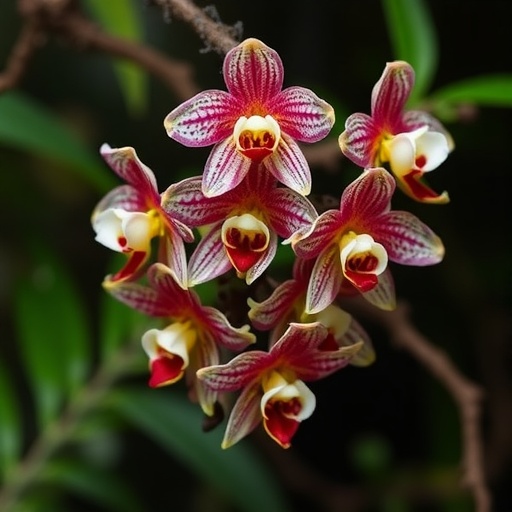
In the cloud forests of the southern Ecuadorian Andes, where steep ridges wrap themselves in near-perpetual mist and epiphytic orchids crowd every available branch, an invisible partnership determines which of these plants survive and where. A new study published in the journal Microbial Ecology has mapped, at unprecedented resolution, the fungal communities living inside the roots of tropical epiphytic orchids, and the results reveal that these essential symbioses are structured by environmental gradients acting simultaneously at several spatial scales. The findings carry a clear warning: orchid–fungus partnerships, so finely tuned to elevation and local conditions, may be among the most sensitive components of tropical montane ecosystems to the disruptions of a changing climate.
Orchids occupy a peculiar position in the plant world. Their seeds are among the smallest produced by any flowering plant, essentially dust-like grains that carry almost no nutritional reserves. In nature, an orchid seed cannot germinate at all unless it is first colonized by a compatible fungus, which supplies the developing embryo with carbon and other nutrients. Throughout the plant’s life, root-associated fungi continue to play critical roles in nutrient acquisition and stress tolerance. For epiphytic orchids, which perch high on branches with no direct connection to the soil, these fungal partners are not merely helpful; they are indispensable. Yet despite more than a century of scientific fascination with orchid mycorrhizas, the ecological rules governing which fungi colonize which orchids, and why those partnerships shift across landscapes, have remained remarkably opaque, especially in the species-rich tropics.
A research team from the Universidad Técnica Particular de Loja, led by Juan Pablo Suárez together with Stefania Cevallos and Paulo Herrera, set out to address this gap in one of the most orchid-divense regions on Earth. The southern Ecuadorian Andes host extraordinary concentrations of epiphytic orchids, compressed along elevational gradients so steep that a hiker can traverse dramatic shifts in temperature, humidity and vegetation within a single day’s walk. This natural laboratory allowed the researchers to ask a deceptively simple question with profound implications: what actually determines the composition of the fungal communities inside orchid roots? Is it the elevation at which the orchid grows, the specific site and its local microenvironment, or the identity of the orchid host itself?
To answer it, the team collected root samples from 699 individual orchid plants representing 11 species across elevational belts in the tropical montane forests of the region. This scale of sampling, covering hundreds of individual plants of many different host species along a continuous mountain gradient, is unusual in mycorrhizal ecology and gave the study its statistical power. From each root sample, the researchers extracted DNA and sequenced the internal transcribed spacer 2 region, a standard DNA barcode for fungi, using high-throughput amplicon sequencing. The approach allowed them to catalogue the entire community of fungi dwelling in each orchid’s roots, from genuine mycorrhizal partners to harmless or poorly understood endophytes.
The sequencing effort returned a striking total: 4,697 operational taxonomic units, or OTUs, essentially molecular proxies for fungal species, across the entire dataset. Within this diversity, the team identified 271 OTUs classified as putative orchid mycorrhizal fungi, the lineages known to form true nutritional symbioses with orchids. This rich catalogue provided the raw material for testing how fungal diversity and community composition change with elevation, among sites within the same elevational belt, and among host species.
One of the clearest patterns to emerge was a mid-elevation peak in fungal richness. The number of fungal OTUs associated with orchid roots was highest at intermediate elevations and declined toward higher elevations. Mid-elevation bulges in biodiversity have been documented for many groups of organisms in tropical mountains, but demonstrating the same pattern for root-associated fungi places these hidden symbionts within the same biogeographic framework as birds, plants and insects. The decline in fungal richness at the highest elevations suggests that increasingly harsh conditions, including lower temperatures, greater cloud immersion and reduced nutrient availability, act as an environmental filter, screening out fungal lineages that cannot tolerate them.
Beyond simple richness, the researchers examined how the identity of the fungal communities changed along the gradient. Community composition differed significantly among elevational belts, among sites within belts, and among host orchid species, confirming that all three factors matter. Importantly, the differences among elevations were driven primarily by species turnover rather than nestedness. In ecological terms, this means that as one moves up or down the mountain, fungal communities are not simply subsets of richer communities elsewhere; instead, entirely different suites of fungal taxa replace one another. Each elevational band harbors its own characteristic mycorrhizal partners, a pattern consistent with strong environmental sorting of fungal species along the gradient.
Yet within this turnover, the study uncovered a reassuring element of stability: the mycorrhizal assemblages maintained a persistent core across elevations. A set of widespread orchid-associated fungi appeared in roots sampled throughout the gradient, suggesting that some partnerships are robust to the environmental variation that reshuffles the rest of the community. This core persistence may be ecologically crucial. If a handful of reliable fungal generalists accompany orchids across the landscape, those fungi could serve as anchors for orchid establishment in new locations, while the more specialized, elevation-specific partners contribute to the fine-scale differentiation that makes each forest site unique. Site-level heterogeneity, the team found, contributed to this fine-scale differentiation, indicating that even within the same elevational belt, local differences in humidity, substrate, forest structure or disturbance leave measurable signatures in the root fungal communities of the orchids growing there.
The role of host identity adds another layer to the story. Even when growing side by side at the same elevation and site, different orchid species carried distinguishable fungal communities. This suggests that orchids are not passive recipients of whatever fungi happen to be drifting through the canopy; they exert some degree of selective control over their symbionts, a form of partner choice that has evolutionary as well as ecological significance. Taken together, the results indicate that fungal community assembly in epiphytic orchids is structured across multiple spatial scales simultaneously: broad elevational gradients set the regional template, local environmental conditions differentiate sites within that template, and host identity filters the fungi that ultimately take up residence in each root system.
The implications of these findings extend well beyond mycology. The authors note that the mid-elevation diversity peak and the stronger filtering observed at higher elevations indicate that orchid–fungus symbioses are highly sensitive to environmental gradients. This sensitivity has potential consequences for the stability of these partnerships under ongoing environmental change in tropical montane forests. Rising temperatures effectively shift elevational zones upsward, cloud bases lift, and rainfall patterns grow erratic. A mycorrhizal community finely tuned to a narrow elevational band may be unable to track its shifting habitat, particularly if the fungi involved have limited dispersal ability or narrow environmental tolerances. Because orchid germination depends absolutely on encountering compatible fungi, disruption of these symbioses could translate directly into recruitment failure for orchid populations, compounding the threats already posed by deforestation and illegal collection in one of the world’s biodiversity hotspots.
There is also a conservation planning dimension. If different elevational belts harbor different mycorrhizal communities through species turnover, then protecting a single elevational band cannot safeguard the full diversity of orchid–fungus partnerships across the landscape. Effective conservation of these epiphytic orchids, and the many other organisms that depend on intact montane forest canopies, will require protecting corridors that span complete elevational gradients, allowing both plants and their fungal partners to migrate as conditions change. The study’s demonstration of a persistent mycorrhizal core offers a note of hope, hinting that some partners may be flexible enough to accompany orchids through such transitions, but the turnover-driven architecture of these communities suggests that much of the symbiotic diversity is localized and, therefore, vulnerable.
The research, funded by Ecuador’s Secretaría de Educación Superior, Ciencia, Tecnología e Innovación, also highlights the value of studying symbioses in systems where environmental gradients are compressed into small geographic areas. Tropical montane forests, with their steep climatic gradients over short distances, function as natural experiments in community assembly, and the Ecuadorian Andes stand out as a global epicenter of epiphytic orchid diversity. By combining intensive field sampling across hundreds of individual plants with modern DNA sequencing, the Loja-based team has transformed a largely descriptive field into one capable of testing rigorous ecological hypotheses about how symbiotic communities are built.
As molecular tools become faster and cheaper, studies of this kind are likely to proliferate, revealing hidden dimensions of biodiversity that field surveys of visible organisms cannot capture. For now, this study stands as a detailed portrait of an invisible world beneath the bark and inside the roots: a world where thousands of fungal species sort themselves along mountainsides, where orchids choose and are chosen by their microbial partners, and where the delicate balance of these interactions may prove to be an early indicator of how tropical montane ecosystems respond to the pressures of the twenty-first century. What happens to the fungi in orchid roots, the work suggests, may ultimately shape what happens to the orchids themselves, and to the dazzling epiphytic communities that make tropical cloud forests among the most biologically rich places on the planet.
Subject of Research: Mycorrhizal fungal communities associated with tropical epiphytic orchids and their structuring across elevational gradients, sites and host species in the southern Ecuadorian Andes.
Subject of Research: Biology
Article Title: Multiscale Structuring of Mycorrhizal Fungal Communities of Tropical Epiphytic Orchids
Article References: Suárez, J. P., Cevallos, S., & Herrera, P. (2026). Multiscale Structuring of Mycorrhizal Fungal Communities of Tropical Epiphytic Orchids. Microbial Ecology. https://doi.org/10.1007/s00248-026-02830-2
Image Credits: AI Generated
DOI: 10.1007/s00248-026-02830-2
Keywords: orchid mycorrhiza, elevational gradients, environmental filtering, root-associated fungal endophytes, species turnover, tropical montane cloud forests, epiphytic orchids, ITS2 amplicon sequencing, fungal community assembly, Ecuadorian Andes
Cite Scienmag News
APA
MLA
Chicago
Roger Howard. (September 10, 2026). Hidden Fungal Partners Shape Tropical Epiphytic Orchids Across Multiple Scales. Scienmag. https://scienmag.com/hidden-fungal-partners-shape-tropical-epiphytic-orchids-across-multiple-scales/
Roger Howard. “Hidden Fungal Partners Shape Tropical Epiphytic Orchids Across Multiple Scales.” Scienmag, 10 September 2026, https://scienmag.com/hidden-fungal-partners-shape-tropical-epiphytic-orchids-across-multiple-scales/. Accessed 10 September 2026.
Roger Howard. “Hidden Fungal Partners Shape Tropical Epiphytic Orchids Across Multiple Scales.” Scienmag. September 10, 2026. https://scienmag.com/hidden-fungal-partners-shape-tropical-epiphytic-orchids-across-multiple-scales/
Copy citation
Download RIS
Tags: climate change impact on orchid-fungal partnershipsclimate change impacts on orchidscloud forest ecosystemselevation and environmental gradientselevation-specific fungal associationsenvironmental gradients and orchid distributionfungal communities in orchid rootsfungal diversity in cloud forest epiphytesfungal diversity in orchidsfungal symbiosismicrobe-plant interactionsmicrobial ecologymicrobial ecology of tropical forestsmontane biodiversityorchid conservation and ecosystem sensitivityorchid seed germinationorchid seed germination and fungiorchid-fungal relationshipsorchid-fungus relationshipsplant-microbe interactionsroot-associated fungiTropical epiphytic orchids