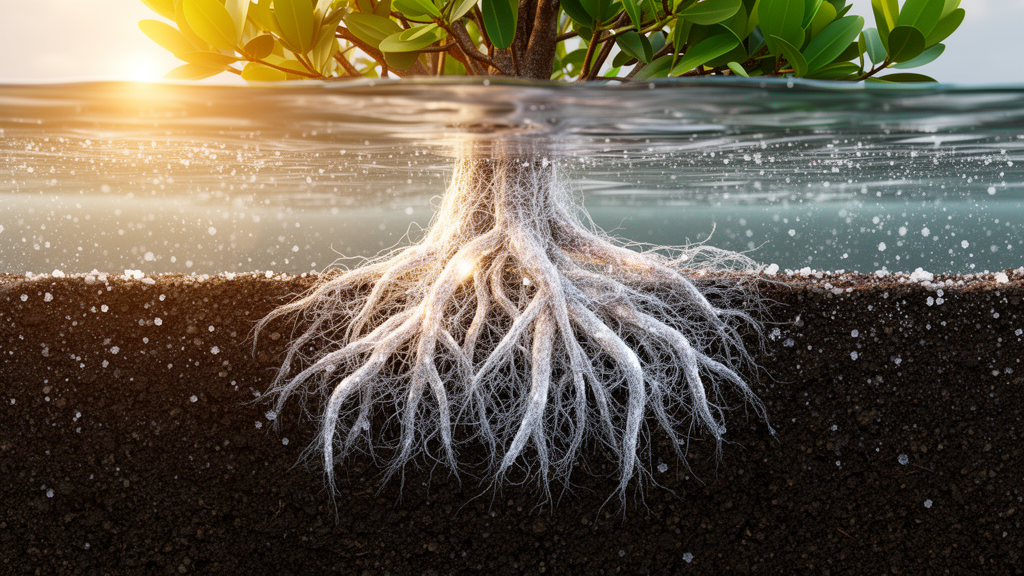
Deep in the muddy sediments of coastal India, an invisible partnership may hold the key to saving one of the planet’s most valuable ecosystems. A new study published in Discover Plants has shown that arbuscular mycorrhizal fungi, ancient soil dwellers that form symbiotic relationships with plant roots, can dramatically improve the ability of grey mangrove seedlings to withstand the escalating salinity that threatens mangrove forests worldwide. The research, led by Supriti Paul of the Forest Research Institute Deemed to Be University in Dehradun together with colleagues at St. Xavier’s College in Kolkata, offers a biologically grounded strategy for restoring coastlines that are becoming steadily saltier as seas rise and climate change intensifies.
The stakes could hardly be higher. Mangroves buffer tropical and subtropical shores against storm surges, cyclones and erosion, sequester carbon at remarkable rates, and sustain coastal livelihoods across the tropics. Yet according to recent global assessments cited in the study, roughly half of the world’s mangrove ecosystems now face potential collapse. Without effective intervention, projections suggest that by 2050 around 7,065 square kilometres of mangroves could be lost outright, while another 23,672 square kilometres may become submerged as sea levels climb. Rising salinity is a central driver of this decline, impairing growth, photosynthesis and survival even in plants that evolved to live at the land-sea boundary.
The grey mangrove, Avicennia marina, is the most widely distributed mangrove species on Earth, stretching from the Arabian Gulf to the coasts of the Red Sea and across the Indo-Pacific. But even this hardy pioneer has its limits. Previous work has shown that elevated soil salinity reduces water potential, disrupts ionic balance and induces phosphorus deficiency, all of which stunt growth and diminish photosynthetic performance. The new study set out to test whether the right fungal partners could tip the balance back in the mangrove’s favour.
Arbuscular mycorrhizal fungi, or AMF, are among the most successful symbionts in nature, associating with more than 80 percent of terrestrial plant species. Their microscopic hyphae thread through the soil, extending the effective reach of plant roots and improving the uptake of water and nutrients, particularly phosphorus. Under saline conditions, these fungi are known to help plants maintain ionic homeostasis, activate antioxidant defences and preserve photosynthetic efficiency. What remained poorly understood was how they perform in mangrove ecosystems, where salinity is not an occasional stress but a permanent feature of the environment.
To find out, the team grew even-aged Avicennia marina seedlings in a greenhouse in Kolkata under three salinity regimes: low at 9 deciSiemens per metre, moderate at 14 dS/m and high at 19 dS/m, levels that span the range these trees encounter in degrading coastal habitats. Seedlings were inoculated with either a consortium of Glomus species, including Glomus mosseae, G. multicaule and G. macrocarpum, a consortium of Gigaspora species, including Gigaspora margarita and G. gigantea, or a combined inoculum of both genera. Uninoculated salt-stressed seedlings and unstressed controls served as comparisons. After 180 days, the researchers measured everything from shoot and root length to photosynthetic pigments, antioxidant enzymes, osmolytes, oxidative damage markers and mycorrhizal soil proteins.
The results were striking. Seedlings receiving the combined Glomus and Gigaspora consortium grew tallest under every salinity level, reaching an average shoot length of 61.60 centimetres under high salinity, nearly three times the 21.20 centimetres recorded in the salt-stressed control. Root growth followed the same pattern, with consortium-treated seedlings producing roots almost 39 centimetres long under the harshest conditions, compared with barely 5 centimetres in unstressed controls. Intriguingly, the consortium also reduced the salt concentration of the surrounding soil, from 18.87 dS/m in uninoculated high-salinity pots down to 13.75 dS/m, suggesting the fungi actively modulate salt dynamics in the rhizosphere rather than merely helping plants tolerate it.
The biochemical story was equally compelling. Consortium-inoculated seedlings accumulated the most chlorophyll a and total chlorophyll under low and moderate salinity, indicating better-preserved photosynthetic machinery. Their roots showed the highest activities of catalase, acid phosphatase, alkaline phosphatase and dehydrogenase, enzymes that collectively dismantle reactive oxygen species and unlock soil phosphorus. Meanwhile, two classic markers of oxidative damage, malondialdehyde and hydrogen peroxide, plummeted in consortium-treated plants, falling to 1.09 and 1.44 nanomoles per gram respectively under high salinity, compared with values approaching 8.68 and 6.43 in stressed and unstressed controls. Lower MDA means less lipid peroxidation and better-protected cell membranes, a direct sign that the fungal partnership was shielding the seedlings at the cellular level.
The fungi also appeared to restructure the soil itself. Easily extractable glomalin-related soil protein, a glycoprotein produced by AMF hyphae that glues soil particles into stable aggregates, peaked at 11.60 micrograms per gram in consortium-treated pots under high salinity, far above the near-zero levels in controls. Glomalin improves soil structure, carbon sequestration and resilience in saline environments, and its accumulation may partly explain the reduced rhizosphere salinity observed in the study. Proline, an osmoprotective amino acid that helps cells retain water under salt stress, also climbed to its highest levels in consortium-inoculated seedlings, reinforcing the picture of a coordinated osmotic and defensive response orchestrated by the symbiosis.
Multivariate statistics sharpened the interpretation. Principal component analysis showed that the first two components captured more than 84 percent of the variation at each salinity level, and in every case the consortium treatment clustered with antioxidant enzymes, glomalin, proline and growth traits, while salt-only seedlings grouped with the oxidative damage markers. Hierarchical clustering and Pearson correlation analysis reinforced the same conclusion: growth, photosynthesis, osmotic adjustment and antioxidant defence rise and fall together, and the dual fungal inoculum sits at the centre of that coordinated network. Notably, Gigaspora alone excelled at promoting biomass, while Glomus alone drove anthocyanin accumulation under severe stress, hinting that the two genera supply complementary functions that only together deliver full protection.
The authors are careful to note that the molecular mechanisms behind these effects, the long-term persistence of the fungal benefits and the interactions with native microbial communities remain to be explored, and that field trials will be needed to validate the approach under natural coastal conditions. Even so, the study marks a significant step forward. As salinization accelerates across the Sundarbans and other vulnerable deltas, projections warn that a 50 percent rise in salinity by 2050 could cut mangrove ecosystem productivity by nearly 30 percent. A cheap, sustainable inoculum of native mycorrhizal fungi, applied to nursery-raised seedlings before outplanting, could give restoration projects a crucial head start. In the contest between rising seas and the forests that defend our coasts, the smallest players, threads of fungus thinner than a human hair, may prove to be the most decisive allies of all.
Subject of Research: Mycorrhizal fungi-mediated salinity stress tolerance in the grey mangrove Avicennia marina
Article Title: Arbuscular Mycorrhizal fungi alleviate salinity stress in Avicennia marina through morphophysiological and biochemical modulation
Article References: Paul, S., Parkash, V., Kaundal, R., Thapa, M., Dhara, B., & Mitra, A. K. (2026). Arbuscular Mycorrhizal fungi alleviate salinity stress in Avicennia marina through morphophysiological and biochemical modulation. Discover Plants, 3(1), Article 447. https://doi.org/10.1007/s44372-026-00916-2
Image Credits: AI Generated
DOI: 10.1007/s44372-026-00916-2
Keywords: mangroves, Avicennia marina, arbuscular mycorrhizal fungi, salinity stress, Glomus, Gigaspora, glomalin, proline, antioxidant enzymes, coastal restoration, oxidative stress, plant physiology
News Source: Alan Morgan. (October 8, 2026). Hidden Fungal Allies Could Save the World’s Mangroves From Rising Salt. Scienmag.