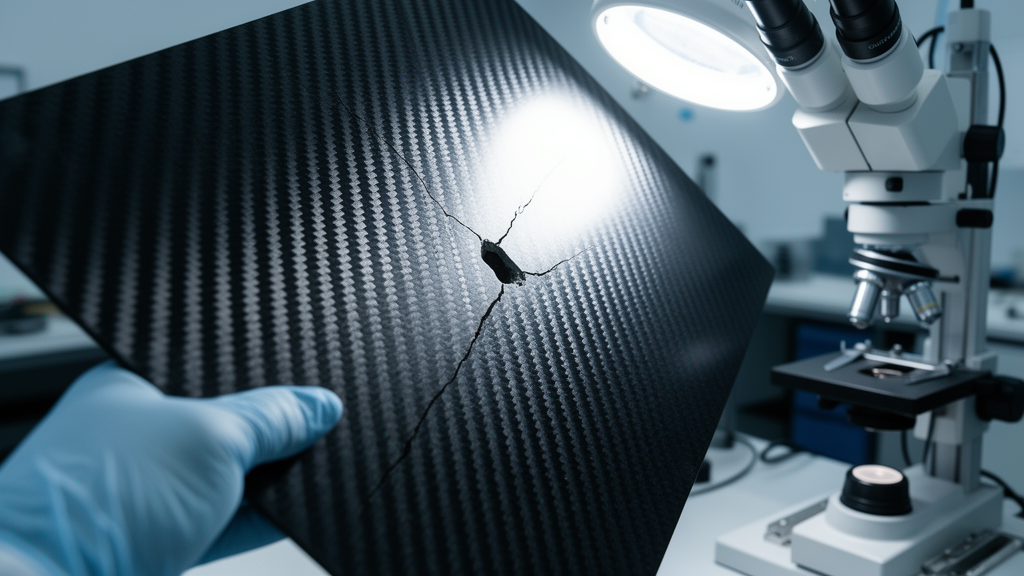
Carbon-fibre-reinforced polymer composites are the quiet workhorses of modern engineering. They carry the wings of airliners, the pressure vessels of hydrogen tanks, the monocoques of racing cars and the blades of wind turbines, all while weighing a fraction of what steel or aluminium would. Yet a new review published in the Journal of Materials Science argues that the industry’s confidence in these materials rests on an incomplete picture. The real threat to their reliability is not the material itself but the microscopic and mesoscopic defects that every manufacturing process leaves behind, and the way those defects interact, multiply and evolve into damage during a component’s service life.
The review, led by Ziyang Liu and Minghe Li of Jilin Agricultural Science and Technology College together with colleagues, systematically examines how process-induced defects form, how they can be quantitatively characterized, and how they trigger damage initiation and propagation that degrades performance in nonlinear and often surprising ways. Its central conceptual move is to reinterpret defects not as isolated flaws with nominal dimensions and acceptance thresholds, but as local structural perturbation fields collectively shaped by the manufacturing process. What matters most, the authors conclude, is not simply how much void content a laminate contains or how large a wrinkle is, but how the defect changes the local fibre architecture, the interlaminar constraint between plies, and the pathways through which stress is transferred through the structure.
Voids are the most pervasive of these perturbation fields. They form during resin impregnation, cure and consolidation when air, volatiles or moisture become trapped in the polymer matrix. X-ray computed tomography has transformed the field by allowing researchers to map voids in three dimensions without destroying the specimen, revealing their spatial morphology, size distributions and clustering behaviour. Studies cited in the review show that voids can independently trigger matrix cracking, interfacial debonding and interlaminar delamination, and that their effects depend critically on where they sit relative to ply interfaces and stress concentrations. Under cyclic loading, voids shift the sites where cracks first appear and redirect the dominant propagation paths, producing fatigue life reductions that conventional mean-property knockdown factors fail to capture.
Fibre waviness presents a different kind of challenge. When fibres deviate from their intended alignment, whether through layup errors, tooling interactions or cure-induced deformation, the compressive strength of the composite can fall dramatically because misaligned fibres are prone to kinking, a cooperative buckling instability in which fibres rotate and fracture within a narrow band. The review highlights experimental and computational work showing that embedded wrinkles act as preferential sites for kink-band formation under longitudinal compression, and that waviness also degrades fatigue life by concentrating damage at the wavy region. Crucially, the authors note that waviness and voids do not act independently; recent failure analyses of unidirectional CFRP under longitudinal compression reveal coupled effects in which initial fibre waviness and voids interact synergistically to accelerate failure.
Automated fibre placement, the robotic process that has become the backbone of modern aerospace composite manufacturing, introduces its own defect signature. Tow-to-tow gaps, overlaps, steering-induced wrinkles and tow-drop effects arise from the interplay of machine kinematics, process conditions and material behaviour. The review draws on experimental studies demonstrating that these AFP defects can measurably reduce shear and compression properties, alter microstructure, and change progressive damage development under both static and fatigue loading. Because AFP defects are distributed across large areas rather than concentrated at single points, their cumulative effect on complex structures is difficult to assess with the single-defect acceptance thresholds that certification practice has traditionally relied upon.
Perhaps the most consequential finding of the review is that the effects of multiple defects are generally non-additive. Two defects that individually cause modest property reductions can together produce a disproportionate loss of strength, or conversely can partially compensate for one another depending on their spatial arrangement and the loading condition. This non-additivity means that conventional quality control, which screens parts against nominal defect content limits and applies mean-property knockdown factors, is structurally inadequate for the reliability assessment of complex composite structures. The authors argue that what is needed instead is a probabilistic multidefect and multiscale framework that accounts for the stochastic spatial distribution of defects and their interactions, validated by in situ observations of damage evolution under realistic loading.
Computational micromechanics and stochastic multiscale analysis are emerging as the tools that could make such a framework possible. Explicit defect modelling allows researchers to insert realistic three-dimensional defect geometries, obtained from tomography, into finite element models and track how damage initiates and propagates through the perturbed microstructure. Bottom-up stochastic multiscale models, highlighted in the review, propagate microvoid randomness through to laminate-level mechanical behaviour, enabling fast uncertainty quantification for large composite structures. Data-driven prediction, including deep-learning segmentation of tomography images and machine-learning identification of damage mechanisms from acoustic emission signals, is accelerating the extraction of quantitative insight from experimental data that was previously too complex to analyse systematically.
The review also points toward a future in which defect control shifts from post-manufacturing screening to proactive intervention during defect formation. Process monitoring of automated fibre placement, digital twins that simulate cure and consolidation in real time, and online repair frameworks that detect and correct defects as they arise are all identified as components of a closed-loop manufacturing paradigm. Standardized three-dimensional defect characterization and data-reporting frameworks, aligned with FAIR data principles, would allow results from different laboratories and processes to be compared on a common basis, something the field currently lacks and which the authors identify as a prerequisite for building the large, harmonized datasets needed to train reliable predictive models.
The implications reach far beyond the laboratory. As composites spread from aerospace into automotive structures, hydrogen storage, wind energy and consumer products, the cost of undetected defect interactions grows accordingly. A certification regime built on single-defect thresholds may pass a component that contains a synergistic combination of voids, waviness and AFP gaps capable of triggering nonlinear performance degradation in service. Conversely, a more sophisticated probabilistic framework could unlock lighter, more efficient designs by allowing engineers to quantify reliability with greater precision rather than applying conservative blanket knockdowns. The review’s message is ultimately one of opportunity: by understanding defects as perturbation fields whose effects depend on local architecture and stress transfer, and by integrating process monitoring, multiscale modelling and data-driven prediction into a closed loop, the composites community can move from reacting to defects after they form to controlling them as they form, transforming both the safety and the performance ceiling of the materials that carry us into the sky and across the road.
Subject of Research: Materials Science
Article Title: Review: process-induced defects and damage evolution in carbon-fibre-reinforced polymer composites
Article References: Liu, Z., Li, M., Cui, B., Wei, G., Chen, Q., Guo, X., He, K., & Chen, R. (2026). Review: process-induced defects and damage evolution in carbon-fibre-reinforced polymer composites. Journal of Materials Science, 61(41), 31600-31639. https://doi.org/10.1007/s10853-026-13657-0
Image Credits: AI Generated
DOI: 10.1007/s10853-026-13657-0
Keywords: carbon-fibre composites, CFRP, manufacturing defects, voids, fibre waviness, automated fibre placement, damage evolution, computational micromechanics, multiscale modelling, digital twins, X-ray computed tomography, reliability
News Source: Denise Maddox. (October 19, 2026). Hidden Flaws in Carbon-Fibre Composites: How Tiny Defects Decide Whether Aircraft and Cars Survive. Scienmag.