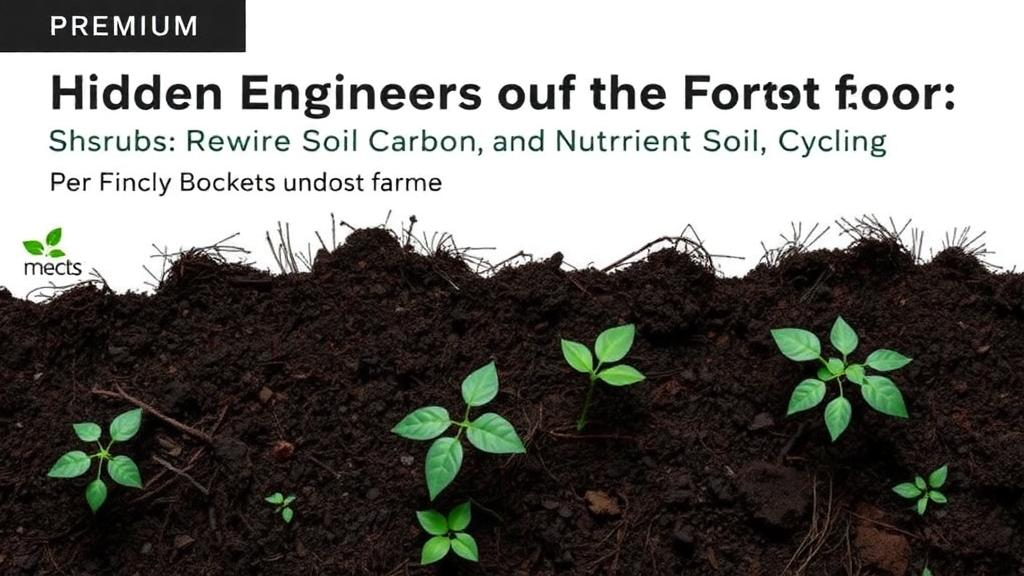
Beneath the quiet canopy of Scots pine forests in southern Poland, an unassuming cast of understory shrubs is quietly rewriting the rules of soil chemistry. A new study published in the journal Plant and Soil reveals that three common shrub species—European hazel, alder buckthorn, and rowan—do far more than fill the space between trees. They act as active biochemical engineers, dramatically altering how carbon and nitrogen are stored, released, and cycled through one of Earth’s most important carbon reservoirs: forest soil.
The research, conducted by a team from the University of Agriculture in Krakow and partner institutions, examined forty plots of eighty-year-old pine stands in the Olkusz Forest District, some with dense shrub biogroups and some without. The sites sat on sandy Podzols developed from fluvioglacial sands, with nearly identical texture across plots—roughly 88 percent sand—which allowed the researchers to isolate the effect of shrub identity from confounding soil factors. Mean annual temperature at the sites is 7.1 degrees Celsius, with 737 millimeters of yearly precipitation, a typical temperate setting for these widespread European understory species.
What the team found challenges a long-standing assumption in forest ecology. Shrubs have often been treated as structural bystanders—green filler beneath the canopy. Instead, the study shows they are powerful regulators of soil organic matter, the heterogeneous mixture of plant and microbial residues that determines soil fertility, water retention, and the planet’s capacity to lock away atmospheric carbon. Soils beneath all three shrub species contained significantly more total carbon and nitrogen than pure pine stands, along with higher concentrations of dissolved organic carbon and nitrogen, the mobile compounds that feed soil microbes and transport nutrients downward through the profile.
The key to understanding these effects lies in how soil organic matter is fractionated. The researchers used a density-based physical separation technique, employing a heavy sodium metatungstate solution to divide organic matter into a free light fraction, an occluded light fraction released by sonication, and a mineral-associated fraction. Each fraction tells a different story about time. The light fractions consist of recently shed leaf litter and fine roots that decompose within months to years, fueling rapid microbial activity. The mineral-associated fraction, by contrast, represents organic matter bound to clay and mineral surfaces—a far more stable pool that can persist for decades or centuries and underpins long-term carbon sequestration.
The results showed a striking species-specific signature. European hazel emerged as the strongest soil modifier, significantly boosting carbon and nitrogen in both light fractions, elevating the activity of carbon-degrading enzymes such as beta-glucosidase, beta-D-cellobiosidase, and beta-xylosidase, and increasing the mobility of dissolved nutrients. Alder buckthorn produced the highest dissolved organic carbon concentrations and the greatest sums of dissolved cations and anions, indicating intensified leaching and nutrient turnover—though it also produced the most acidic soils. Rowan took a different path entirely: its soils showed the highest carbon and nitrogen accumulation in the mineral-associated fraction, and the greatest dehydrogenase activity, a marker of overall microbial metabolism, suggesting a role in longer-term carbon stabilization rather than short-term nutrient flushing.
Statistical modeling reinforced the mechanistic story. Multiple linear regression showed that carbon in the free light fraction was strongly predicted by total soil carbon and nitrogen, with the model explaining nearly 89 percent of the variance. Yet the mineral-associated fraction responded only moderately, and the occluded fraction barely at all—confirming the researchers’ hypothesis that shrubs primarily influence the labile, fast-cycling pools while the stabilized pools remain governed by slower processes of microbial processing and mineral binding. A principal component analysis, capturing 65 percent of total variance, cleanly separated hazel- and buckthorn-influenced soils, with their high organic matter content and enzyme activity, from pure pine soils clustered at the low end of the biochemical spectrum, with rowan soils occupying an intermediate position.
The enzymatic measurements provide some of the most vivid evidence of shrub influence. Six extracellular enzymes were assayed, including those that dismantle cellulose and hemicellulose and one, N-acetyl-beta-glucosaminidase, that microbes deploy when mining nitrogen from organic residues. Hazel soils showed the highest activities of the nitrogen-acquiring enzyme and the highest beta-xylosidase and beta-D-cellobiosidase activities, reflecting abundant, nutrient-rich substrates. Rowan soils led in dehydrogenase activity. Pine monoculture soils consistently registered the lowest values across nearly every assay, a sign of limited substrate availability and sluggish organic matter turnover beneath the needle litter.
Why would shrub species differ so sharply? The answer likely lies in litter chemistry and root behavior. Hazel produces nutrient-rich, readily decomposable litter with a lower carbon-to-nitrogen ratio than pine needles, promoting rapid incorporation of organic residues into labile pools and potentially shifting microbial communities from slower, fungal-dominated decomposition toward faster bacterial processing. Root exudates—sugars and organic acids released by living roots—further stimulate distinct microbial processes in the rhizosphere. Buckthorn’s pronounced leaching effect suggests its litter releases highly soluble compounds, while rowan’s comparatively modest litter inputs may explain its weaker but more selective influence on stabilized carbon pools.
The broader implications reach into climate science and forest management. Soil holds more carbon than the atmosphere and vegetation combined, and the balance between fast-cycling labile fractions and slow mineral-stabilized pools determines whether that carbon stays put. The study suggests that ongoing shrub expansion in pine-dominated forests—driven by canopy disturbances, changing light regimes, and management decisions—could accelerate nutrient cycling and increase vertical transport of dissolved carbon, with consequences for nutrient retention and ecosystem carbon budgets that depend on which shrub species moves in. Because mineral-associated pools showed such inertia, short-term vegetation shifts will be recorded first in the labile fractions, making these fractions sensitive early-warning indicators of change.
The authors note that this is the first study to directly couple physical organic matter fractionation, dissolved organic matter dynamics, and enzymatic activity across different understory shrub species in temperate pine forests. They caution that microbial communities were not directly assessed, and they call for future work integrating microbial community analysis, shrub functional traits, and long-term observation. But the central message is already clear: the shrub layer is not scenery. It is a working part of the forest’s biochemical machinery, and the identity of the species that occupy it may help decide how much carbon temperate forests store, and for how long.
Subject of Research: Effects of understory shrub species on soil organic matter fractionation and biochemical processes in temperate pine forests
Article Title: Effect of shrub vegetation on soil organic matter fractionation and soil biochemical processes
Article References: Lasota, J., Kaczorek, D., Delgado-Moreira, M. I., & Błońska, E. (2026). Effect of shrub vegetation on soil organic matter fractionation and soil biochemical processes. Plant and Soil. https://doi.org/10.1007/s11104-026-09061-x
Image Credits: AI Generated
DOI: 10.1007/s11104-026-09061-x
Keywords: soil organic matter, shrubs, carbon sequestration, dissolved organic carbon, enzyme activity, nitrogen cycling, Scots pine, Podzols, forest ecology, mineral-associated organic matter, litter decomposition, biogeochemistry
News Source: Chloe Pearson. (October 11, 2026). Hidden Engineers of the Forest Floor: Shrubs Rewire Soil Carbon and Nutrient Cycling. Scienmag.