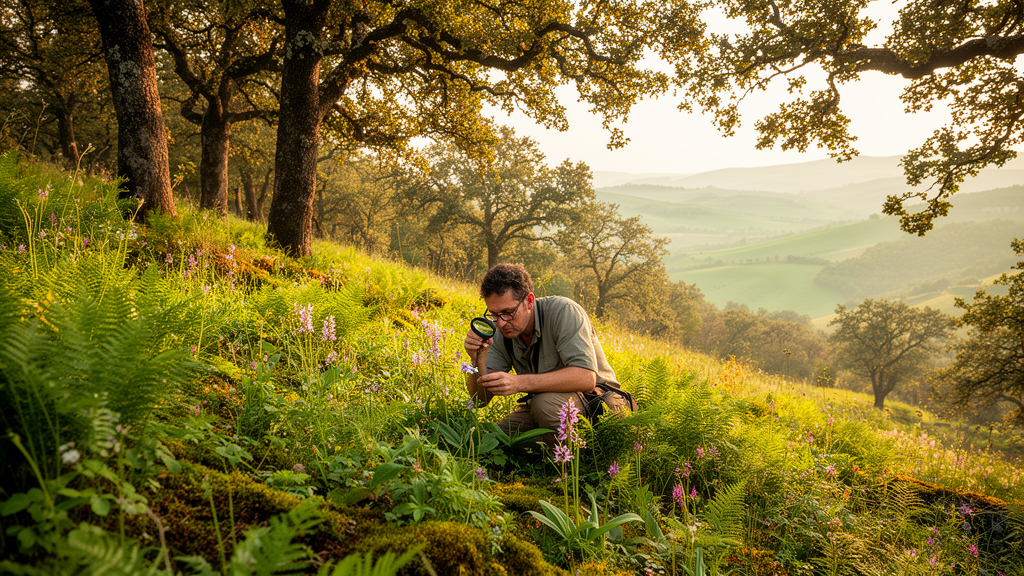
Tucked between the Arno river and the wetlands of the Fucecchio swamp in northern Tuscany lies a modest chain of low hills that, according to a new comprehensive survey, punches far above its weight in plant diversity. The Cerbaie hills, whose highest point barely reaches 117 meters above sea level, are home to 1,107 species and subspecies of vascular plants, a team of botanists from the University of Pisa reports in the journal Italian Botanist. The inventory, built from a decade of fieldwork between 2010 and 2022 combined with a painstaking review of more than 160 years of published records, establishes the area as one of the most floristically rich and biogeographically intriguing corners of the region, and a site of growing conservation concern.
The Cerbaie cover roughly 114 square kilometers across the territories of seven municipalities in the provinces of Florence, Pisa and Lucca. Geologically, they consist of Pliocene and Pleistocene sedimentary rocks and sediments that give rise to acidic, siliceous soils, an unusual substrate in a part of Tuscany where calcareous materials often dominate. The climate is temperate and distinctly continental, with mean annual precipitation between 950 and 1,100 millimeters concentrated in autumn and spring, and a degree of summer aridity that peaks in July. This combination of acidic soils, abundant streams and small valleys, known locally as vallini, and a temperate climate has created a mosaic of habitats in which mesophilous, hygrophilous and thermophilous species can grow within meters of one another, a juxtaposition that is rare in the lowland Mediterranean landscape.
Compiling the inventory required the researchers to reconcile a long and fragmented history of botanical exploration. The first records for the hills date back to the mid-nineteenth century with the pioneering work of Piero Caruel, followed by the substantial contributions of Sandri and Fantozzi in 1895 and the first dedicated floristic study by Giuseppina Di Moisè in 1959. The team extracted every occurrence record from these historical sources, cross-checked them against modern nomenclature using the Portal to the Flora of Italy, and supplemented the literature data with observations from the crowdsourced portal Wikiplantbase #Toscana and their own extensive field expeditions. To gauge whether the hills were truly exceptional, they applied a predictive framework based on species-area relationships adjusted by environmental modeling, which estimated an expected richness of 1,021 species and subspecies for an area of this size and character.
The observed count of 1,107 taxa exceeded that prediction by eight percent, a margin the authors interpret as evidence of genuinely high floristic richness compared with other Tuscan territories. Three families dominate the spectrum: the daisies of Asteraceae with 126 taxa, the legumes of Fabaceae with 112, and the grasses of Poaceae with 96, together accounting for roughly thirty percent of the flora. Sedges, too, are remarkably well represented with 53 taxa, reflecting the importance of wet habitats. Among genera, Trifolium leads with 35 species, followed by Carex with 20 and Lathyrus with 17. The life-form spectrum is dominated by hemicryptophytes at 35.2 percent and therophytes at 32.2 percent, with geophytes contributing another 15.1 percent, a profile typical of temperate rather than strictly Mediterranean floras.
Perhaps the most striking biogeographical signal comes from the chorological analysis. Despite the hills’ low elevation, fully 32.5 percent of the flora shows Eurosiberian affinities, with a further 25.5 percent transitional between Eurosiberian and Mediterranean regions, while purely Mediterranean elements make up only 15.4 percent. This marked northern signature mirrors the temperate, continental climate of the area and echoes the vegetation of the preapenninic acidophilous durmast oak woods that clothe much of the territory. Several species reinforce this pattern dramatically: the round-leaved sundew, Drosera rotundifolia, a carnivorous plant of acidic bogs, persists here at the southern edge of its European range, while species such as white birch, white hellebore and Asphodelus macrocarpus, which normally grow at considerably higher elevations, find refuge on these low acidic slopes.
The survey also delivered discoveries of direct taxonomic significance. Two taxa, the sedge Carex oedipostyla and Thalictrum simplex subsp. galioides, a meadow-rue, are recorded for the first time in Tuscany, and in both cases the Cerbaie currently represent their only known regional locality. A further 330 taxa are new records for the study area itself. At the other end of the ledger, the team confirmed 344 previously reported taxa during field surveys, judged 47 unconfirmed but reliable, classified 19 as doubtfully present, and identified three as wrongly reported in the literature. Three species, Lysimachia tenella, Menyanthes trifoliata and Potentilla alba, were not rediscovered and may now be locally extinct, a quiet warning about the vulnerability of the wetland habitats they once occupied.
Endemism adds another layer of value. Thirteen Italian endemic taxa occur in the hills, including the Etruscan star-of-Bethlehem Ornithogalum etruscum in both its subspecies, several narrowly distributed orchids of the genus Ophrys, and the endemic subspecies Polygala vulgaris subsp. valdarnensis, originally described from this very area. A dandelion microspecies, Taraxacum cerbariense, is putatively a narrow endemic confined to the Cerbaie themselves. In total, 44 taxa of conservation interest are present, among them six species listed as Endangered at the national level, including Baldellia ranunculoides, the water-violet Hottonia palustris and Exaculum pusillum, a tiny gentian that in Tuscany now survives only here, alongside the marsh gentian Gentiana pneumonanthe.
The shadow hanging over this richness is the alien flora. One hundred naturalized non-native taxa grow in the hills, about nine percent of the established flora, and this figure exceeds the model-based expectation by a remarkable 53 percent. Among them is the tree of heaven, Ailanthus altissima, one of the handful of invasive species listed under European Union Regulation 2019/1262, while the North American black locust, Robinia pseudoacacia, is spreading through the woods alongside maritime pine. The authors note that surrounding territories can fare even worse, with the municipality of Empoli showing alien richness more than 200 percent above expectation, but the trend at Cerbaie is unambiguous and tracks the intensification of land use across the Tuscan lowlands.
For the researchers, the message of the inventory is twofold. Scientifically, the Cerbaie hills demonstrate that exceptional biodiversity does not require mountains; a combination of acidic substrates, humid microclimates and biogeographical position at the meeting point of Mediterranean and Eurosiberian zones can generate a flora comparable to that of far more celebrated landscapes. Practically, the hills are already designated a Special Area for Conservation under the European Union’s Habitats Directive, and the new data, with their explicit lists of confirmed, doubtful, extinct and threatened taxa, provide the evidence base needed to target management. As the authors conclude, thanks to its rich and diversified flora, the Cerbaie hills stand out as one of the sites of highest phytogeographical and conservation interest in Tuscany, a status that now rests on verified, up-to-date data rather than on a scattered century and a half of records.
Subject of Research: Updated floristic inventory of the vascular flora of the Cerbaie hills in Tuscany, Italy
Article Title: An updated inventory of the vascular flora of the Cerbaie hills (Tuscany, Italy)
Article References: Gestri, G., Pierini, B., D’Antraccoli, M., Bernardini, A., & Peruzzi, L. (2023). An updated inventory of the vascular flora of the Cerbaie hills (Tuscany, Italy). Italian Botanist, 15, 165-175. https://doi.org/10.3897/italianbotanist.15.105302
Image Credits: AI Generated
DOI: 10.3897/italianbotanist.15.105302
Keywords: floristics, biodiversity, Tuscany, Cerbaie hills, vascular plants, alien species, conservation, biogeography, species-area relationship, endemic plants, updated, inventory
News Source: Margaret Porter. (October 19, 2026). Hidden botanical hotspot: Italy’s low Cerbaie hills shelter 1,107 plant species. Scienmag.